
Study For Autumn Landscape With Boats — History & Facts
Where does light end, and longing begin? In the vibrant hues of Study For Autumn Landscape With Boats, a restless energy pulses, hinting at the chaotic dance between nature and the human soul. Focus on the swirling strokes of ochre and crimson that capture the essence of autumn — the season of decay yet rich with life. Notice how the brushwork blends seamlessly, creating a rhythm that pulls the eye toward the horizon, where boats float serenely yet seem burdened by an invisible weight. The contrasting blues and yellows evoke a sense of melancholy beneath the vibrancy, suggesting that even beauty can be tinged with madness. Delve deeper into the thick texture of paint that reveals Kandinsky’s emotional landscape, where abstraction becomes a means of expressing the intrinsic connection between nature and human experience.
The juxtaposition of light and dark, movement and stillness, embodies the tension between the artist's inner turmoil and the serene facade of the landscape. Each element is not merely a representation but an invocation of feelings, presenting a world that is both inviting and unsettling. In 1908, Kandinsky was immersed in the burgeoning expressionist movement in Munich, grappling with his own artistic identity amid the societal upheaval of pre-World War I Europe. His explorations of color and form were rooted in a desire to transcend the material world, seeking to capture the essence of emotion and spirituality.
This work reflects his quest to articulate the sublime chaos of his inner world, at a time when the boundaries of art were being redefined.
More Artworks by Wassily Kandinsky
Browse all →
Jocular Sounds
Wassily Kandinsky
Green Lane in Murnau
Wassily Kandinsky

Murnau
Wassily Kandinsky

Murnau – View from the window of the Griesbräu
Wassily Kandinsky

Landscape with a yellow field
Wassily Kandinsky
Zubovsky Platz
Wassily Kandinsky

Murnau – Castle and Church
Wassily Kandinsky
Park Von St. Cloud – Herbst I
Wassily Kandinsky

Cemetery and rectory in Kochel
Wassily Kandinsky
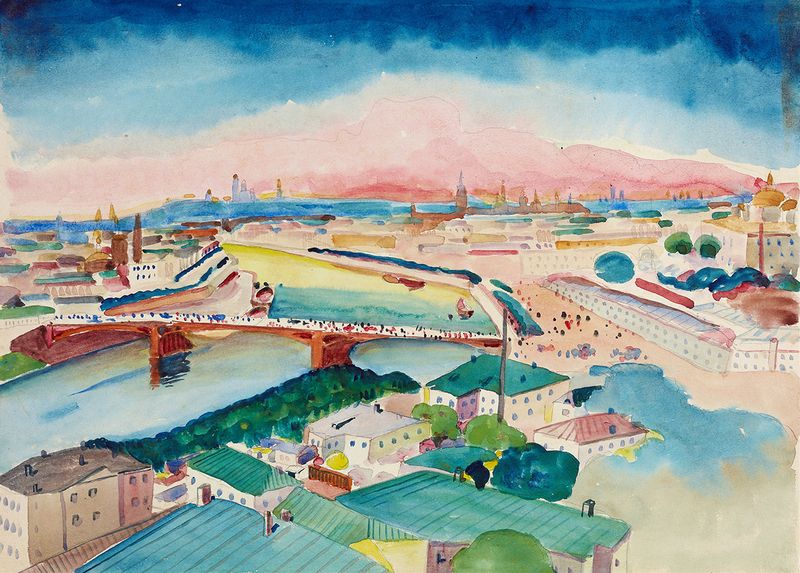
Blick auf Moskau
Wassily Kandinsky





