
The Laughing Toper — History & Facts
No fewer than six versions of The Laughing Toper are known to exist, a testament to the popularity and demand for this subject in the bustling taverns and collectors’ salons of the Dutch Golden Age. While the painting is widely attributed to Frans Hals, its exact date and authorship have sparked debate, as the work’s lively brushwork and infectious humor made it a favorite for copyists and followers. Some scholars point out that the composition’s enduring appeal lies in its ambiguity: is the toper a figure of carefree joy, or a warning about excess? The painting’s proliferation across Europe in the 17th and 18th centuries ensured its place in the popular imagination. At the heart of The Laughing Toper is a moment of unguarded hilarity.
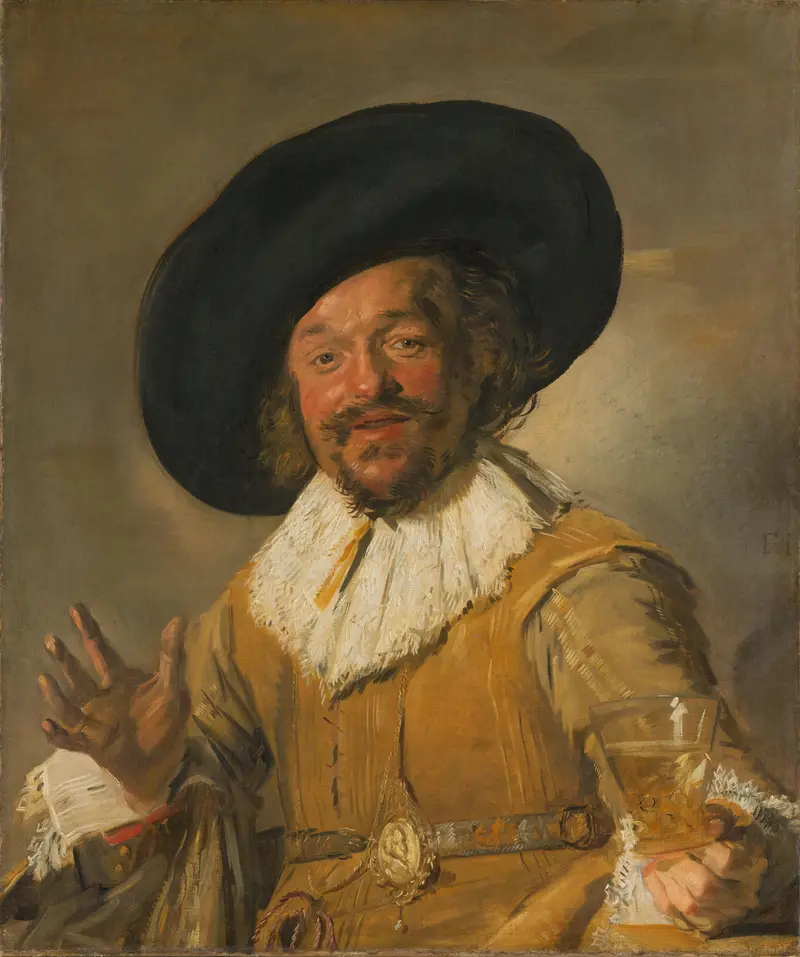
The central figure, flushed and grinning, raises a pewter mug mid-toast, his eyes sparkling with mischief. The loose, energetic brushstrokes capture the fleeting nature of laughter, while the sitter’s open mouth and ruddy cheeks suggest the effects of drink. A simple chain around his neck hints at modest prosperity, and the rough wooden table, scattered with crumbs, roots the scene in everyday life.
Unlike the moralizing tone of Jan Steen’s tavern scenes, Hals’s toper seems to revel in the pleasures of the moment, inviting the viewer to join in rather than judge. The journey of this particular version is less well documented than others, but paintings of this type were typically commissioned or purchased by prosperous burghers eager to display both their taste for fine art and their appreciation for life’s pleasures. Over time, the attribution to Frans Hals has been questioned, as the demand for such images led to many copies by his workshop and imitators. Today, The Laughing Toper is celebrated as an emblem of the Dutch genre tradition, capturing both the technical brilliance and the earthy humor that made Hals a key figure in the Baroque movement.
Its enduring appeal lies in the immediacy and warmth of its subject, which continues to delight viewers centuries later.
More Artworks by Frans Hals

Banquet of the Officers of the St George Civic Guard
Frans Hals

Portrait of Jacob Pietersz Olycan (1596-1638)
Frans Hals

Laughing Cavalier
Frans Hals

Militia Company of District XI under the Command of Captain Reynier Reael, Known as ‘The Meagre Company’
Frans Hals

Regentesses of the Old Men's Alms House
Frans Hals
Portrait of Aletta Hanemans (1606–1653)
Frans Hals

Portrait of a Married Couple, Likely Isaac Abrahamsz Massa and Beatrix van der Laen
Frans Hals
The Merry Drinker
Frans Hals

Portrait of Paulus Verschuur
Frans Hals

Portrait of Pieter van den Broecke
Frans Hals
More Genre Scene Art
Banquet of the Officers of the St George Civic Guard
Frans Hals

Rembrandt and Saskia in the Scene of the Prodigal Son
Rembrandt van Rijn

Bal du moulin de la Galette
Pierre-Auguste Renoir

Quadrille at the Moulin Rouge
Henri de Toulouse-Lautrec

A Burial at Ornans
Gustave Courbet

When Will You Marry?
Paul Gauguin