
Wartenfels — History & Facts
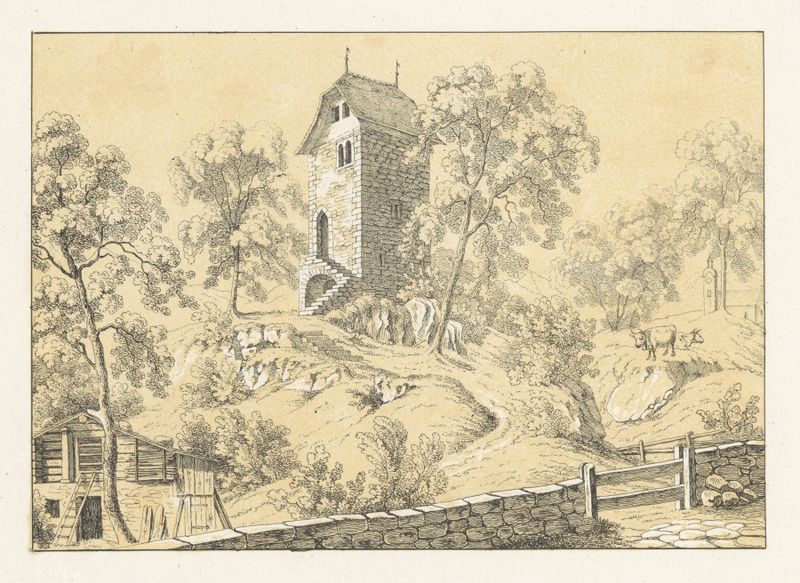
Can beauty exist without sorrow? In Johann Friedrich Wagner's Wartenfels, this question reverberates through the landscape, where longing and desire entwine like the shadows cast by the setting sun. Look to the left side of the canvas, where the craggy silhouette of Wartenfels Castle looms against a backdrop of deep, ochre-hued skies. The stark contrasts of light and shadow draw the eye, guiding it across the sweeping valley below, rich with verdant greens and earthy browns. Notice how the delicate strokes render the foliage, each leaf seemingly alive with the weight of unseen stories, while the distant mountains stand sentinel, their muted blues offering a sense of tranquility amidst the emotional undercurrents. The scene encapsulates a profound dialogue between beauty and melancholy.
The castle, a symbol of history and human ambition, contrasts sharply with the untamed natural landscape, suggesting the transience of man-made structures against the enduring power of nature. The horizon glows with a sense of yearning, inviting viewers to contemplate the interplay of desire and isolation. Each element whispers of aspirations unfulfilled, as if the landscape itself echoes the silent dreams of those who once walked its paths. Between 1840 and 1844, Wagner was immersed in the Romantic tradition that emphasized emotion and sublime nature.
During this period, the artist was living in Germany, an era marked by socio-political upheaval and a burgeoning desire for individual expression in art. As he painted Wartenfels, Wagner sought to capture not just the physical beauty of the landscape, but the deeper human emotions that resonate within it, positioning him as a vital figure in the evolution of Romantic landscape painting.
More Artworks by Johann Friedrich Wagner
Browse all →
Chillon
Johann Friedrich Wagner

Valangin
Johann Friedrich Wagner
Greifenstein
Johann Friedrich Wagner

Vorburg
Johann Friedrich Wagner
Delémont
Johann Friedrich Wagner

Pleujouse
Johann Friedrich Wagner

Challay
Johann Friedrich Wagner
Mont Salvant
Johann Friedrich Wagner
Aha. Od. Untere Burg von Sarnen
Johann Friedrich Wagner
Lausanne
Johann Friedrich Wagner





