
Woman Carrying a Child on Her Back — History & Facts
What holds the eye here is the utter economy of line: a mother, rendered in stark black against pale paper, carries her child on her back with a gesture so spare it feels almost like a memory. The figure is stripped of detail, yet nothing essential is lost—the child’s head peeks out from a striped shawl, the woman’s arms cradle a round object, perhaps bread or a bowl, grounding her in daily labor. The shadows beneath their feet anchor them to the earth, while the vertical folds of her skirt and the diagonal wrap of the rebozo create a rhythm that guides the gaze upward, from bare feet to the child’s watchful face.
The print’s small scale and minimalism invite a kind of intimacy, as if the viewer is being let in on a quiet, private moment. Created sometime between 1890 and 1910, this print belongs to a world in flux—Mexico at the end of the nineteenth century, where artists like José Guadalupe Posada turned to the lives of ordinary people for their subjects. Prints such as this were often produced quickly and in large numbers, intended for broad circulation among the public rather than the elite. Posada’s works became visual chronicles of street life, celebrations, and struggles, capturing both hardship and resilience with a few deft marks.
This sheet, now preserved in the Metropolitan Museum of Art’s collection, is a rare survivor of an everyday art form. It stands as a reminder to look closely at the lives that history often leaves at the margins—here, in a few lines, is a world.
More Artworks by José Guadalupe Posada

La Calavera Catrina
José Guadalupe Posada

The Rich Man Turning Away the Poor
José Guadalupe Posada

A Child Tipping a Table
José Guadalupe Posada

A Holy Procession
José Guadalupe Posada

A Man Before Three Monuments
José Guadalupe Posada

A Soldier's Standoff
José Guadalupe Posada

A Toy Vendor
José Guadalupe Posada

Firefighters with a New Engine
José Guadalupe Posada

A Saint with Angels and Skeletons
José Guadalupe Posada
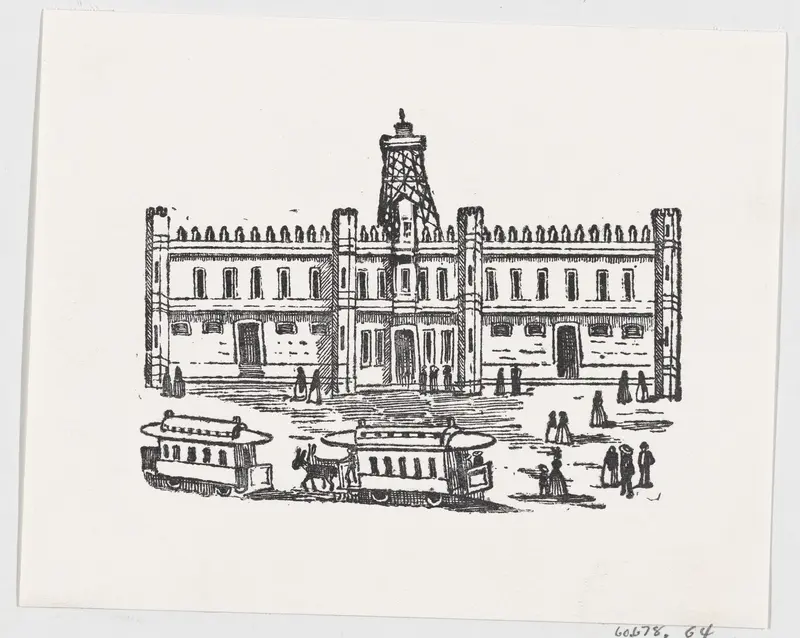
A Scene in the Town Square
José Guadalupe Posada
More Genre Scene Art

Banquet of the Officers of the St George Civic Guard
Frans Hals

Rembrandt and Saskia in the Scene of the Prodigal Son
Rembrandt van Rijn

Bal du moulin de la Galette
Pierre-Auguste Renoir

Quadrille at the Moulin Rouge
Henri de Toulouse-Lautrec

A Burial at Ornans
Gustave Courbet

When Will You Marry?
Paul Gauguin