
Wr. Umgebung; Wienerwald — History & Facts
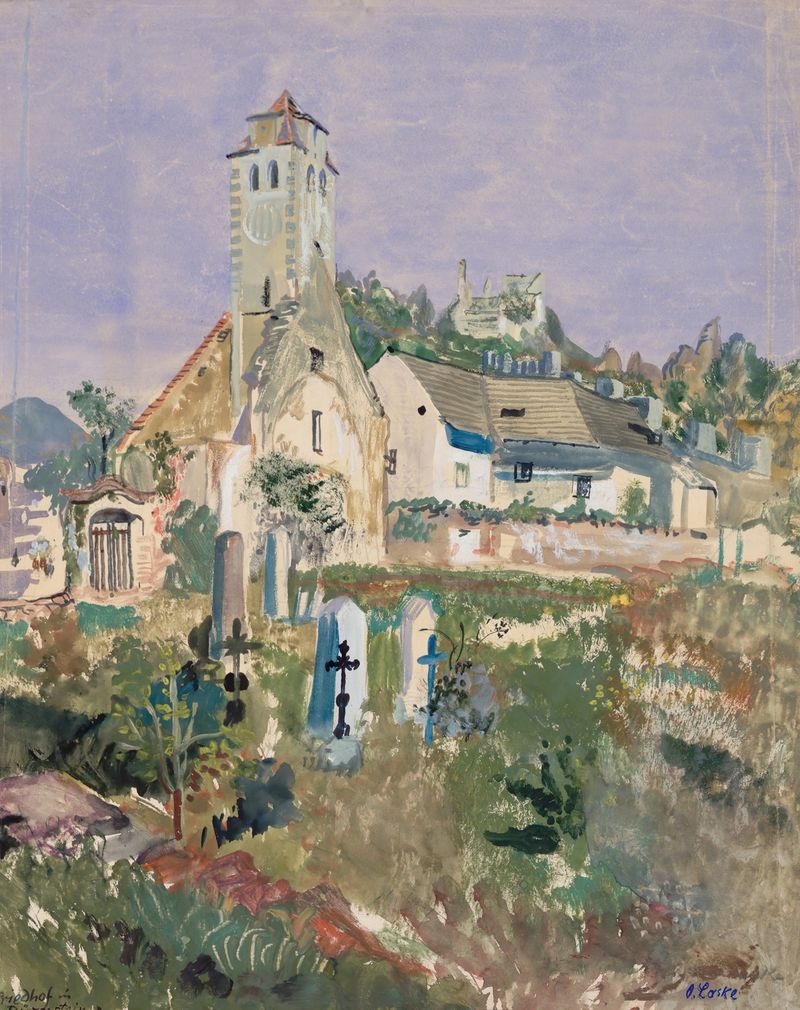
When did color learn to lie? In the depths of Oskar Laske’s Wr. Umgebung; Wienerwald, hues twist and turn, whispering dreams and secrets that question our perception of reality. Every stroke becomes a pathway to explore the duality of truth and illusion, urging us to confront the legacies we inherit through what we see and what we choose to believe. Look to the left, where vibrant greens burst forth from a turbulent underlayer, inviting you to the heart of the Wienerwald.
The rich brushwork creates an almost tactile quality to the foliage, as if you could reach in and feel the vitality of the landscape. Notice how the light filters through the trees, casting intricate shadows that dance across the canvas, a testament to Laske's mastery of color and composition which brings the scene to life while veiling it in mystery. Yet, beneath this lush exterior lies a tension between chaos and serenity, a contradiction that mirrors the complexities of legacy. The vivid colors suggest an exuberance of life, while the almost frenetic application of paint reveals an underlying turmoil.
Each brushstroke speaks of a story untold, hinting at the weight of history intertwined with nature, asking us to reflect on how our surroundings shape our narrative. In 1929, Laske created this work amidst a turbulent period in post-World War I Vienna, where the art world was caught between tradition and modernity. During this time, he was influenced by the Austrian expressionist movement, which emphasized emotional experience over physical reality. The painting reflects his desire to capture the essence of his homeland, offering a glimpse into the complex interplay of life, nature, and the legacy we continue to navigate today.
More Artworks by Oskar Laske
Browse all →
Faschingsumzug am Stock im Eisen Platz
Oskar Laske

Schönbrunn (Winter)
Oskar Laske
Friedhof in Dürnstein
Oskar Laske

Pratermotiv an der alten Donau
Oskar Laske

Frühjahrsnebel in Niederösterreich
Oskar Laske

Begräbnis des Wiener Bürgermeisters Dr. Karl Lueger
Oskar Laske

Maria Theresien-Denkmal mit Blick gegen das Burgtor
Oskar Laske
Wiener Straßenbild vom Mai 1945
Oskar Laske

Winterlandschaft in Pressbaum
Oskar Laske

Ansicht von Positano
Oskar Laske





