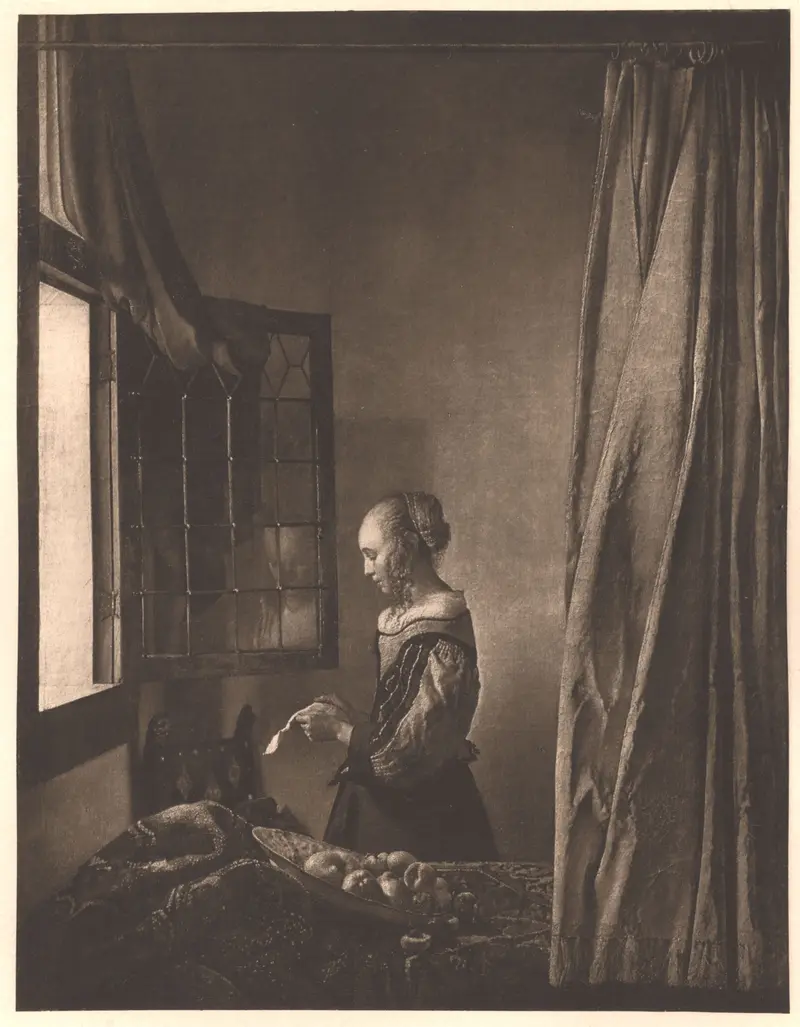
At the Window — History & Facts
Few realize that At the Window marks a turning point in Paul Gauguin's life: painted in 1882, it belongs to the brief period when he was still a successful Parisian stockbroker, painting in the evenings, before his fateful decision to abandon the comforts of bourgeois life for art. This work stands at the crossroads of his transformation, capturing the domestic world he would soon leave behind. The painting is one of the last examples of Gauguin’s early style, before his travels to Brittany and Tahiti would radically alter his palette and vision.
Its quiet intimacy is a window not only onto a scene, but onto the artist’s own uncertainty and longing. A woman stands by a window, half-turned toward the light, her features softly illuminated as she looks out onto an unseen world. The room is rendered with careful attention to detail: a vase of flowers on the sill, the gentle folds of her dress, the subtle interplay of shadow and sunlight. The window itself is more than architecture—it is a threshold between interior and exterior, safety and possibility.
Gauguin’s brushwork is precise, almost reserved, recalling the influence of Impressionism but with a solidity that hints at his later experiments. Unlike Berthe Morisot’s women at windows, who seem to dissolve into their surroundings, Gauguin’s figure is anchored, caught in a moment of contemplation. The exact provenance of At the Window is not fully documented, and its medium remains uncertain, though oil on canvas is likely. The painting was created during Gauguin’s years as an amateur, before he joined the circles of Pissarro and Degas, and before his dramatic move to Pont-Aven.
It has since appeared in several retrospectives, valued for its glimpse into the artist’s formative years. Today, it stands as a testament to the quiet drama of ordinary life, and to the personal crossroads that would eventually lead Gauguin far from the Parisian interiors of his early work.
More Artworks by Paul Gauguin

Self Portrait
Paul Gauguin

Three Tahitian Women
Paul Gauguin

When Will You Marry?
Paul Gauguin

Where Do We Come From? What Are We? Where Are We Going?
Paul Gauguin

Merahi metua no Tehamana
Paul Gauguin

Nave Nave Mahana
Paul Gauguin

Fatata te Miti (By the Sea)
Paul Gauguin

Three Tahitians
Paul Gauguin

Breton Girls Dancing,Pont-Aven
Paul Gauguin

Nave Nave Fenua
Paul Gauguin