
Berthe Morisot with a Fan — History & Facts
In 1874, Édouard Manet painted his close friend and fellow artist, Berthe Morisot, in a portrait that would come to symbolize both their artistic kinship and the shifting roles of women in Impressionist circles. The painting, Berthe Morisot with a Fan, stands out not only for its subject but for the air of mystery surrounding Morisot herself, who was at once Manet’s muse and a pioneering painter in her own right. This work was completed the same year Morisot married Manet’s brother, Eugène, deepening the personal and professional ties between sitter and artist.
Critics at the time remarked on the intimacy and psychological complexity of Manet’s portraits of Morisot, noting how they seemed to capture "the very soul behind the eyes." At the heart of Berthe Morisot with a Fan is a moment of poised ambiguity: Morisot gazes out, her dark eyes partially veiled by the delicate fan she holds, her black dress and hat setting her apart from the pale, undefined background. The fan, both accessory and barrier, suggests a subtle interplay of openness and reserve, while the loose, energetic brushwork blurs the boundaries between figure and space. This technique, characteristic of Manet’s late style, invites comparison with Pierre-Auguste Renoir’s softer, more sentimental portraits of women, yet Manet’s Morisot remains enigmatic, her individuality undiminished by the artist’s hand.
The light, falling across her face and glinting off the fan, draws the viewer’s attention to her expression—a blend of confidence and introspection. The exact provenance of Berthe Morisot with a Fan is less documented than some of Manet’s other works, but it is known to have remained within private collections for many years before entering the public eye. The portrait marks a significant moment in Manet’s career, reflecting his deep engagement with the Impressionist movement and his evolving approach to portraiture. Today, the painting is recognized as a testament to the close-knit world of Parisian artists in the 1870s, and to the mutual influence between Manet and Morisot.
Its presence in museum collections continues to invite viewers into the complex, interconnected lives of those who shaped the course of modern art.
More Artworks by Édouard Manet

Luncheon on the Grass
Édouard Manet

Chez Tortoni
Édouard Manet

The Execution of Emperor Maximilian
Édouard Manet

Olympia
Édouard Manet

A Bar at the Folies-Bergère
Édouard Manet

The ‘Kearsarge’ at Boulogne
Édouard Manet

Executie van keizer Maximiliaan
Édouard Manet

Boating
Édouard Manet

Woman Reading
Édouard Manet
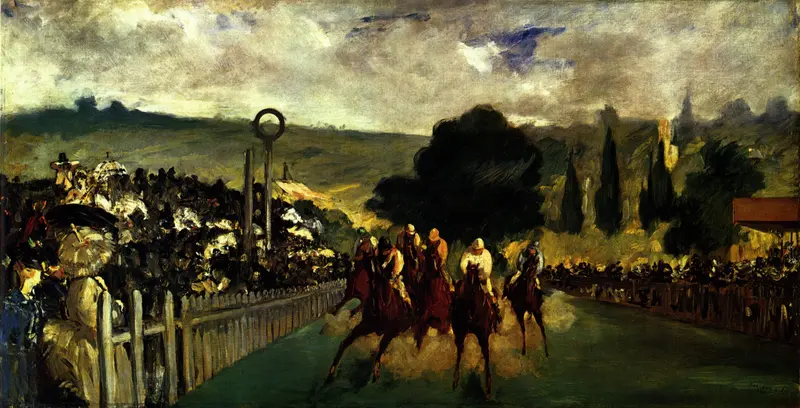
The Races at Longchamp
Édouard Manet





