Den sönderslagna statyn II — History & Facts
Few works by Nils Dardel have sparked as much intrigue as Den sönderslagna statyn II, largely because its date and original context remain unknown. The painting’s very title—Swedish for “The Broken Statue II”—hints at a sequence, yet no definitive record of a first version has surfaced. This air of mystery has led art historians to speculate whether Dardel intended a series or if the “II” refers to a more personal or symbolic continuation.
The lack of documentation has only deepened the fascination around the piece, making it a touchstone for debates about lost works and hidden meanings in early 20th-century Swedish art. In the scene, a shattered statue lies amidst a sparse, ambiguous landscape, its fragments scattered across the foreground. A solitary figure stands nearby, gazing down at the ruins—perhaps in mourning, perhaps in contemplation. The broken marble limbs and severed head evoke the fall of ideals or the end of an era, while the figure’s posture suggests both loss and reflection.
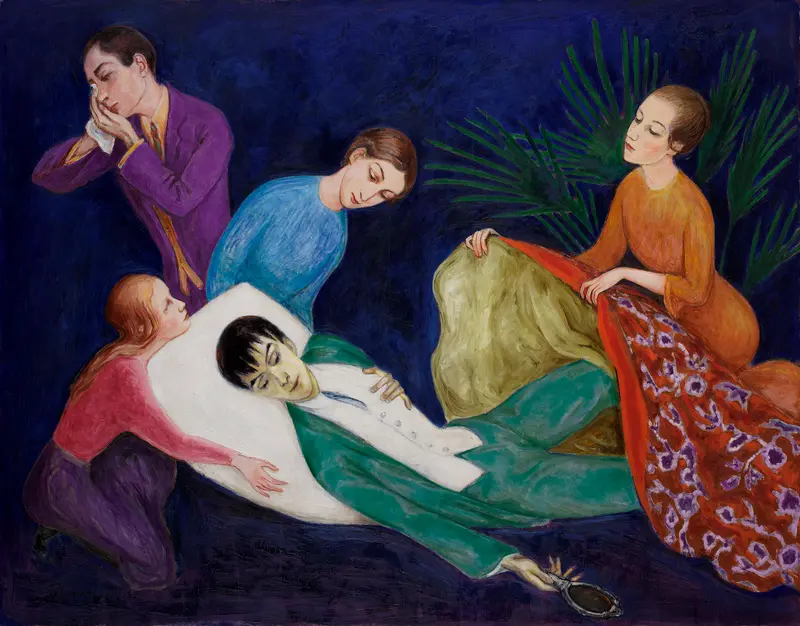
The cool, muted palette and stylized forms recall the psychological intensity found in Dardel’s other works, such as The Dying Dandy, but here the drama is quieter, more internal. Unlike Giorgio de Chirico’s metaphysical cityscapes, which use statues to evoke mystery, Dardel focuses on the aftermath, inviting viewers to ponder what has been destroyed—and why. The physical history of Den sönderslagna statyn II is as enigmatic as its imagery. No records of commission, exhibitions, or early provenance have been confirmed, and the painting’s medium is undocumented, though it is presumed to be oil on canvas, in keeping with Dardel’s usual practice.
Today, the work is held in a private collection, rarely loaned and seldom seen in public, contributing to its almost legendary status among admirers of Swedish Modernism. Within Dardel’s career, it stands apart for its somber tone and unresolved narrative, offering a stark contrast to the vibrant theatricality of his better-known pieces. Its obscurity and unanswered questions continue to invite new interpretations and research.