
Familjeidyll — History & Facts
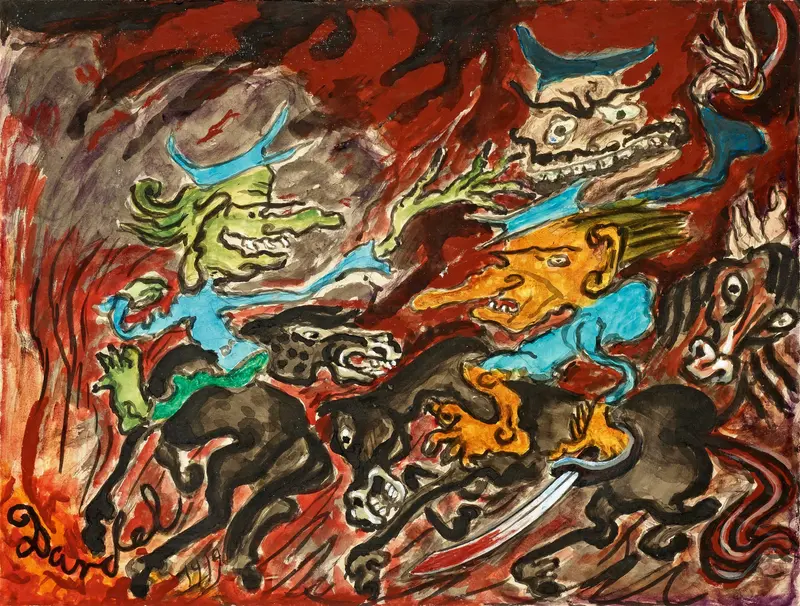
When Familjeidyll appeared in the 1920s, it sparked immediate recognition among Swedish viewers for its sly, almost theatrical depiction of domestic life—a theme rarely treated with such irony in the work of Nils Dardel. The painting’s title, which translates as “Family Idyll,” plays with expectations, as Dardel was known for his satirical takes on bourgeois society. Critics at the time noted the contrast between the painting’s cheerful palette and the subtle tensions lurking beneath the surface, with one contemporary observer remarking on its “deliciously uncomfortable calm.” The work stands out in Dardel’s oeuvre for its blend of affection and critique, capturing both the warmth and the constraints of family rituals. At the center of Familjeidyll, a family gathers in a well-appointed room, their postures stiff yet their faces frozen in polite smiles.
The father’s hand rests protectively on the child’s shoulder, while the mother’s gaze drifts away, lost in thought. Dardel arranges the figures almost like actors on a stage, their gestures slightly exaggerated to hint at the roles they play rather than the people they are. The bright, patterned wallpaper and carefully arranged furniture evoke a sense of order, but the unnatural stillness and the characters’ fixed expressions suggest a performance rather than true intimacy.
Unlike the sentimental family scenes of Carl Larsson, Dardel’s version is tinged with irony, exposing the gap between appearance and reality. The exact circumstances of Familjeidyll’s creation remain unclear, as the painting is undated and its first owner is unknown. It is typical of Dardel’s mature period, when he was deeply engaged with Swedish modernism and often explored themes of identity and social convention. The painting has passed through several private collections and has been exhibited in retrospectives of Dardel’s work, where it is frequently cited as a prime example of his satirical approach to everyday life.
Today, Familjeidyll is recognized as a key piece in understanding Dardel’s unique blend of humor and psychological insight within early 20th-century Swedish art.
More Artworks by Nils Dardel





More Genre Scene Art

Banquet of the Officers of the St George Civic Guard
Frans Hals

Rembrandt and Saskia in the Scene of the Prodigal Son
Rembrandt van Rijn

Bal du moulin de la Galette
Pierre-Auguste Renoir

Quadrille at the Moulin Rouge
Henri de Toulouse-Lautrec

A Burial at Ornans
Gustave Courbet

When Will You Marry?
Paul Gauguin