
Landscape with three Horsemen — History & Facts
What first draws the eye in Landscape with three Horsemen is the quiet grandeur of its riders, poised at the edge of a sunlit clearing, as if pausing between worlds. The central figure, dressed in blue and perched on a dappled grey horse, turns to meet the viewer’s gaze with a look that is both direct and enigmatic, while his companions—one in rich red, the other in somber black—attend to their mounts or look off into the golden distance. The light, filtered through a great oak, spills across the horses’ flanks and the riders’ fine garments, picking out the sheen of satin and the gloss of well-groomed manes.
In the lower left, a pair of dogs nose the ground, hinting at a hunt or a leisurely ride, their presence a reminder of the pleasures and privileges of the landowning class. The landscape itself, with its low horizon and distant ruin, invites the eye to wander, promising stories beyond the frame. Painted around 1665, this work belongs to a world where the Dutch Golden Age was in full flower, and landscape painting had become a prized genre among the prosperous elite. Artists like Aelbert Cuyp were celebrated for their ability to capture not just the likeness of a place, but the atmosphere—the sense of a particular hour, a certain clarity of air.
Such paintings were often commissioned to commemorate status, leisure, and the harmony between man and the land he commands. While history has kept few traces of this specific canvas’s journey, its presence in a modern collection allows us to step into that world for a moment, to feel the weight of a gaze, the cool of a morning, and the promise of a ride yet to begin.
More Artworks by Aelbert Cuyp

The Maas at Dordrecht
Aelbert Cuyp
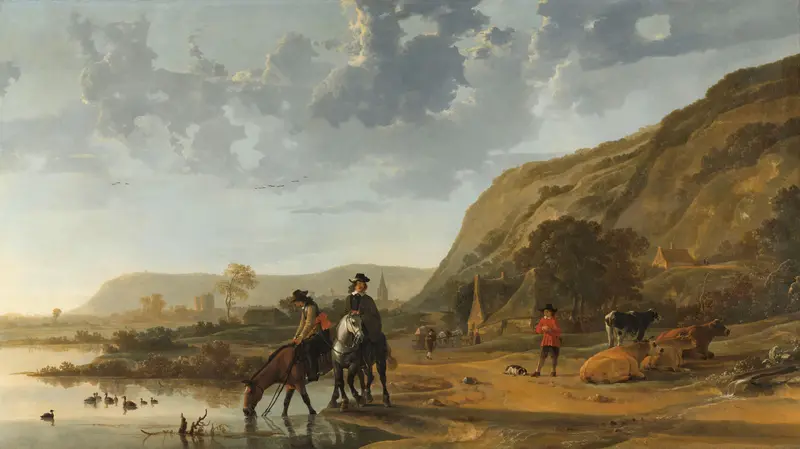
River Landscape with Riders
Aelbert Cuyp

The Maas at Dordrecht
Aelbert Cuyp
Gezicht op Dordrecht
Aelbert Cuyp
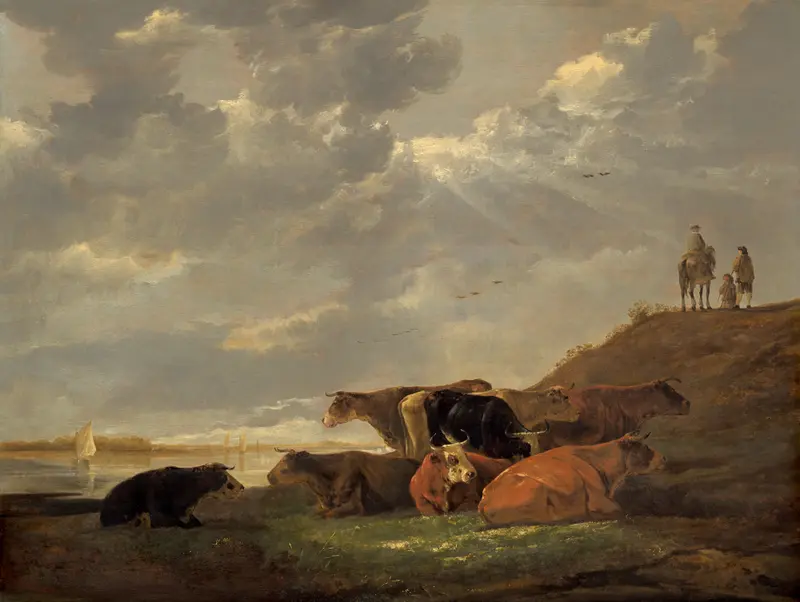
River Landscape with Cows
Aelbert Cuyp
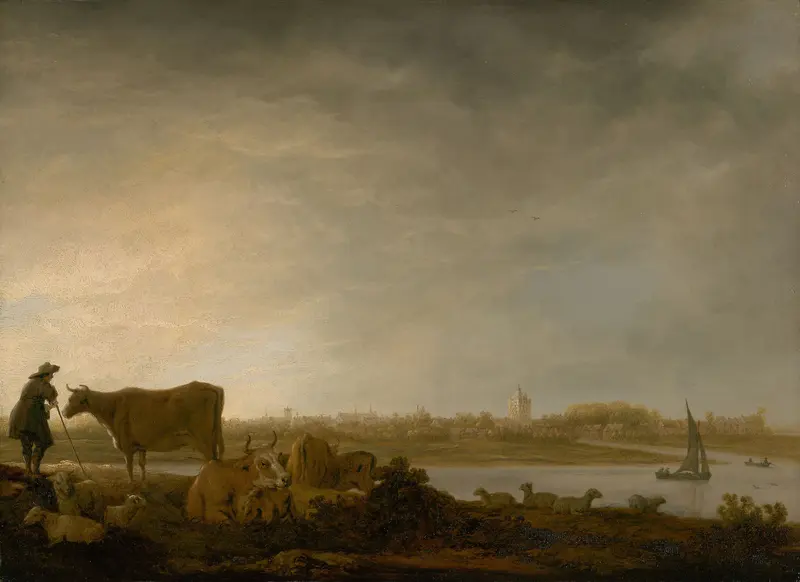
A View of Vianen with a Herdsman and Cattle by a River
Aelbert Cuyp
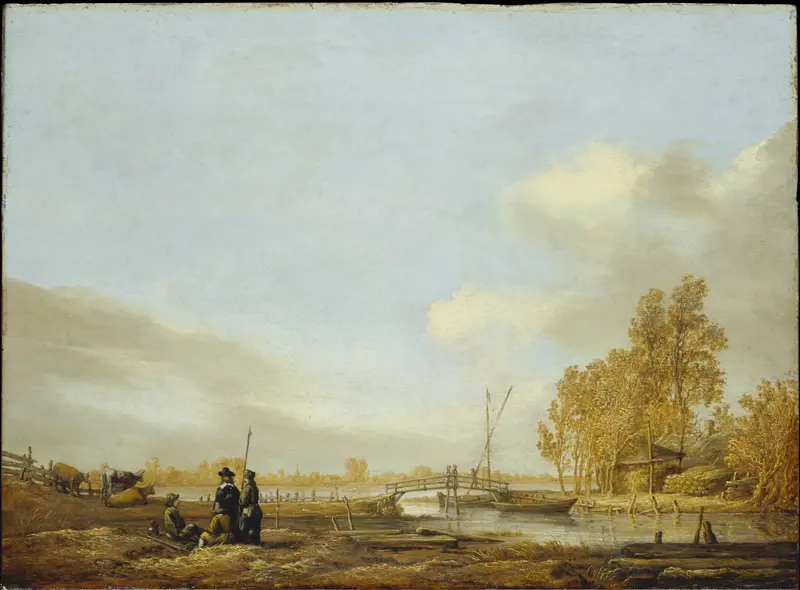
River Landscape with Footbridge
Aelbert Cuyp
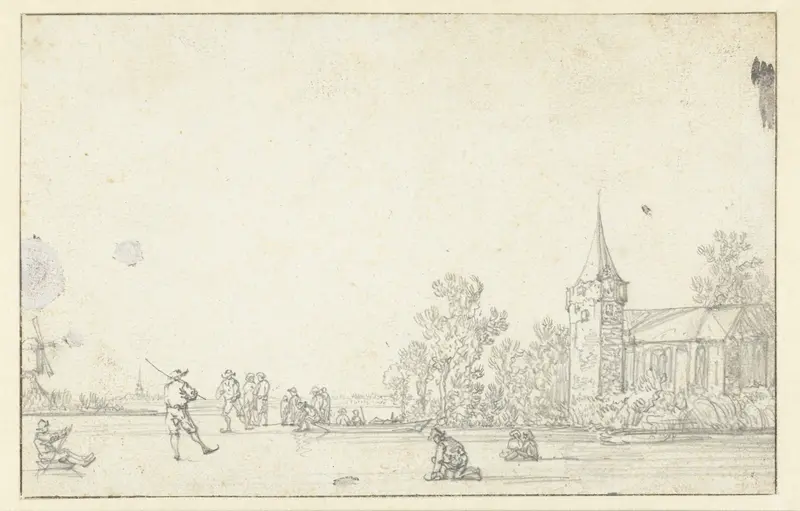
Bevroren rivier met schaatsers bij een kerk
Aelbert Cuyp

Cattle near a River
Aelbert Cuyp
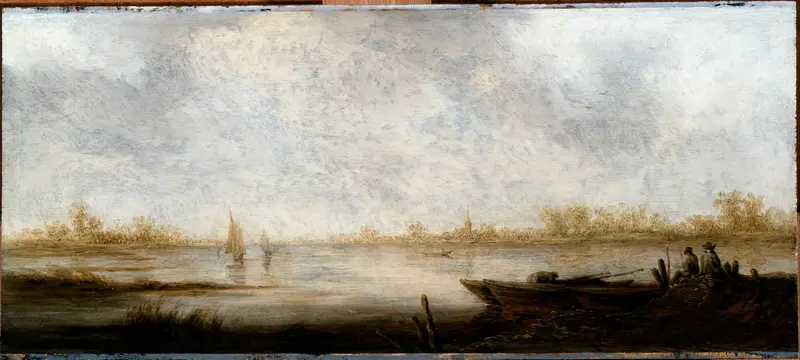
River Landscape
Aelbert Cuyp
More Landscape Art

The Starry Night
Vincent van Gogh

View of Delft
Johannes Vermeer

Water Lilies
Claude Monet

The Grand Canal, Venice, looking north-west from the Ca' Corner to the Ca' Contarini degli Scrigni, with the campanile of Santa Maria della Carità
Canaletto

Windsor Castle
Canaletto

The Grand Canal looking North-East from the Palazzo Dolfin-Manin to the Rialto Bridge
Canaletto