
Les femmes à la toilette — History & Facts
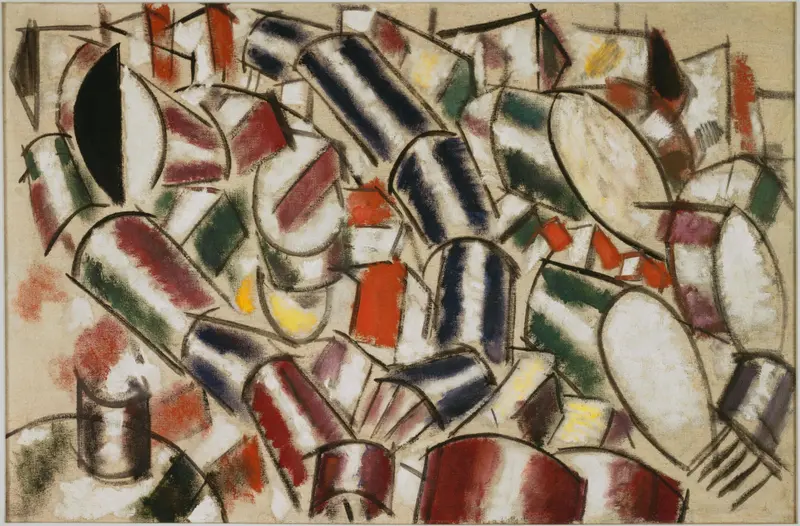
What first catches the eye in Les femmes à la toilette is the sense of movement and rhythm, as if the very air were pulsing with energy. The painting is a riot of interlocking shapes—circular forms, bold stripes, and blocks of color—each jostling for space yet held in a careful balance. The palette is crisp and lively: reds, blues, greens, and yellows set against stark black and white, creating a visual music that guides the viewer’s gaze from one segment to the next.
There is no single focal point; instead, the composition invites the eye to wander, to piece together the suggestion of figures and objects from the abstracted forms. The title hints at an everyday scene, but here, the act of women at their toilette is transformed into a modernist puzzle—intimate ritual rendered as a dynamic construction. Painted in 1920, this work belongs to a world in the throes of reinvention. In the wake of the First World War, artists like Fernand Léger sought new ways to represent life, turning to abstraction and the machine age for inspiration.
The angular geometry and mechanical precision of this canvas speak to the influence of Cubism, but also to Léger’s own fascination with the visual language of industry and urban life. Such paintings were rarely commissioned in the traditional sense; rather, they were born from the artist’s drive to capture the spirit of a rapidly changing era. The canvas, signed and dated by Léger, stands as a testament to a moment when painting broke free from old constraints, inviting us to find beauty—and perhaps even narrative—in the interplay of form and color.
Look again, and let the shapes suggest their own story.
More Artworks by Fernand Léger

The Tugboat Bridge
Fernand Léger
The Wheels
Fernand Léger

Le Cirque Médrano
Fernand Léger
The Disks in the City
Fernand Léger
Le Jongleur et les acrobates
Fernand Léger
Three Women and Still Life (Déjeuner)
Fernand Léger

Reading
Fernand Léger
Femme couchée
Fernand Léger
Woman holding flowers
Fernand Léger
The Tug
Fernand Léger



