
River Landscape with Horseman and Peasants — History & Facts
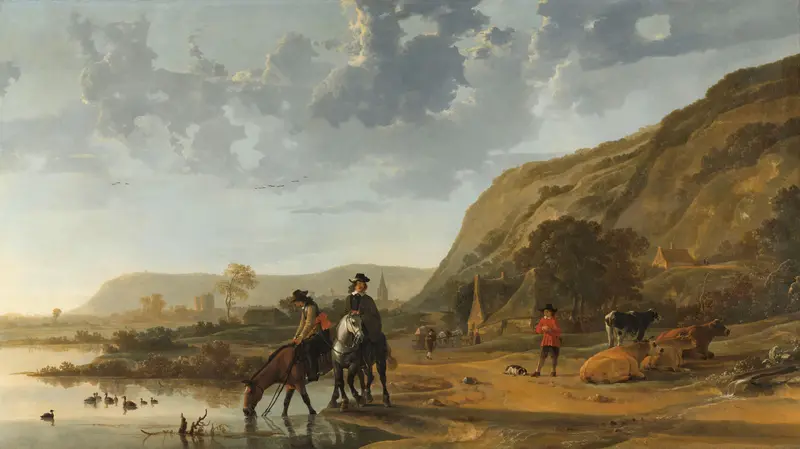
What first draws the eye is the golden hush that settles over the landscape, as if the entire scene is caught in the gentle pause before evening. Light pours in from the left, flooding the riverbank and catching the backs of cattle, the white of a horse, and the hats of peasants as they go about their work. The horseman, poised and calm, commands the center, his presence both watchful and at ease, while the cattle rest or graze, their forms grounding the composition.
In the far left, a solitary figure crouches in the undergrowth, rifle raised, intent on the waterfowl drifting across the mirrored surface of the river—a quiet drama unfolding at the edge of the frame. The trees arch overhead, their branches filtering the sky, and the distant hills and clustered towers hint at a world beyond this tranquil moment. Works like this, painted by Aelbert Cuyp between circa 1658 and circa 1660, belong to the flowering of Dutch landscape painting, when scenes of rural life and luminous skies became prized possessions in prosperous homes. The Dutch Republic of the seventeenth century was a place of new wealth and curiosity, where landowners and merchants alike found pleasure in images that celebrated both the bounty of the land and the quiet dignity of its people.
Paintings such as this, now in the National Gallery, London, were not simply records of place—they were invitations to linger, to imagine oneself within the scene, to savor the play of light and the slow rhythms of country life. Few traces remain of the individual stories behind each canvas, but the world they conjure is still there, waiting in the long shadows and distant towers for the viewer to step in.
More Artworks by Aelbert Cuyp

The Maas at Dordrecht
Aelbert Cuyp
River Landscape with Riders
Aelbert Cuyp

The Maas at Dordrecht
Aelbert Cuyp
Gezicht op Dordrecht
Aelbert Cuyp
River Landscape with Cows
Aelbert Cuyp
A View of Vianen with a Herdsman and Cattle by a River
Aelbert Cuyp
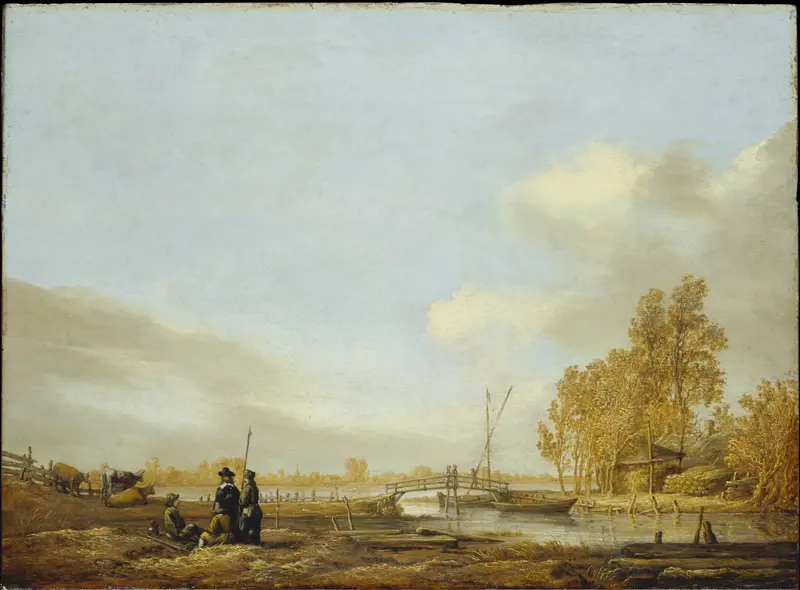
River Landscape with Footbridge
Aelbert Cuyp
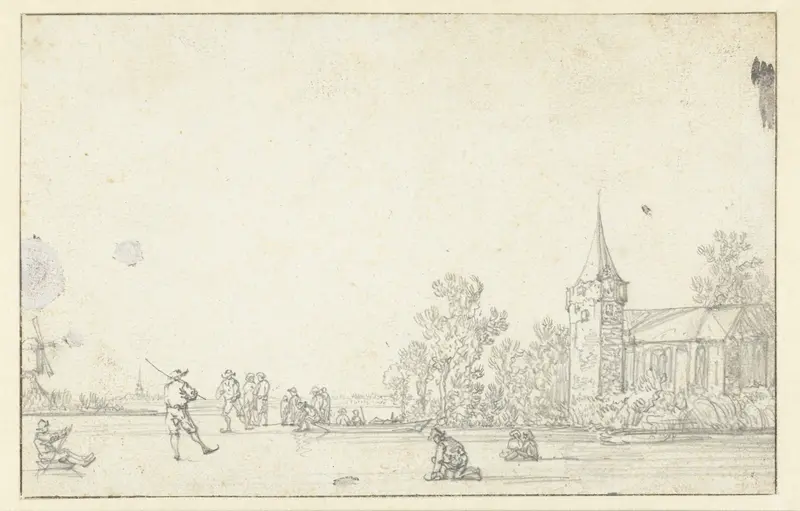
Bevroren rivier met schaatsers bij een kerk
Aelbert Cuyp

Cattle near a River
Aelbert Cuyp
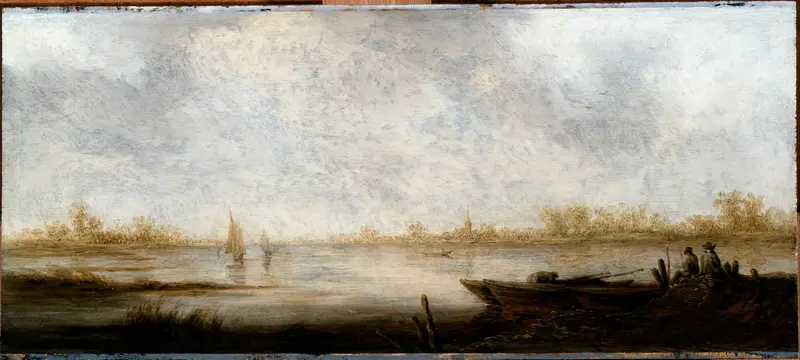
River Landscape
Aelbert Cuyp
More Landscape Art

The Starry Night
Vincent van Gogh

View of Delft
Johannes Vermeer

Water Lilies
Claude Monet

The Grand Canal, Venice, looking north-west from the Ca' Corner to the Ca' Contarini degli Scrigni, with the campanile of Santa Maria della Carità
Canaletto

Windsor Castle
Canaletto

The Grand Canal looking North-East from the Palazzo Dolfin-Manin to the Rialto Bridge
Canaletto