Still-Life with Candelabrum and Box — History & Facts
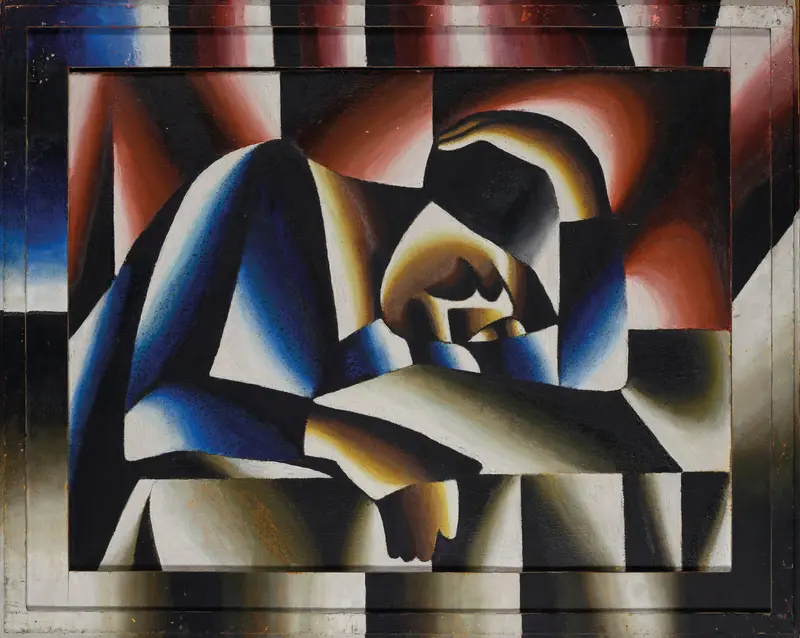
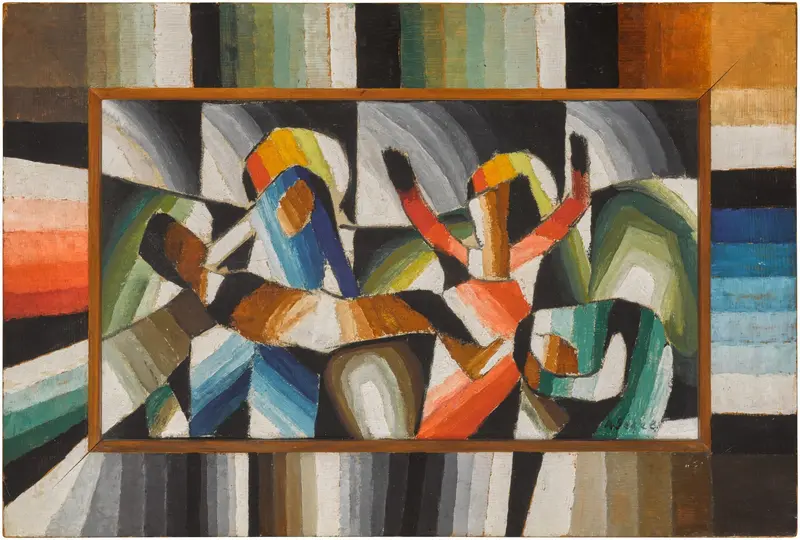
A candelabrum rises like a riddle at the heart of Still-Life with Candelabrum and Box, its arms and shadows fractured into sharp geometry, as if the object itself is being reassembled before your eyes. The painting’s surface is a chessboard of light and dark, where familiar forms dissolve into angular planes and cryptic volumes. The eye is drawn first to the reddish, almost sculptural candelabrum—central, upright, and casting a shadow that splits the space—then to the mysterious box below, rendered as a shifting prism.
Every line and shadow seems to point both inward and outward, inviting the viewer to decipher the puzzle of what is solid, what is void, and where the boundaries of objects truly lie. This work was created in 1926, when Arthur Segal was exploring the possibilities of Cubism and abstraction in the wake of World War I. Still-lifes like this, once the domain of fruit and flowers, had become laboratories for artists to test the limits of perception and representation. In the Europe of the 1920s, such paintings were both a challenge and a promise: a challenge to the old certainties of vision, and a promise that art could find new order in a fractured world.
Today, housed in the Museo Nacional Thyssen-Bornemisza, Still-Life with Candelabrum and Box stands as a testament to that restless search for meaning—a painting that rewards every fresh look with another question.