
Art movement · 1940s–1950s · New York
Abstract Expressionism Art and Paintings
Abstract Expressionism is an art movement that began in New York in the 1940s, when American painters such as Jackson Pollock, Willem de Kooning and Mark Rothko made large abstract paintings meant to be emotional and expressive. Some, the action painters, worked with sweeping, spontaneous brushstrokes or poured paint; others, the color field painters, filled their canvases with large areas of a single color. It is also known as the New York School.
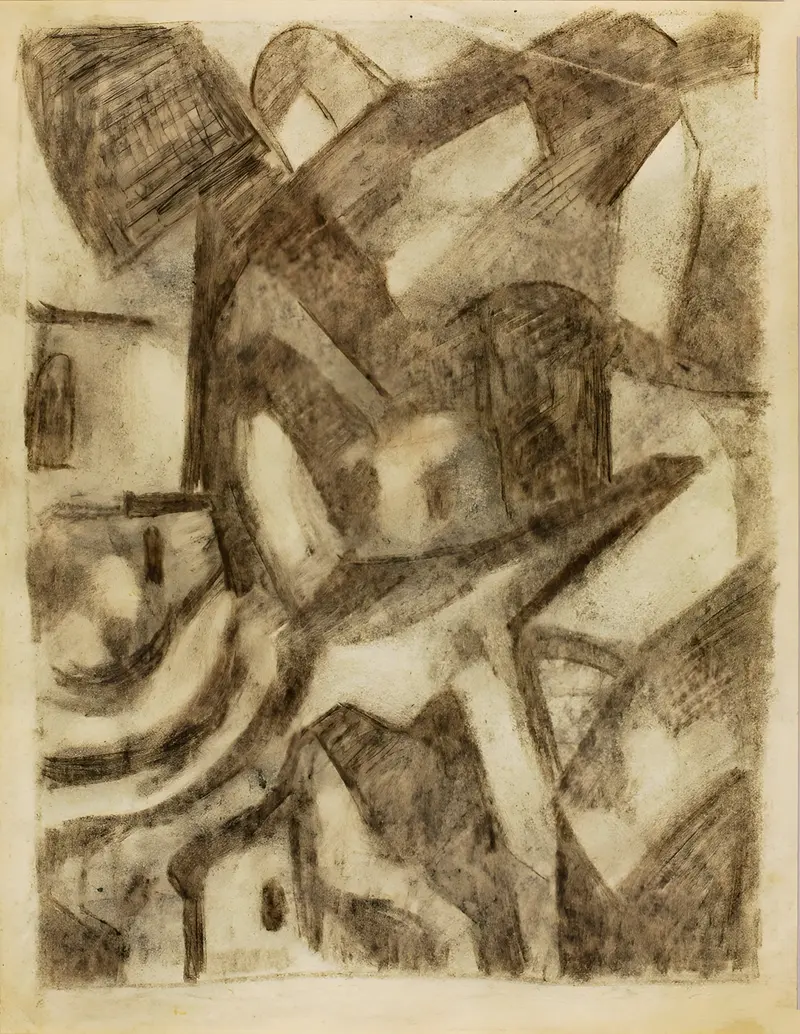
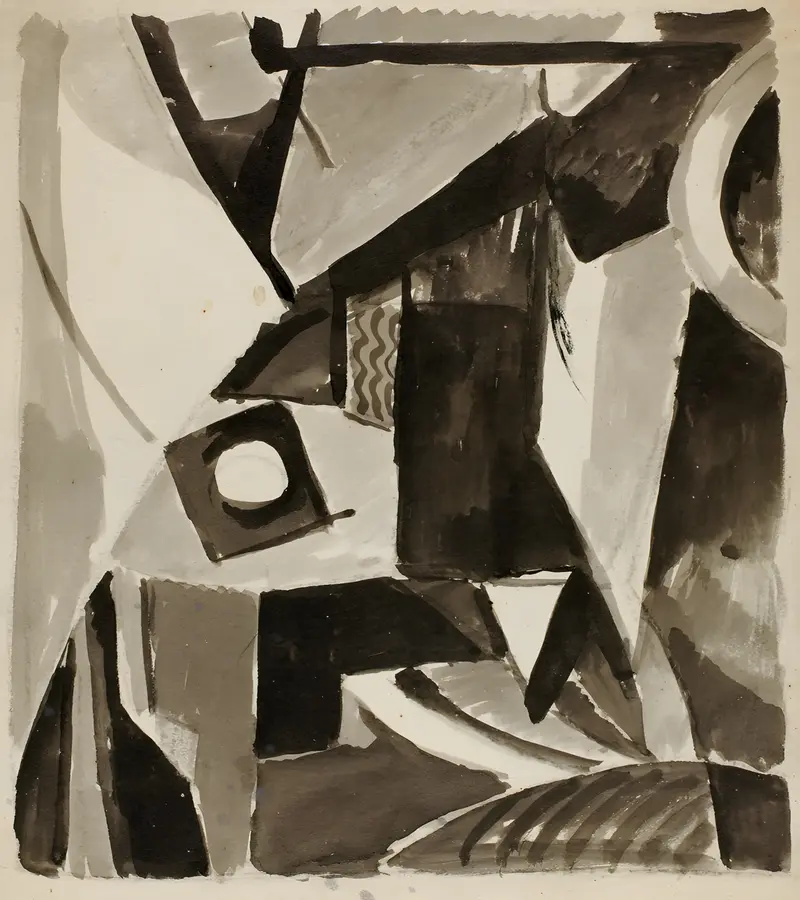
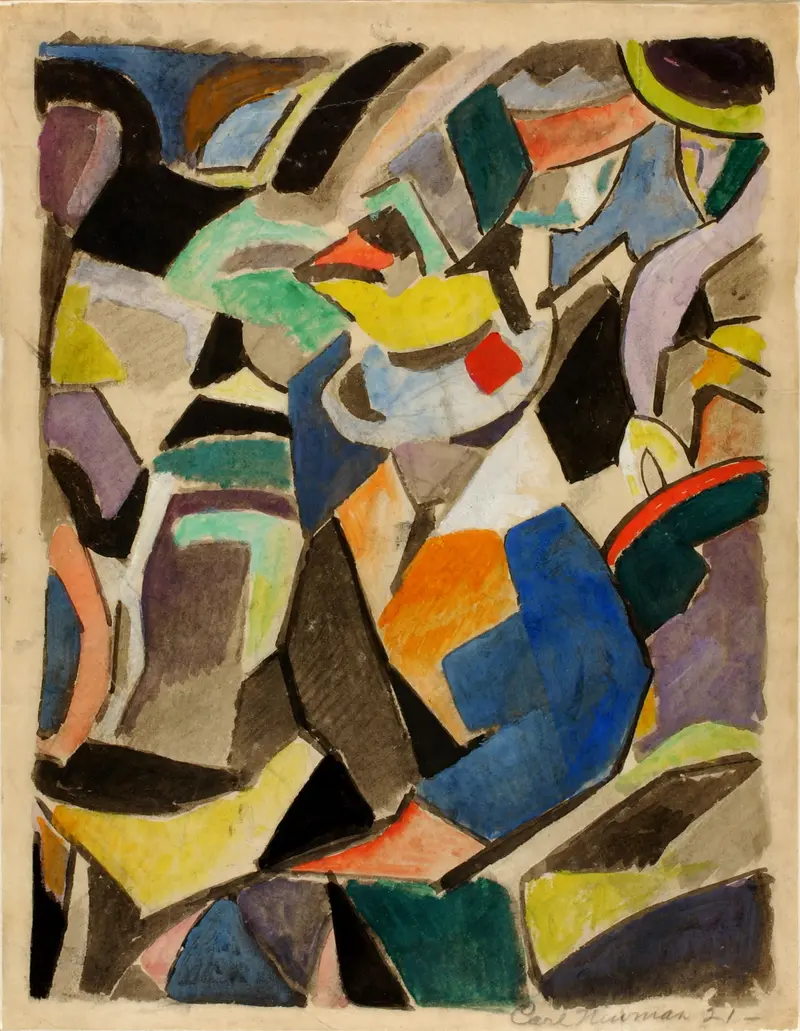
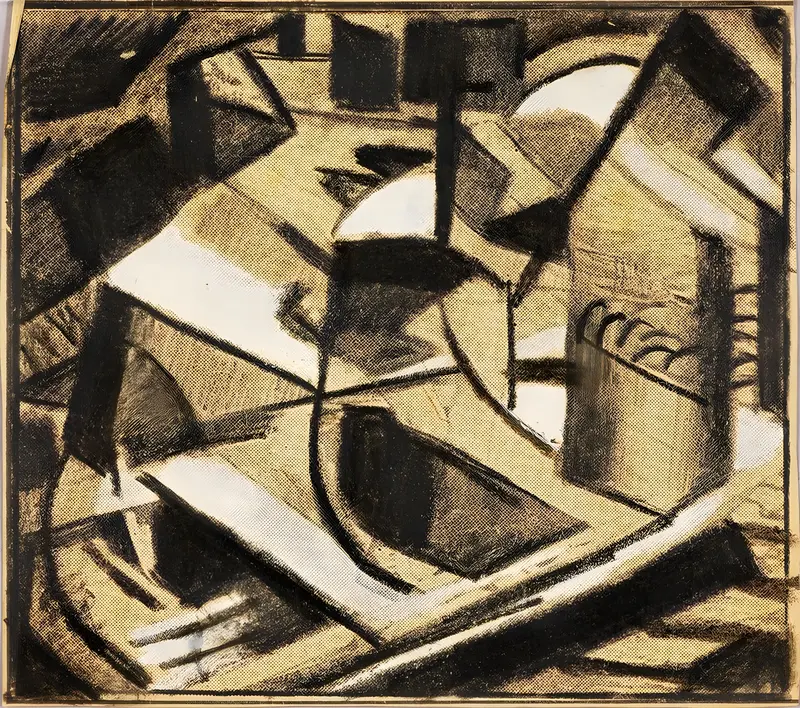
Almost all of its painters died after 1955, so their paintings are still under copyright in most countries and are not shown here: Pollock died in 1956, Rothko in 1970 and de Kooning in 1997. The 9 works filed under this label in our collection are earlier abstract drawings by the American painter Carl Newman, who died in 1932, and the Belgian Futurist Jules Schmalzigaug.
Browse the 9 works filed under Abstract Expressionism in our collection below, all public domain and free to download.
Selected and written by Pavel MazuelasUpdated November 5, 2026
Part of Art Movements and Painting StylesRelated: Expressionism, Surrealism, Abstract art
All works filed under Abstract Expressionism
Abstract drawings by the American painter Carl Newman (1858–1932) and the Belgian Futurist Jules Schmalzigaug (1882–1917), made before the movement began. All public domain, free to download.


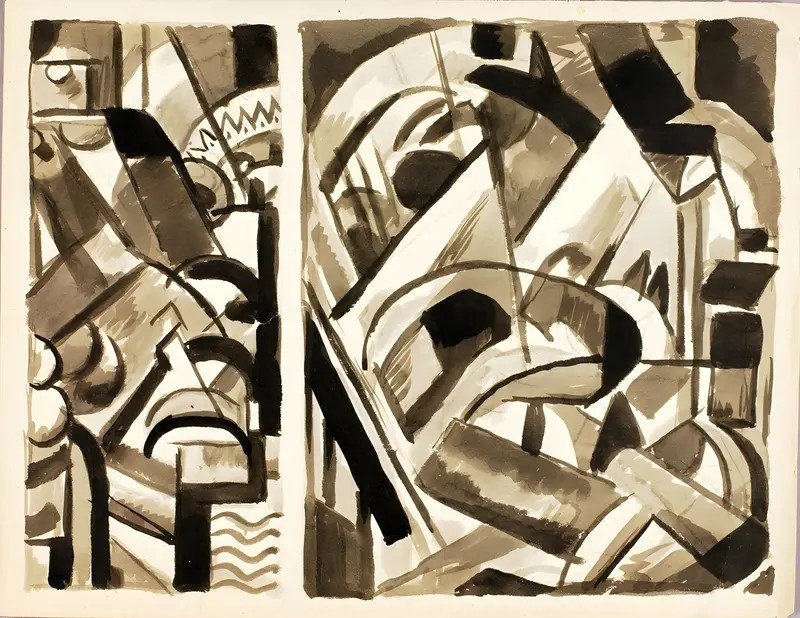
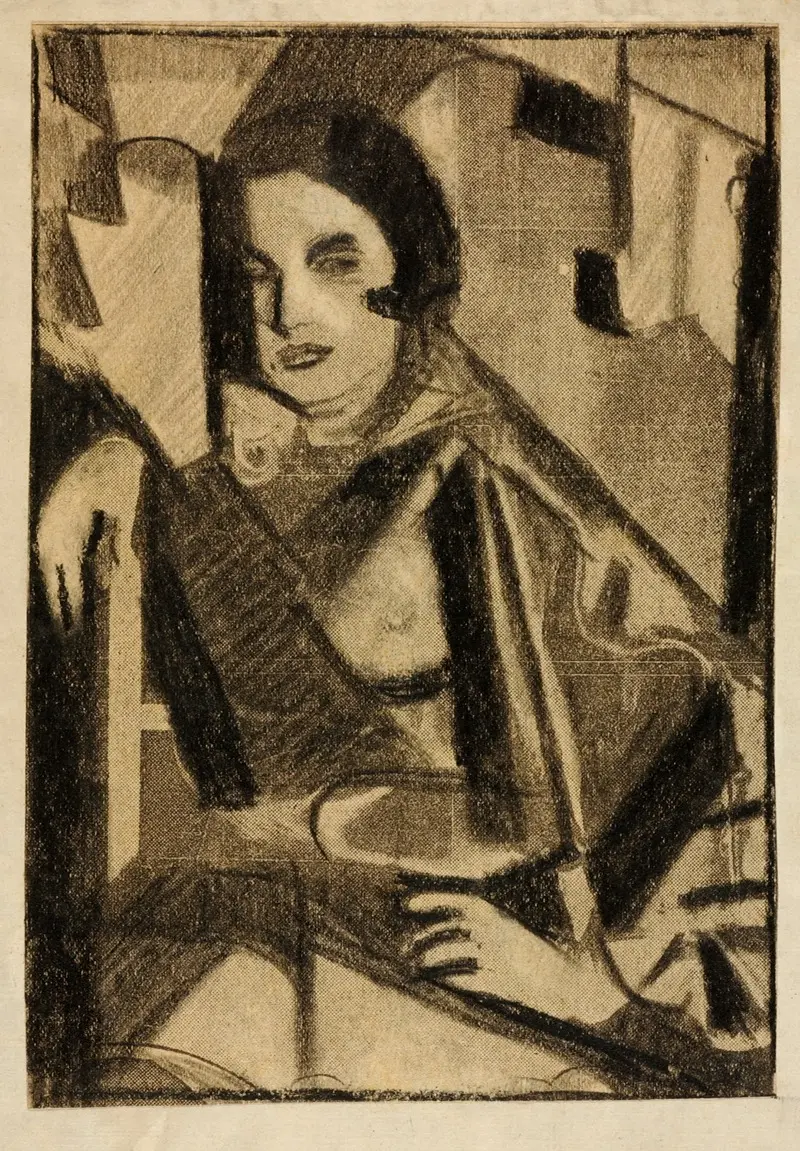
Before and after Abstract Expressionism
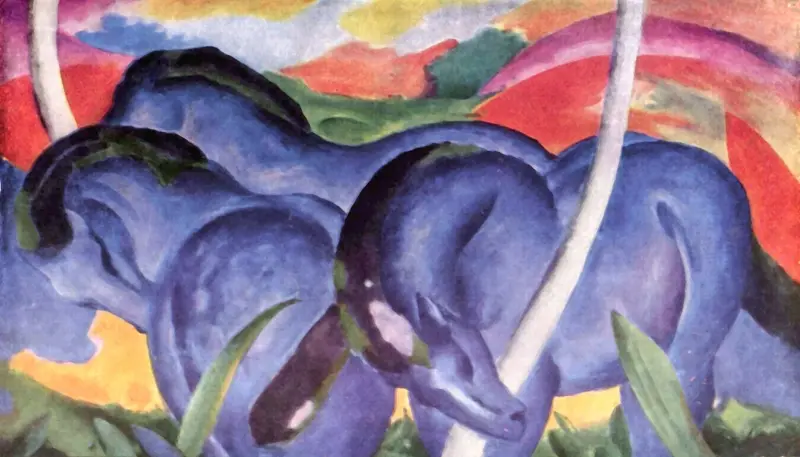 Expressionismc. 1905–1914
 Cubismc. 1907–1914
 SurrealismFrom 1924
 Abstract Expressionism1940s–1950s
 Contemporaryc. 1970–today
Abstract Expressionism vs Expressionism and Surrealism
| Compared | Expressionism | Surrealism | Abstract Expressionism |
|---|---|---|---|
| When | c. 1905–1914 | From 1924 | 1940s–1950s |
| Where | Germany (Dresden, Munich, Berlin) and Austria | Paris, then Belgium, Britain, the United States and Mexico | New York, United States |
| Aim | Express inner feelings rather than how things look | Free the unconscious mind through dreams and chance | Make abstract art that is still expressive or emotional in its effect |
| Methods | Intense, non-naturalistic color, distorted forms, thick paint | Dream images in realistic detail, automatic drawing, uncanny combinations | Sweeping gestural brushstrokes, paint poured or trailed onto canvas on the floor, large areas of a single color |
| Famous example | Munch, The Scream | Dalí, The Persistence of Memory | Pollock, Autumn Rhythm (Number 30) |
| Key artists | Munch, Kirchner, Kandinsky, Marc | Breton, Dalí, Magritte, Ernst, Miró, Tanguy | Pollock, de Kooning, Rothko, Kline, Newman, Still |
Abstract Expressionism: questions and answers
What is Abstract Expressionism, and what does it mean?
In art, Abstract Expressionism means the new forms of abstract painting developed by American artists such as Jackson Pollock, Mark Rothko and Willem de Kooning in New York in the 1940s and 1950s. Tate explains that the name evokes their aim to make art that, while abstract, was also expressive or emotional in its effect. The Getty's art vocabulary describes a range from spontaneous, gestural compositions that record the act of painting to calm, nearly single-color works built from large areas of color.
Sources: Tate: Abstract expressionism · Getty AAT: Abstract Expressionist
What are the main characteristics of Abstract Expressionism?
Abstract Expressionist paintings are abstract, often monumental in scale, and meant to carry emotion. Tate names two broad kinds: action painting, with sweeping, expressive brushstrokes and paint poured or trailed onto the canvas, and color field painting, with simple compositions of large areas of a single color meant to produce a contemplative response. Both often give an impression of spontaneity, and many of the artists drew on myth and on the Surrealist idea that art should come from the unconscious mind.
Sources: Tate: Abstract expressionism · Tate: Gestural · The Art Story: Abstract Expressionism
When did Abstract Expressionism start and end?
Abstract Expressionism took shape in New York in the 1940s and flourished into the 1950s. Tate says the name New York School came into use in the 1940s and the new style became known as Abstract Expressionism in the early 1950s; the critic Harold Rosenberg coined the term action painting in ARTnews in December 1952. From around 1960 a more purely abstract color field painting, which the critic Clement Greenberg called Post-Painterly Abstraction in 1964, took its ideas in a new direction.
Sources: Getty AAT: Abstract Expressionist · Tate: New York school · Tate: Action painters · Tate: Colour field painting
Who started Abstract Expressionism?
No single artist founded it; it grew among painters working in New York in the 1940s. Tate calls Arshile Gorky a seminal figure in its formation: in the 1940s he met Surrealists exiled from wartime Europe and, stimulated by their ideas of free-flowing, automatic painting, developed the style for which he became famous. Clyfford Still has been credited with setting the movement going just after the Second World War, and Jackson Pollock developed his drip technique in 1947.
Sources: Tate Modern: Arshile Gorky (exhibition, 2010) · The Art Story: Abstract Expressionism
Who are the famous Abstract Expressionist artists?
The best-known Abstract Expressionists are Jackson Pollock, Willem de Kooning and Mark Rothko. Tate counts Pollock, de Kooning, Franz Kline and Arshile Gorky among the action painters, and Rothko, Barnett Newman and Clyfford Still among the painters of large areas of color; it also names Robert Motherwell and Hans Hofmann as gestural painters, and Helen Frankenthaler among those who took color field painting further around 1960. Of all of them, only Gorky, who died in 1948, is public domain where copyright lasts 70 years after death.
Sources: Tate: Abstract expressionism · Tate: Action painters · Tate: Gestural · Tate: Colour field painting · Tate: Arshile Gorky, 1904–1948
What are the famous Abstract Expressionist paintings?
Measured by the number of languages with an encyclopedia article about it, the best-known Abstract Expressionist painting is Jackson Pollock's No. 5, 1948 (22 languages), followed by Willem de Kooning's Woman III of 1953 (15) and Pollock's Autumn Rhythm (Number 30) of 1950 (11), at the Metropolitan Museum of Art. Other famous examples are Pollock's Lavender Mist in the National Gallery of Art in Washington and One: Number 31, 1950 at the Museum of Modern Art, and Barnett Newman's Vir Heroicus Sublimis, also at MoMA. They are still under copyright, so they are named here but not shown.
Sources: Metropolitan Museum of Art: Jackson Pollock, Autumn Rhythm (Number 30)
What is action painting, and what was Jackson Pollock's style?
Action painting is the gestural side of Abstract Expressionism, in which the physical act of painting is part of the finished work. The critic Harold Rosenberg coined the term in ARTnews in December 1952, thinking of artists such as Arshile Gorky, Franz Kline, Willem de Kooning and Jackson Pollock. Pollock's own style is known as drip painting: Tate says he placed the canvas on the ground and moved around it, pouring paint from the can or trailing it from a brush or a stick.
Sources: Tate: Action painters · Tate: Abstract expressionism · Tate: Gestural · The Art Story: Abstract Expressionism
What is color field painting?
Color field painting is the side of Abstract Expressionism built on large areas of more or less flat, single color. Tate says the term was first applied to the work of Mark Rothko, Barnett Newman and Clyfford Still from about 1950, whose simple compositions were meant to produce a contemplative or meditative response. From around 1960 Helen Frankenthaler, Morris Louis, Kenneth Noland and others developed a more purely abstract color field painting without the emotional, mythic or religious content of the earlier artists.
Sources: Tate: Colour field painting · Tate: Abstract expressionism · Getty AAT: Color-field
Who were the women of Abstract Expressionism?
Women Abstract Expressionists include Lee Krasner, Elaine de Kooning, Grace Hartigan, Joan Mitchell and Helen Frankenthaler, as well as Mary Abbott, Perle Fine, Jay DeFeo and Sonia Gechtoff. Many of them worked in New York and San Francisco in the 1940s and 1950s but were long left out of accounts of the movement; the Denver Art Museum brought their work together in a traveling exhibition in 2016. Their paintings are still under copyright: Krasner died in 1984 and Frankenthaler in 2011.
Sources: The Art Story: Abstract Expressionism · Tate: Lee Krasner, 1908–1984 · Tate: Helen Frankenthaler, 1928–2011
What is the difference between Expressionism and Abstract Expressionism?
Expressionism is the earlier movement, begun by artists in Germany in the early 1900s, which turned landscapes and portraits into dramatic expressions of inner feeling through intense color and distorted forms. Abstract Expressionism developed in the United States after the Second World War, and Tate describes it as an increasingly abstract form of expressionist painting: recognizable subjects mostly give way to paint, gesture and color, which carry the emotion on their own.
Sources: Tate: Expressionism · Tate: Abstract expressionism · Tate: Gestural
How did Surrealism influence Abstract Expressionism?
Surrealism gave the Abstract Expressionists the idea that art should come from the unconscious mind, Tate says, together with the automatic, unplanned drawing of Joan Miró. Leading Surrealists fled the war in Europe to New York, where Arshile Gorky met them in the 1940s and, stimulated by their free-flowing, automatic way of painting, developed his mature style. The Getty's art vocabulary also lists Synthetic Cubism and Neo-Plasticism among the movement's sources.
Sources: Tate: Abstract expressionism · Tate Modern: Arshile Gorky (exhibition, 2010) · Getty AAT: Abstract Expressionist · The Art Story: Abstract Expressionism
Did the CIA promote Abstract Expressionism?
Yes, in part. In 1995 The Independent reported, quoting former CIA officers, that during the Cold War the agency secretly promoted Abstract Expressionism abroad as proof of American creative freedom, mainly through the Congress for Cultural Freedom, which it funded. Touring shows such as The New American Painting, seen in European cities in 1958–59, were part of this, and the artists did not know of the support. The same article concludes that the movement would probably have become dominant without it.
Sources: The Independent: Modern art was CIA 'weapon' (22 October 1995)
Is Abstract Expressionist art in the public domain, and can I download it free?
Mostly not yet. Where copyright lasts 70 years after the artist's death, as in Britain and the European Union, only painters who died in 1955 or earlier are free: among the Abstract Expressionists, Arshile Gorky (died 1948) and Bradley Walker Tomlin (died 1953). Jackson Pollock died in 1956, so his paintings join them on January 1, 2027, while Rothko and de Kooning stay protected for decades. In the United States, the Met and the Art Institute of Chicago still mark Pollock's and Gorky's paintings © their foundations and the Artists Rights Society.
Sources: UK Copyright, Designs and Patents Act 1988, section 12 · Cornell University Library: Copyright Term and the Public Domain · Tate: Arshile Gorky, 1904–1948 · Metropolitan Museum of Art: Bradley Walker Tomlin, Number 11 · Tate: Jackson Pollock, 1912–1956 · Tate: Mark Rothko, 1903–1970 · Tate: Willem de Kooning, 1904–1997 · Metropolitan Museum of Art: Jackson Pollock, Autumn Rhythm (Number 30) · Art Institute of Chicago: Arshile Gorky, After Khorkom
Where can you see famous Abstract Expressionist paintings?
In New York, the Museum of Modern Art holds Pollock's One: Number 31, 1950, de Kooning's Woman I and Barnett Newman's Vir Heroicus Sublimis, and the Metropolitan Museum of Art has Pollock's Autumn Rhythm (Number 30) and Gorky's Water of the Flowery Mill. Tate Modern in London has a room of Mark Rothko's dark Seagram Murals, a selection of nine canvases he gave to Tate after withdrawing from a New York restaurant commission in 1960. The National Gallery of Art in Washington has Pollock's Lavender Mist.
Sources: Metropolitan Museum of Art: Jackson Pollock, Autumn Rhythm (Number 30) · Metropolitan Museum of Art: Arshile Gorky, Water of the Flowery Mill · Tate Modern: Mark Rothko, Seagram Murals
Why no famous paintings are shown yet
The famous paintings on this page are the Abstract Expressionist paintings in our collection that have an encyclopedia article in at least two languages and whose painters' work is in the public domain, checked in November 2026. Today no painting in our collection passes that test, so this page has no list of famous paintings yet.
The best-known Abstract Expressionist paintings, such as Jackson Pollock's No. 5, 1948 and Autumn Rhythm (Number 30) and Willem de Kooning's Woman III, are not shown because their painters died after 1955 and the paintings are still under copyright in most countries. We include only works by artists who died in 1955 or earlier. Of the movement's painters, only Arshile Gorky (died 1948) and Bradley Walker Tomlin (died 1953) meet that rule, and none of their paintings is in our collection yet. The 9 works filed under Abstract Expressionism in our catalog are earlier drawings by Carl Newman and Jules Schmalzigaug, so they are not counted as Abstract Expressionist paintings.
Dates, places and descriptions come from Tate, the Getty Research Institute's Art & Architecture Thesaurus, the Metropolitan Museum of Art, the National Gallery of Art, the Smithsonian American Art Museum and Wikidata.
Spotted a mistake? Tell us and we will correct it.