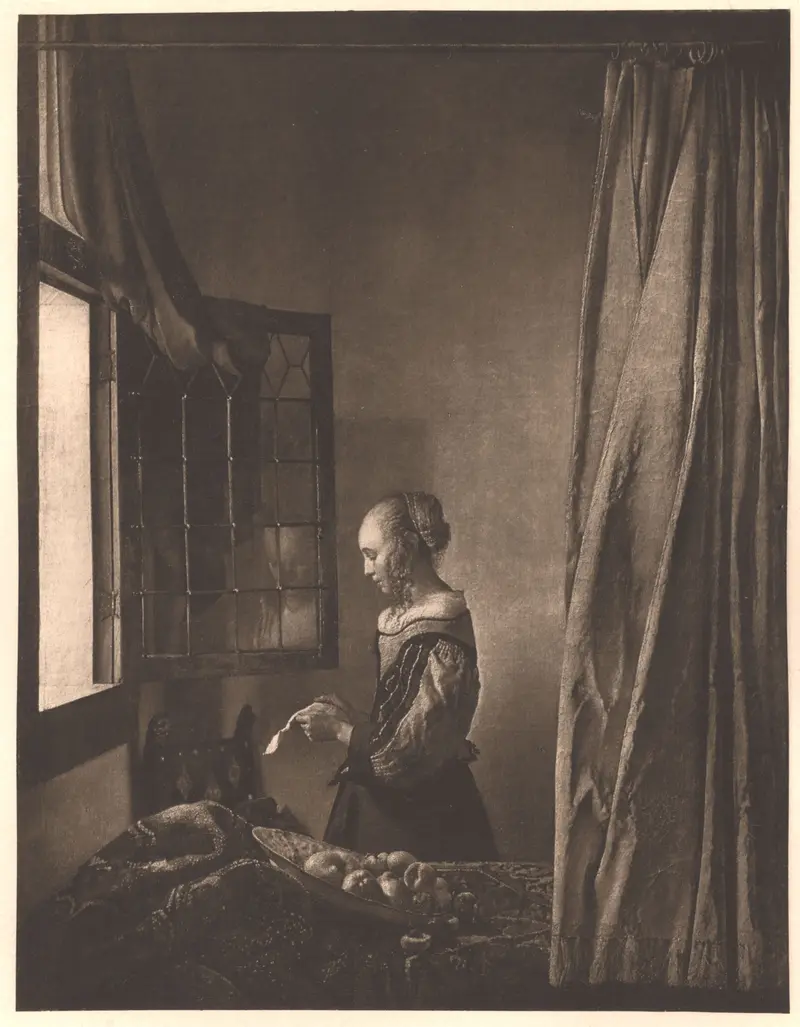
At three in the afternoon — History & Facts
When At three in the afternoon first appeared in print, viewers immediately recognized the hand of Charles Dana Gibson, the celebrated American illustrator whose “Gibson Girl” defined an era. Gibson’s drawings, published in widely read magazines at the turn of the twentieth century, were not only admired for their technical finesse but also for their sharp social observation. This particular work is notable for its ambiguity: no date, no clear setting, and no known commission, yet it captures a moment so specific that it invites speculation about its story and meaning.
The lack of documentation has only fueled curiosity, making it one of Gibson’s more enigmatic images. The scene unfolds at the precise hour named in its title, with a group—often interpreted as a family or close acquaintances—gathered in a parlor, their expressions caught between anticipation and fatigue. Afternoon light slants through a window, illuminating the languor of the hour: a woman reclines with a book closed in her lap, a gentleman checks his watch, and a child gazes out, perhaps waiting for an arrival or event. Gibson’s line work is crisp yet sensitive, capturing both the details of dress and the subtleties of posture.
The composition’s quiet tension recalls John Singer Sargent’s interiors, though Gibson’s approach is more psychological, using gesture and gaze to suggest what remains unsaid. The clock on the mantel, set precisely at three, becomes a silent protagonist, marking time in a scene where little seems to happen, yet everything is felt. As with many of Gibson’s works, At three in the afternoon was likely created for publication rather than for a private patron or gallery. Its original medium—possibly pen and ink on paper—remains uncertain, as does its current physical whereabouts; many of Gibson’s drawings were dispersed through magazine archives, private collections, or lost altogether.
The work belongs to the late nineteenth or early twentieth century, a period when Gibson’s career was at its height and his images shaped public taste. Today, reproductions circulate widely, but the fate of the original drawing is unknown, adding to its air of mystery and underscoring the ephemeral nature of illustration in Gibson’s era.
More Artworks by Charles Dana Gibson

Temptation
Charles Dana Gibson

To see the art editor
Charles Dana Gibson

In the Lord Chief Justice’s Court
Charles Dana Gibson

A Sidewalk Artist
Charles Dana Gibson

A special exhibit
Charles Dana Gibson

At Dinner
Charles Dana Gibson

At the royal academy
Charles Dana Gibson

At the Savoy
Charles Dana Gibson

Some of the caretaker’s relations
Charles Dana Gibson

Theodore Roosevelt
Charles Dana Gibson