
Bohdan Khmelnytsky with Tugay Bey near Lviv. — History & Facts
In 1885, Jan Matejko chose to immortalize a moment that changed the fate of Eastern Europe: the alliance between Bohdan Khmelnytsky, leader of the Cossack uprising, and Tugay Bey, commander of the Crimean Tatars, as their armies encircled Lviv in 1648. This was no ordinary siege—it marked the high tide of the Khmelnytsky Uprising, a revolt that would shake the Polish-Lithuanian Commonwealth to its core and redraw the region’s political map. Matejko’s painting is one of the few grand canvases to focus on this uneasy partnership, which, for a brief moment, united Christian and Muslim forces against a common foe. Matejko captures the tension and ceremony of the alliance at its most dramatic: Khmelnytsky, in his fur-trimmed coat and with his mace of office, extends a gesture of command or negotiation, while Tugay Bey, resplendent in Ottoman garb, listens intently, his hand resting on his scimitar.
The city of Lviv, distant yet watchful, looms on the horizon, its fate hanging in the balance. The banners and armor gleam with the promise of victory but also hint at the fragility of their pact. The artist’s crowded composition, filled with restless horses and wary soldiers, invites comparison with Matejko’s own Battle of Grunwald, where alliances and betrayals are likewise written on every face. The physical history of Bohdan Khmelnytsky with Tugay Bey near Lviv is less storied than its subject.
Created at the height of Matejko’s career, when he was already celebrated for his vast historical canvases, the painting reflects his lifelong fascination with the tumultuous history of Poland and its neighbors. Though the medium is not always specified in records, it is consistent with his large-scale oil works. Today, the painting is housed in the Lviv National Art Gallery, a fitting home given its subject and the city’s place in the drama it depicts.
Its presence there continues to spark debate and reflection on the shifting borders and alliances that have shaped the region.
More Artworks by Jan Matejko
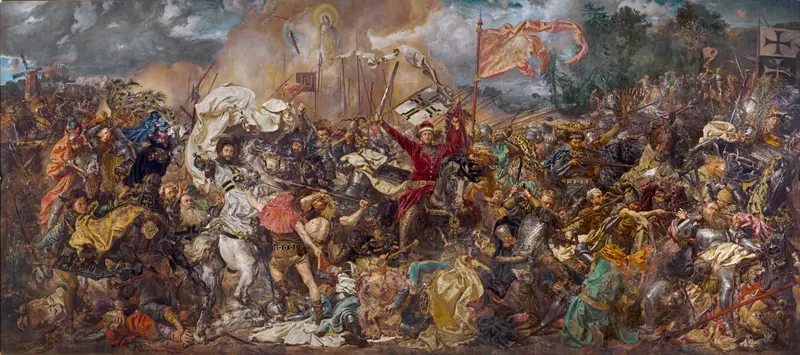
Battle of Grunwald
Jan Matejko

Stańczyk
Jan Matejko

Battle of Raclawice
Jan Matejko
Coronation of the First King, 1001 AD, from the series “History of Civilization in Poland”
Jan Matejko
Portrait of Henryk Krajewski
Jan Matejko
Portrait of Karol Podlewski
Jan Matejko
Portrait of Potocki and Poninski
Jan Matejko
Portrait of the artist's four children
Jan Matejko
Introduction of Christianity in Poland
Jan Matejko
Prussian Homage
Jan Matejko





