Goldie's Bird-of-Paradise — History & Facts
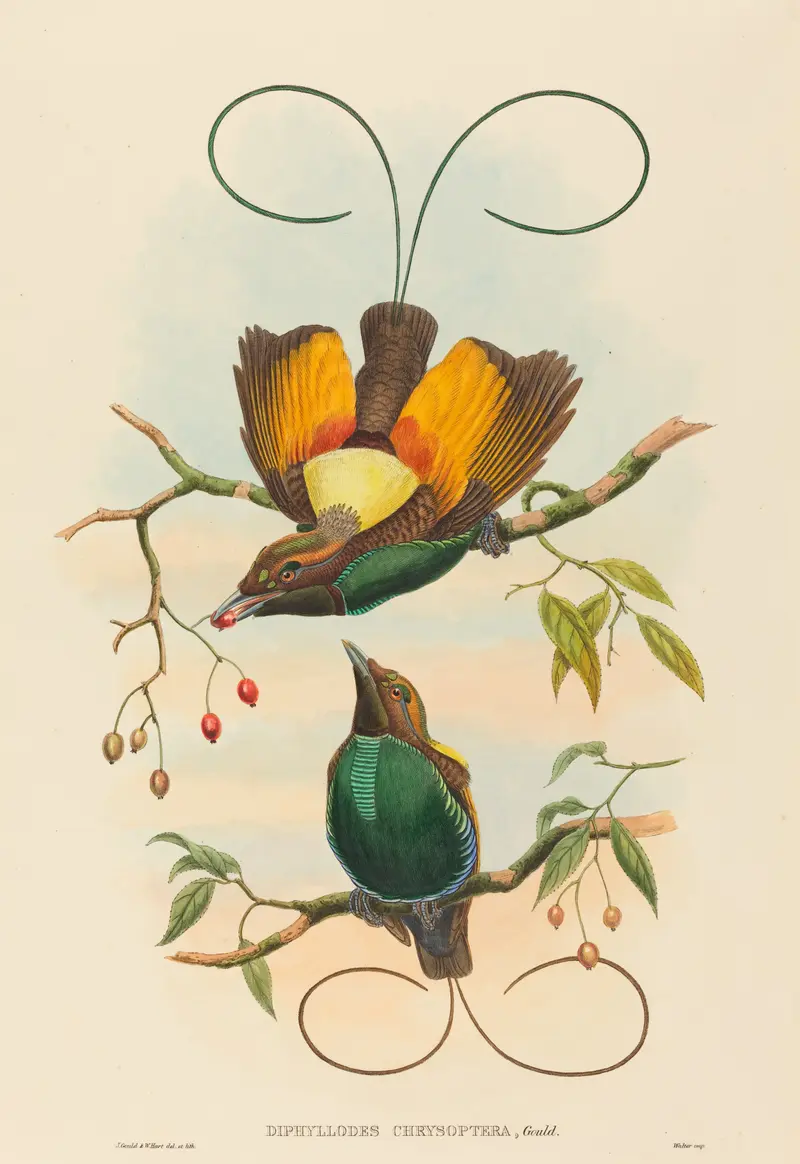
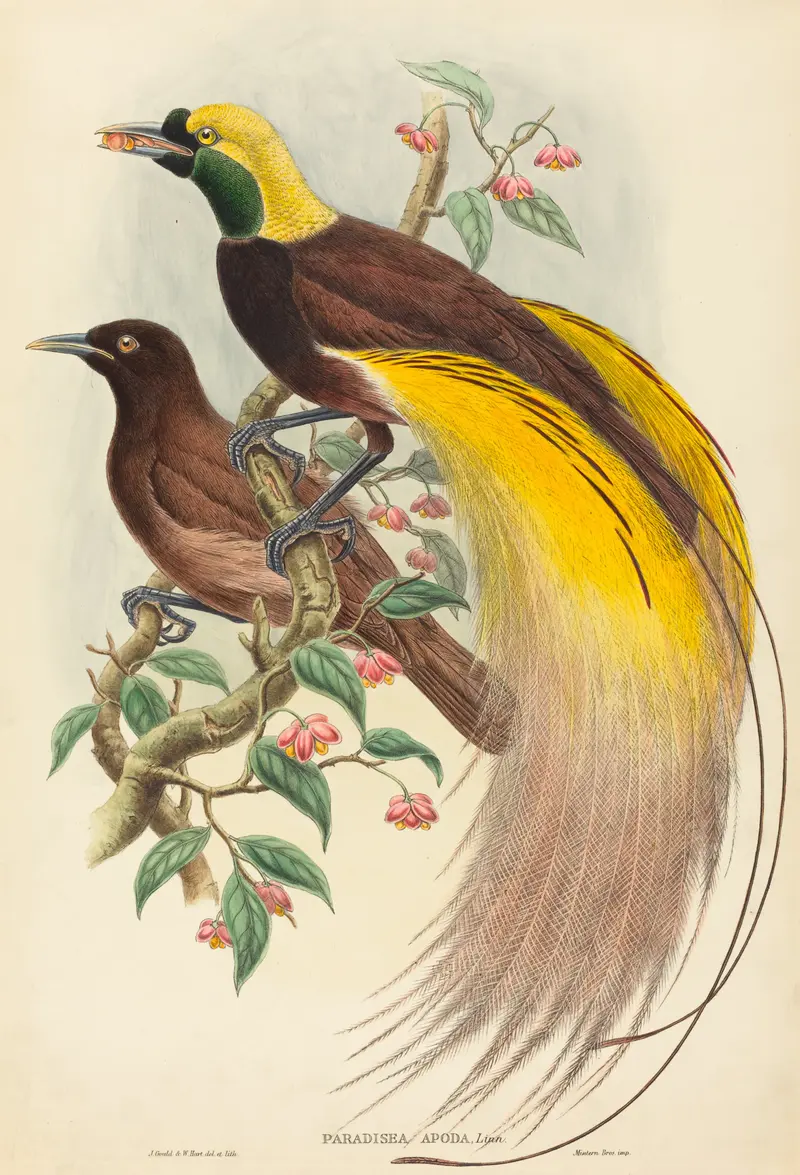
What first grips the viewer in Goldie's Bird-of-Paradise is the extraordinary sweep of the male’s tail: a crimson cascade that seems to overflow the page, daring the eye to follow every filament. The painter’s hand lingers on the contrast between the two birds, perched in perfect stillness, yet alive with color and texture. The male’s emerald throat and golden crown are rendered with such clarity that the feathers almost shimmer, while the female’s subtler hues and dappled breast draw the gaze to quieter marvels.
Every claw, every leaf, is chosen for effect—the forked branch echoing the split in the male’s tail, the leaves framing but never distracting from the birds themselves. The composition is both a portrait and a performance, inviting us to marvel at nature’s extravagance. This image comes from a world in which the wonders of New Guinea and its islands were being catalogued for European eyes, often for the very first time. Between 1875 and 1888, works like this plate from The birds of New Guinea and the adjacent Papuan islands served both as scientific documentation and as objects of desire for collectors and naturalists.
The artist, John Gould, was famed for his lavish ornithological volumes, which bridged the gap between art and science at a time when the boundaries of both were rapidly expanding. History has kept few traces of the individual journeys of such illustrations, but their purpose is clear: to astonish, to instruct, and to bring the farthest reaches of the natural world into the drawing rooms of Europe. Even now, the birds’ gaze seems to ask what else lies just beyond the leaves.