
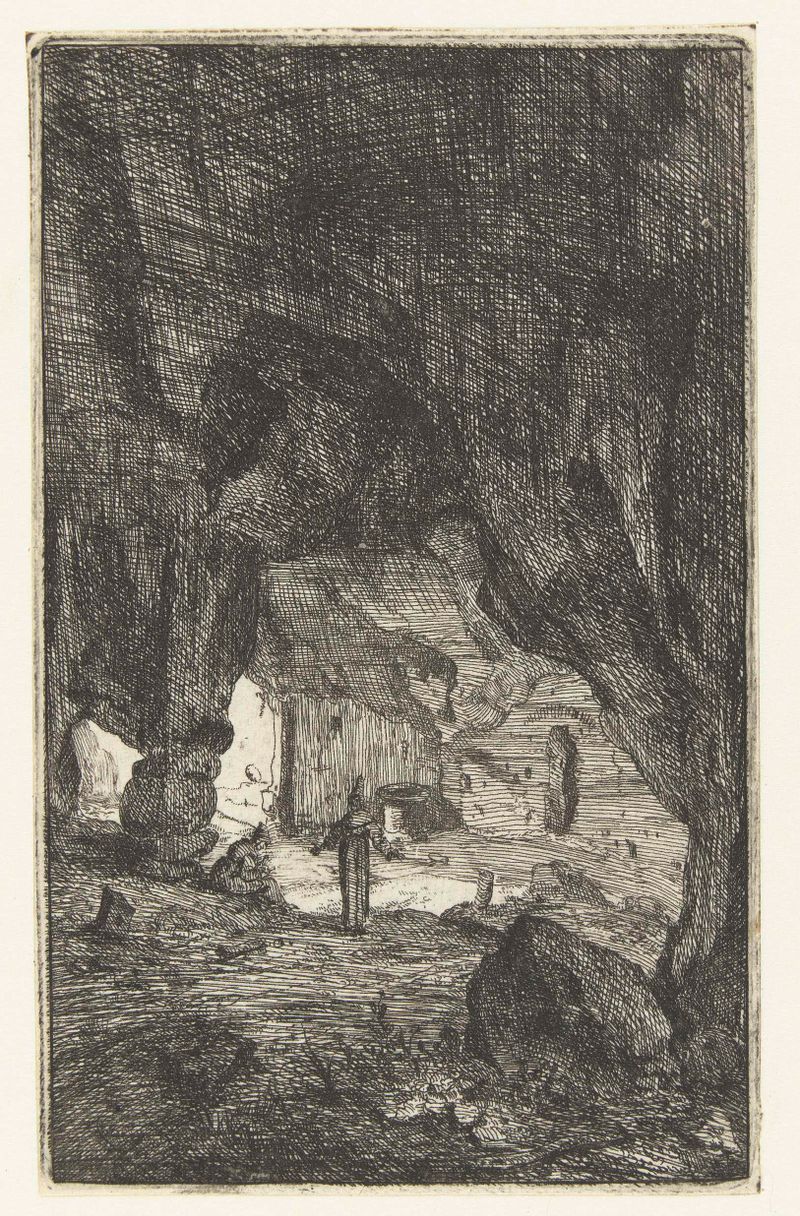
Herberg nabij de Prima Porta — History & Facts
In the delicate interplay of brush and canvas, innocence finds its eternal echo, capturing fleeting moments that slip through the fingers of time. Focus first on the tranquil foreground, where a rustic inn stands as a testament to simplicity and everyday life. The warm hues of ochre and earthy greens envelop the scene, inviting the viewer to linger. Notice how the dappled sunlight filters through the trees, casting gentle shadows that dance across the cobblestone path, leading the eye into the composition.
The figures, depicted with tender realism, engage in their daily routines, each gesture and stance imbued with unpretentious grace, embodying the pure essence of existence. Delve deeper into the artwork and you will uncover a poignant contrast between the idyllic setting and the underlying fragility of innocence. The inn, a refuge, stands resilient against the passage of time; yet, the subtle expressions of the figures remind us of life’s impermanence. Observe the young child playing at the forefront, a symbol of purity in a transient world, while the distant figures, engaged in conversation, hint at unspoken stories and the bittersweet nature of human connection.
This balance of innocence and the inevitability of change resonates through every stroke. During the years 1639 to 1640, the artist created this piece while residing in Italy, a period marked by his exploration of landscapes infused with a sense of nostalgia. Emerging from the Dutch Golden Age, Breenbergh navigated the rich artistic currents of his time, drawing inspiration from the Baroque style. The serene qualities of this work reflect not only the beauty of the Italian countryside but also his desire to encapsulate moments of innocence amidst the evolving world of art and society.
More Artworks by Bartholomeus Breenbergh
Browse all →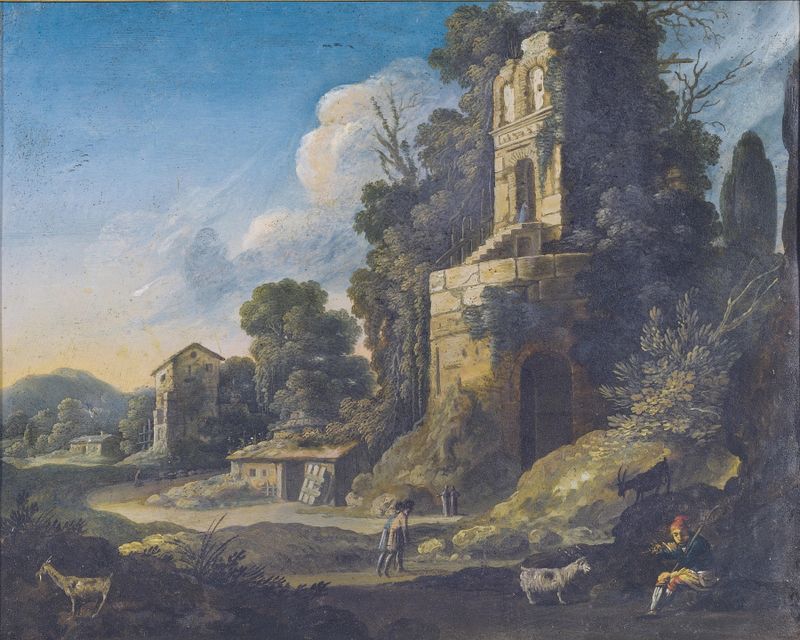
Italianate landscape with buildings and a herdsman playing pipes
Bartholomeus Breenbergh

Arcadian Landscape
Bartholomeus Breenbergh

Ruïnes van keizerlijk paleis te Rome
Bartholomeus Breenbergh

Ruïne van het Colosseum
Bartholomeus Breenbergh
Ruïnes van de stadsmuren van Rome
Bartholomeus Breenbergh
Ruïnes van een paleis te Tivoli
Bartholomeus Breenbergh

Figures Among Ruins By The Tiber
Bartholomeus Breenbergh

Italian Landscape with the Aurelian Wall
Bartholomeus Breenbergh
Ruïnes van de thermen van Caracalla
Bartholomeus Breenbergh
Interieur van een grot
Bartholomeus Breenbergh





