
Landscape with Diogenes — History & Facts
When Nicolas Poussin completed Landscape with Diogenes in 1648, he offered a radical twist on the classical landscape: a philosopher who discards the last of his possessions in favor of nature itself. The painting was created for Jean Pointel, a wealthy Parisian banker and one of Poussin’s most important patrons, who commissioned several works that blended philosophical themes with the grandeur of the Roman countryside. This painting stands out in Poussin’s oeuvre for its unusual focus on a philosopher’s gesture as the organizing principle of an entire landscape, rather than a dramatic myth or biblical scene. The moment captured is drawn from the life of Diogenes the Cynic, the Greek philosopher famed for his austerity.
According to legend, Diogenes, upon seeing a boy drink from his hands, threw away his only possession—a cup—declaring that even this was unnecessary. Poussin sets Diogenes reclining in the foreground, arm outstretched as he tosses his cup aside, while the boy drinks from the stream nearby. The landscape is vast and orderly, dotted with classical ruins and sunlit trees, suggesting a world in harmony with the philosopher’s radical simplicity.
The contrast between Diogenes’ gesture and the bustling city in the distance invites viewers to reflect on the value of worldly goods—a theme also explored by Salvator Rosa in his own, darker treatments of philosophical solitude. Landscape with Diogenes was painted during Poussin’s second Roman period, when he was at the height of his powers and deeply engaged with the intellectual circles of Rome and Paris. The painting remained in private hands for centuries, passing through several notable French collections before entering the Museo del Prado, where it hangs today. Its measured composition and philosophical subject mark it as a turning point in Poussin’s approach to landscape, influencing generations of artists who sought to balance narrative with the grandeur of nature.
The medium is believed to be oil on canvas, though early records are silent on this detail.
More Artworks by Nicolas Poussin

Spring
Nicolas Poussin
The Sacrament of the Holy Eucharist
Nicolas Poussin
The Israelites gathering Manna in the Desert
Nicolas Poussin
The Judgment of Solomon
Nicolas Poussin
Apollo and Daphne
Nicolas Poussin

The Nurture of Jupiter
Nicolas Poussin

Ordination
Nicolas Poussin
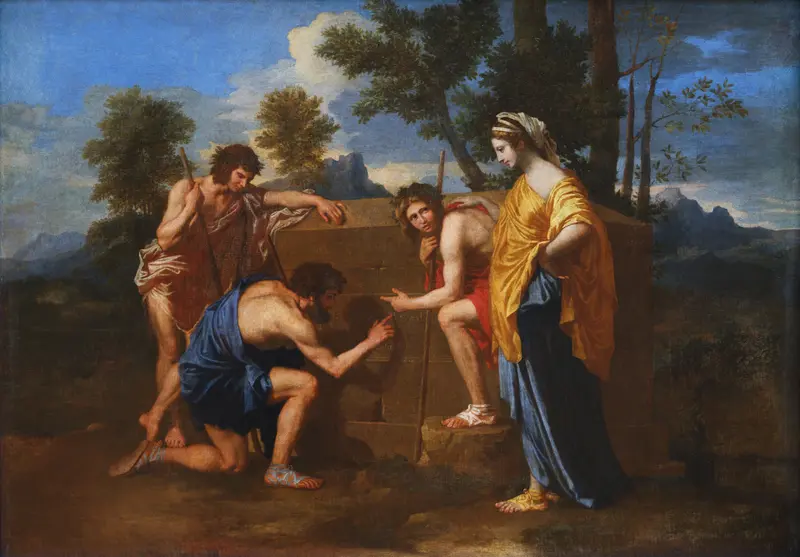
Et in Arcadia ego
Nicolas Poussin
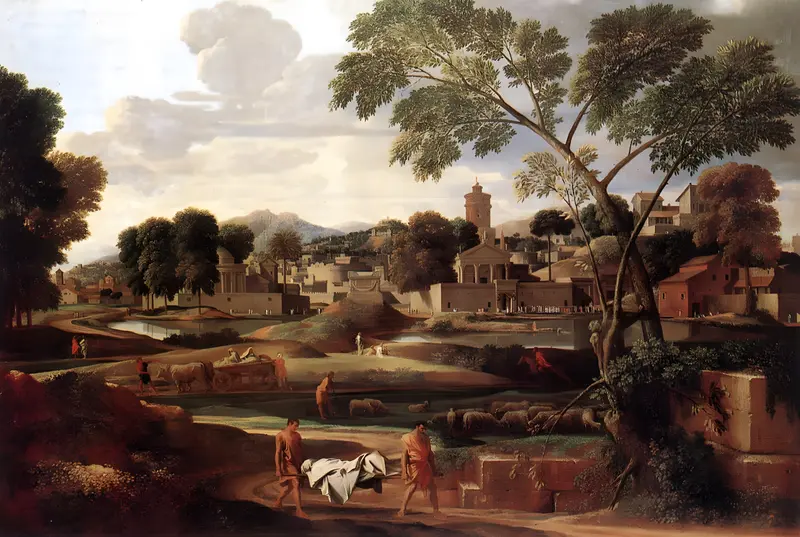
The Funeral of Phocion
Nicolas Poussin
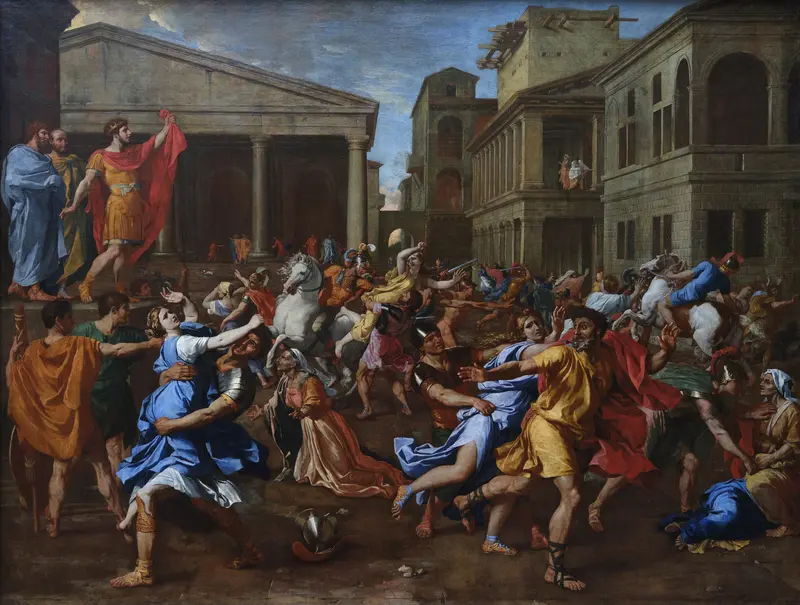
The Rape of the Sabine Women
Nicolas Poussin
More Landscape Art

The Starry Night
Vincent van Gogh

View of Delft
Johannes Vermeer

Water Lilies
Claude Monet

The Grand Canal, Venice, looking north-west from the Ca' Corner to the Ca' Contarini degli Scrigni, with the campanile of Santa Maria della Carità
Canaletto

Windsor Castle
Canaletto

The Grand Canal looking North-East from the Palazzo Dolfin-Manin to the Rialto Bridge
Canaletto