
Madonna and Child with Angels Carrying Candlesticks — History & Facts
No one knows for certain for whom Madonna and Child with Angels Carrying Candlesticks was painted, but the work’s unusual format—an arched tondo, or roundel, with a tenderly intimate scene—suggests a private commission, likely for devotion in a Florentine home. Scholars have long noted that Botticelli returned to this composition several times in the 1480s, each version subtly different, sparking debate about which came first and for whom. The painting’s earliest recorded mention is in a Medici inventory, but whether this is the same panel remains uncertain.
Its popularity is evident: at least three versions by Botticelli and his workshop survive, each with angels bearing candlesticks, a motif rarely seen before in Florentine Madonnas. At the heart of the painting, the Madonna cradles the Christ Child, her gaze lowered in gentle contemplation as two angels flank her, each holding a golden candlestick aloft. This precise moment—quiet, suspended between the sacred and the everyday—invites the viewer into a scene of both maternal affection and ritual solemnity. The candlesticks, burning with steady flames, signal the presence of the divine and echo the candles used in church processions, linking the domestic sphere to the liturgy.
The angels’ youthful faces and delicate gestures recall the influence of Filippo Lippi, Botticelli’s teacher, yet the clarity of line and the subtle play of light on the Madonna’s veil are distinctly Botticelli’s own. Compared to Leonardo da Vinci’s more enigmatic Madonnas, Botticelli’s figures are open, their emotions rendered with a lyrical directness. The exact journey of this panel through the centuries is not fully known, but its style and iconography place it firmly in the late 1480s, at the height of Botticelli’s fame in Florence. Whether it ever left Italy before the modern era is unclear, but works of this type were often passed down through patrician families or entered church collections.
Over time, attribution to Botticelli himself was questioned, as workshop assistants frequently repeated his compositions, yet the finesse of the brushwork here argues for the master’s own hand. Today, the painting is recognized as a prime example of Botticelli’s devotional art, cherished for its intimacy and the quiet dignity of its figures. It stands as a testament to the enduring appeal of the Madonna and Child in Renaissance Florence.
More Artworks by Sandro Botticelli

Virgin and Child
Sandro Botticelli

Madonna and Child and the Young St John the Baptist
Sandro Botticelli

Madonna and Child with six angels and Saint John the Baptist as Child
Sandro Botticelli

Adoration of the Magi
Sandro Botticelli

Virgin and Child with the Young Saint John the Baptist
Sandro Botticelli
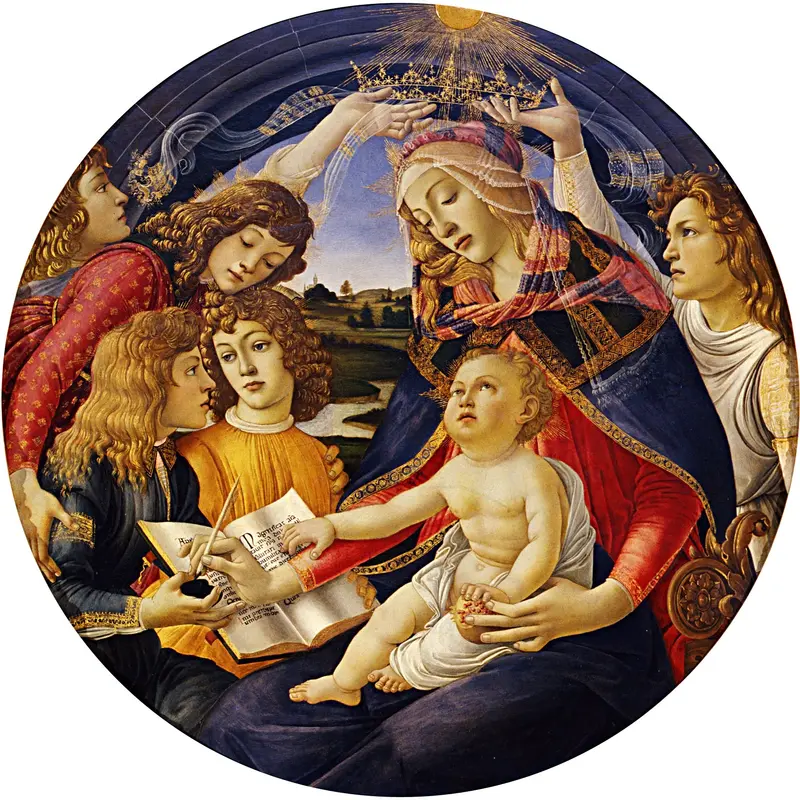
Madonna of the Magnificat
Sandro Botticelli
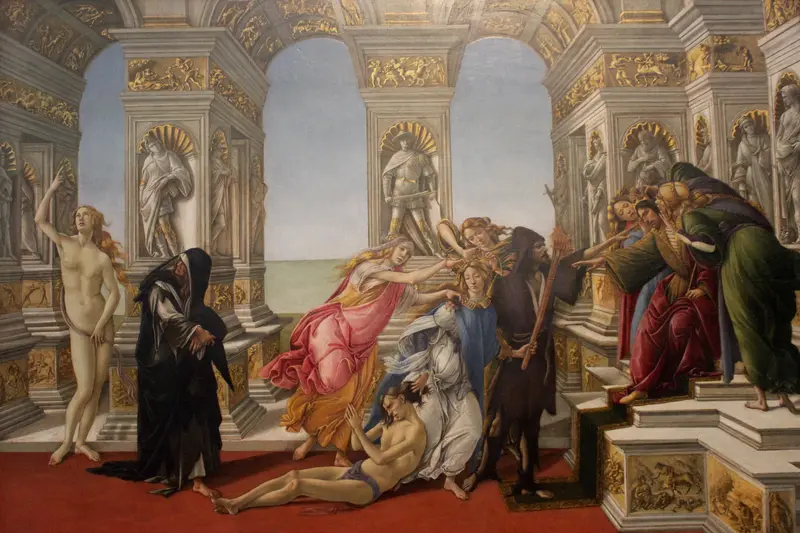
Calumny of Apelles
Sandro Botticelli

Portrait of a young man holding a roundel
Sandro Botticelli

The Trinity with Saint Mary Magdalene and Saint John the Baptist, the Archangel Raphael and Tobias
Sandro Botticelli

Idealized Portrait of a Lady (Portrait of Simonetta Vespucci as Nymph)
Sandro Botticelli





