
The Artist's Daughter, Julie, with her Nanny — History & Facts
What draws the eye first is the hush of intimacy between child and caretaker, a moment caught in the gentle blur of afternoon light. The artist’s daughter, Julie, gazes downward, her features soft and thoughtful, while the nanny leans in, absorbed in her quiet task. The brushwork is swift, almost restless, yet the composition holds a steady calm: the blue of the nanny’s dress anchors the scene, while Julie’s dress, with its lively green and pink, hints at childhood’s energy held just in check.
The window behind them is a lattice of color and quick strokes, suggesting a world outside that is distant and secondary to this private exchange. Every highlight on hair and fabric seems to shimmer with the movement of life, as if the air itself is alive with color and care. Painted around 1884, this work belongs to a world where the Impressionists—Berthe Morisot among them—were reinventing how daily life could be seen and remembered. Domestic scenes like this, especially those featuring women and children, were often commissioned or painted for private enjoyment, reflecting both the artist’s personal world and the shifting roles of women in late nineteenth-century France.
Morisot was one of the few women in the Impressionist circle, and her focus on the lives of women and children was both a reflection of her own experience and a gentle act of defiance in an art world dominated by men. Now in the collection of the Minneapolis Institute of Art, the painting invites viewers to linger in its quiet, sunlit space, and to notice how much feeling can be carried by a single, fleeting glance.
More Artworks by Berthe Morisot

The Harbor at Lorient
Berthe Morisot
Landscape
Berthe Morisot

Hanging the Laundry out to Dry
Berthe Morisot

Woman in a Garden
Berthe Morisot

Young Girl with Hat
Berthe Morisot
Harbor Scene, Isle of Wight
Berthe Morisot
The Port of Nice
Berthe Morisot
The Harbor at Cherbourg
Berthe Morisot

The Mother and Sister of the Artist
Berthe Morisot
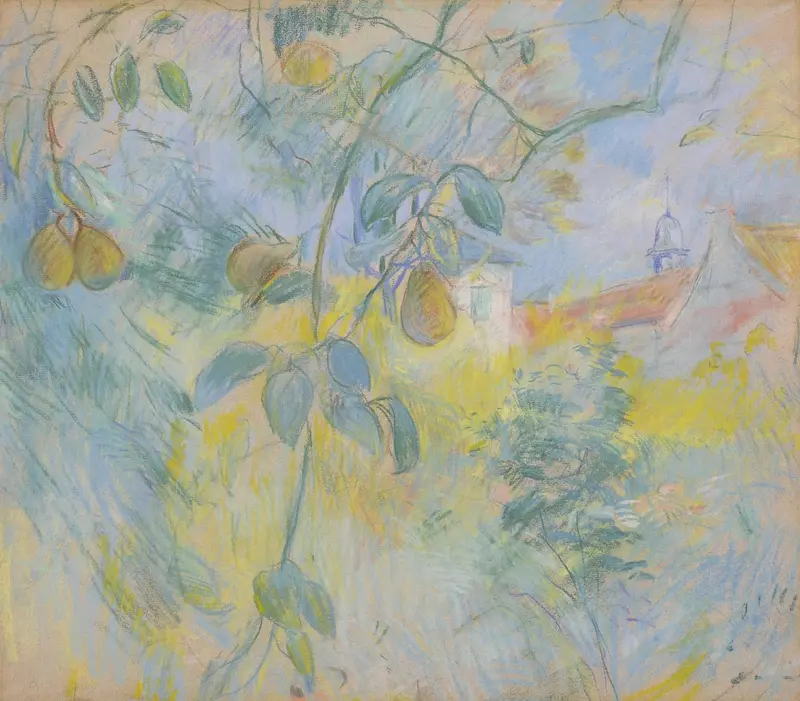
Les Poires
Berthe Morisot
More Genre Scene Art

Banquet of the Officers of the St George Civic Guard
Frans Hals

Rembrandt and Saskia in the Scene of the Prodigal Son
Rembrandt van Rijn

Bal du moulin de la Galette
Pierre-Auguste Renoir

Quadrille at the Moulin Rouge
Henri de Toulouse-Lautrec

A Burial at Ornans
Gustave Courbet

When Will You Marry?
Paul Gauguin