
Toilet of Venus — History & Facts
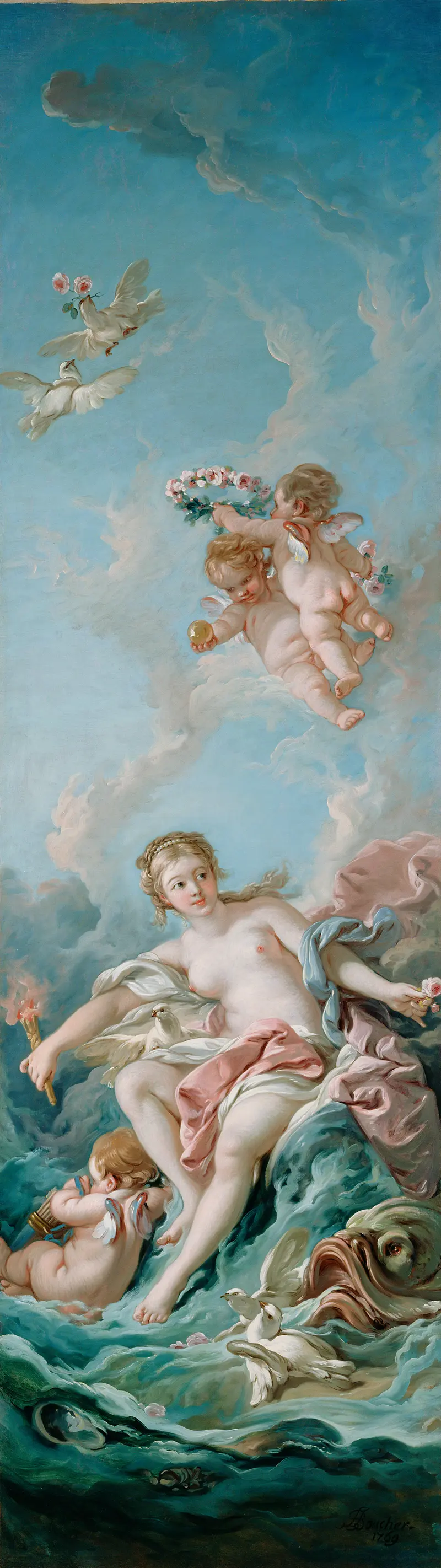
A nude woman sits at the center, her body turned slightly to the right as she gazes outward, her left arm resting on a blue drapery and her right hand holding a string of pearls. Surrounding her are several putti, their wings and rosy bodies scattered across the foreground and left side, one holding a mirror that reflects her face. Another putto at the upper left hovers in the air, holding a single white dove.
Two more putti kneel at the lower left, one reaching toward a pair of doves on the ground, while petals and ribbons are strewn about them. A large golden vessel with elaborate handles sits at the lower right, next to a silver tray and a scattering of jewelry, including a string of pearls and a bracelet. A dramatic sweep of rose-colored drapery billows upward behind the figures, forming a backdrop against a sky filled with soft clouds and blue light.
The painting is arranged in an oval format, with the figures tightly grouped in the foreground and the background receding into a luminous sky. The light falls from the left, highlighting the woman's pale skin and the shimmering folds of blue and white fabric around her. Brushwork is smooth and delicate, with fine modeling of flesh tones and crisp, intricate details in the jewelry and fabrics.
Touches of gold, red, and blue enliven the composition, while the overall palette remains soft and pastel. The figures' gestures are gentle and playful, with the putti interacting with the objects and each other, and the attendants focused on their tasks. The scene represents Venus at her toilette, surrounded by attendants and symbols of beauty and love, including doves and jewelry. Toilet of Venus is a mythological painting by François Boucher, created in France in the 18th century.
Sources: Wikidata Q21722927 · Image source (Wikimedia Commons)
More Artworks by François Boucher

The Toilette of Venus
François Boucher

Diana leaving her Bath
François Boucher

Spring
François Boucher

The Rape of Europa or Abduction of Europa
François Boucher

Portrait of Madame de Pompadour
François Boucher

Vénus désarme l'Amour (Louvre, RF 289)
François Boucher

Madame de Pompadour
François Boucher

The Three Graces
François Boucher

Triomphe de Vénus
François Boucher
Venus on the Waves
François Boucher





