
Vénus désarme l'Amour (Louvre, RF 289) — History & Facts
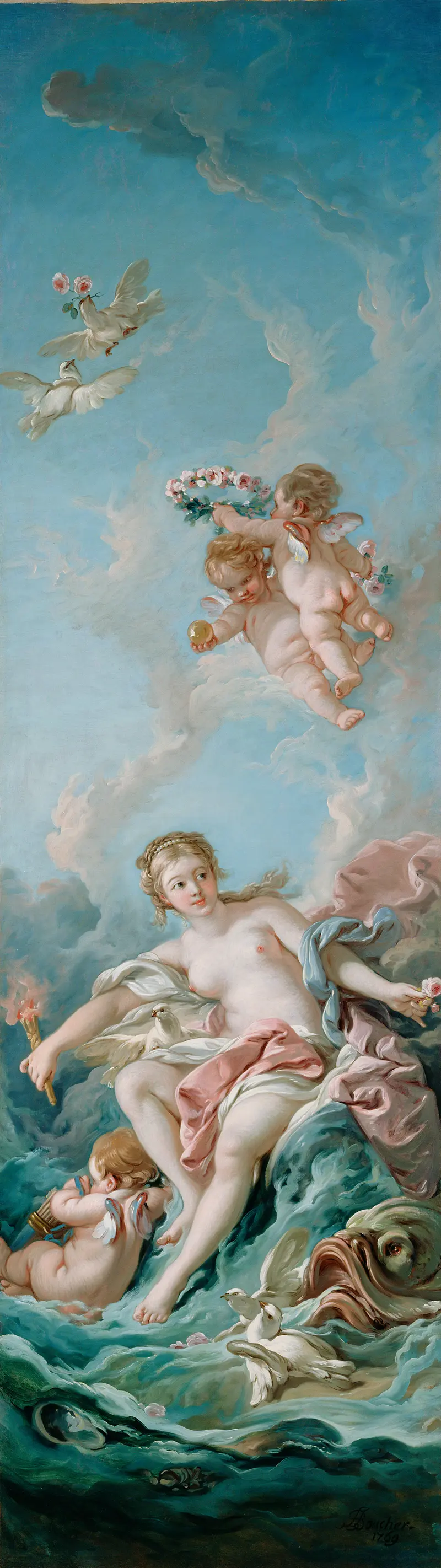
When Vénus désarme l'Amour was first exhibited in 1749, it was immediately seized upon as a dazzling example of François Boucher’s playful yet technically brilliant approach to mythological themes. The painting was commissioned by Madame de Pompadour, the influential mistress of Louis XV, who was both Boucher’s patron and a keen promoter of the Rococo style at court. The work’s subject—a witty twist on the power dynamics of love—was perfectly suited to the refined and flirtatious tastes of Versailles.
Its popularity was such that Boucher himself produced several variants, and engravings after the composition quickly circulated among collectors. Here, Venus, goddess of love, gently disarms her own son, Cupid, at the very moment he is about to unleash another arrow. The scene is caught in a delicate balance: Venus’s hand restrains Cupid’s, her gaze affectionate yet commanding, while Cupid, all rosy limbs and petulant expression, surrenders his quiver. The soft, pearly light bathes their skin, and the billowing drapery and scattered roses underscore the sensuality of the moment.
The painting’s playful eroticism and intimacy are typical of Boucher, but contrast sharply with the more restrained treatment of the same subject by earlier artists like Guido Reni, whose Venus and Cupid is far more chaste and contemplative. The painting has remained in France since its creation, entering the Louvre’s collection in the nineteenth century after passing through several private hands. Its Rococo exuberance and mythological wit have made it a favorite among visitors, and it is often cited as a quintessential example of Boucher’s mature style. While the exact medium is not always specified in early records, it is generally accepted to be oil on canvas, the preferred material for Boucher’s large-scale decorative works.
Today, Vénus désarme l'Amour hangs in the Louvre, a testament to both the taste of Madame de Pompadour and the enduring appeal of Rococo fantasy.
More Artworks by François Boucher

The Toilette of Venus
François Boucher

Diana leaving her Bath
François Boucher

Spring
François Boucher

The Rape of Europa or Abduction of Europa
François Boucher

Portrait of Madame de Pompadour
François Boucher

Madame de Pompadour
François Boucher

The Three Graces
François Boucher

Toilet of Venus
François Boucher

Triomphe de Vénus
François Boucher
Venus on the Waves
François Boucher





