
Triomphe de Vénus — History & Facts
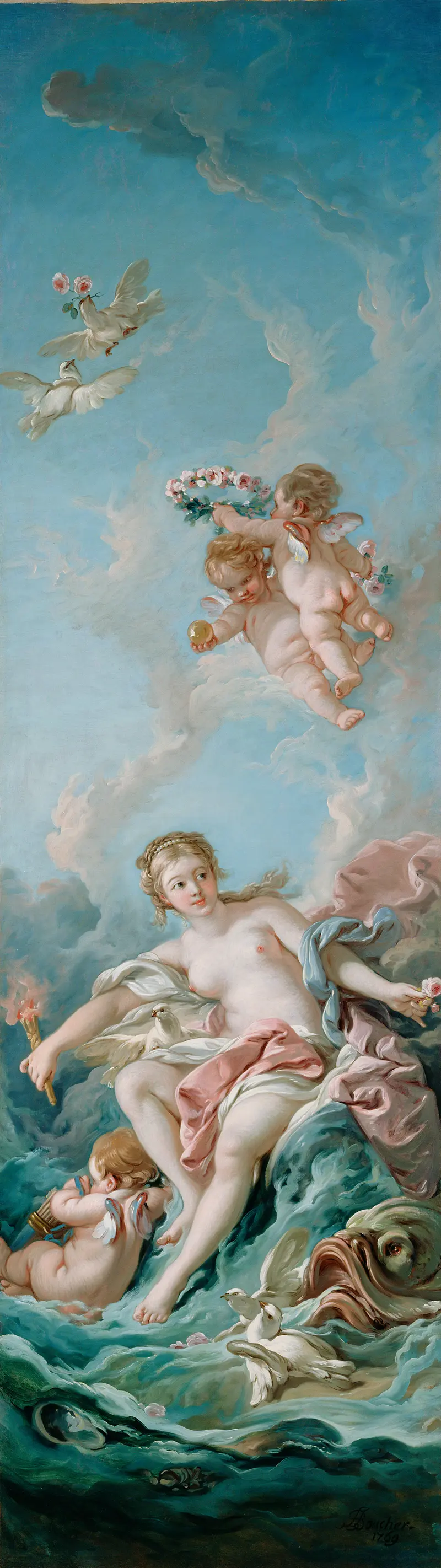
A pale, nude woman reclines at the center right, her body turned in profile and draped in flowing white and pink fabric. Around her, a lively group of figures with muscular bodies and tousled hair emerge from the water, their gestures animated and expressive. Several of these figures have the features of naiads or sea deities, with some riding sea creatures and others reaching toward the central figure.
To the left, two winged cupids hover in the misty sky, their small bodies rendered with soft, swirling brushstrokes. The light in the painting is diffuse and luminous, bathing the scene in pale golds, creams, and delicate pinks that contrast with the darker, turbulent blues and greens of the water below. The composition is enclosed within an elaborate gilded frame, its curves echoing the swirling movement of the figures and waves.
Boucher uses rapid, fluid brushwork to suggest both the foam of the sea and the softness of skin and clouds, giving the whole surface a sense of movement and sensuality. Details such as the flowing hair, the glistening highlights on the bodies, and the delicate folds of the drapery are painted with a loose, confident hand. At the lower edge, hints of red fabric and the twisting forms of sea creatures add to the richness and dynamism of the scene. The subject is mythological, with Venus, the goddess of love, surrounded by cupids and naiads, as indicated by the museum’s description.
François Boucher painted Triomphe de Vénus in 1750, during the eighteenth century. Cupid, Venus, and naiads are all listed as depicted figures in the museum’s record, confirming the mythological narrative.
Sources: Wikidata Q116760691 · Image source (Wikimedia Commons)
More Artworks by François Boucher

The Toilette of Venus
François Boucher

Diana leaving her Bath
François Boucher

Spring
François Boucher

The Rape of Europa or Abduction of Europa
François Boucher

Portrait of Madame de Pompadour
François Boucher

Vénus désarme l'Amour (Louvre, RF 289)
François Boucher

Madame de Pompadour
François Boucher

The Three Graces
François Boucher

Toilet of Venus
François Boucher
Venus on the Waves
François Boucher





