
The Rape of Europa or Abduction of Europa — History & Facts
Europa sits at the center, draped in pale silks, her bare foot resting on the back of a white bull whose head turns gently toward her. To Europa’s left, three young women gather flowers and lean in, their gestures intimate and their faces animated by curiosity and concern. Above, a lively cluster of putti tumble through the sky, scattering blossoms and drawing a billowing drapery that frames the scene with theatrical flair.
The landscape recedes into a dramatic coastline, with dark trees on the left and rocky cliffs fading into mist at the horizon. Light pours from the upper right, illuminating the flesh tones and shimmering fabrics, while deep shadows model the forms and lend depth to the composition. The palette is dominated by cool blues and greens in the sea and sky, offset by the warm pinks, creams, and golds of the figures’ garments and skin.
Brushwork is fluid and lively, especially in the swirling water and the soft clouds, while details such as the flowers and locks of hair are rendered with delicate precision. The composition sweeps in a gentle arc from the lower left, across the figures, and up to the airborne putti, unifying the terrestrial and celestial realms. A small putto clings to Europa’s lap, holding the blue ribbon that encircles the bull’s neck.
Clusters of vivid flowers are scattered on the sandy shore and in the hands of the women and putti, adding bursts of pink, blue, and yellow. The far left corner is densely shadowed by dark green foliage, contrasting with the open, luminous sky on the right. Highlights catch on the wet skin of the sea figures and the bull’s horns, while the paint handling in the water is loose and energetic, with visible brushstrokes suggesting movement. The title The Rape of Europa or Abduction of Europa identifies the mythological subject: Europa’s abduction by Jupiter, who has taken the form of a bull.
The genre is mythological painting, and the scene includes Europa, Jupiter as the bull, and putti, as well as the act of kidnapping.
Sources: Wikidata Q24238843 · Image source (Wikimedia Commons)
More Artworks by François Boucher

The Toilette of Venus
François Boucher

Diana leaving her Bath
François Boucher

Spring
François Boucher

Portrait of Madame de Pompadour
François Boucher

Vénus désarme l'Amour (Louvre, RF 289)
François Boucher

Madame de Pompadour
François Boucher

The Three Graces
François Boucher

Toilet of Venus
François Boucher

Triomphe de Vénus
François Boucher
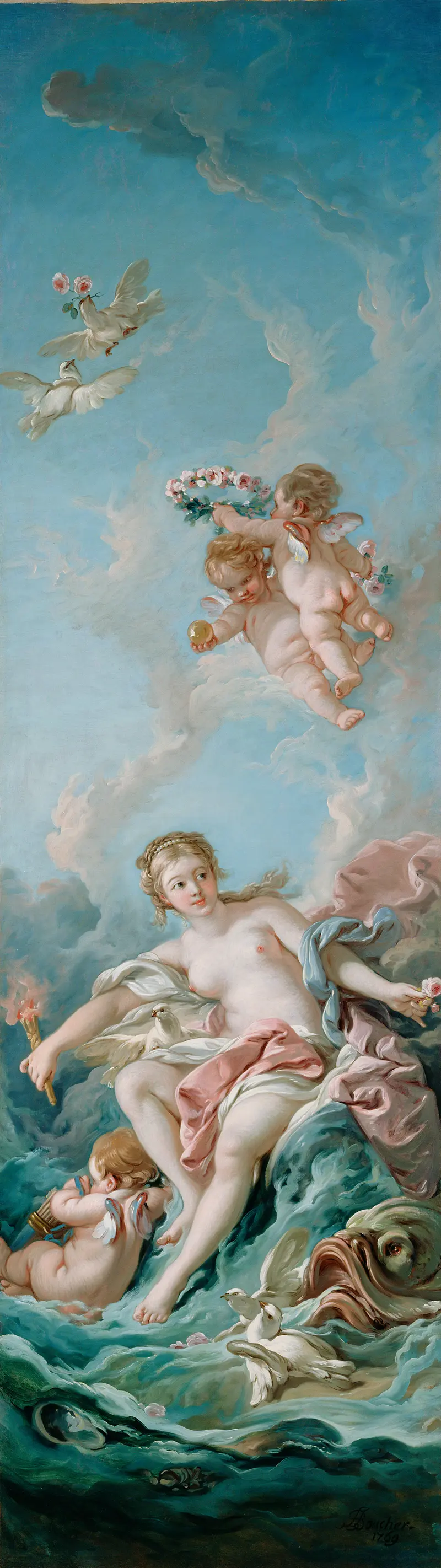
Venus on the Waves
François Boucher





