
The Toilette of Venus — History & Facts
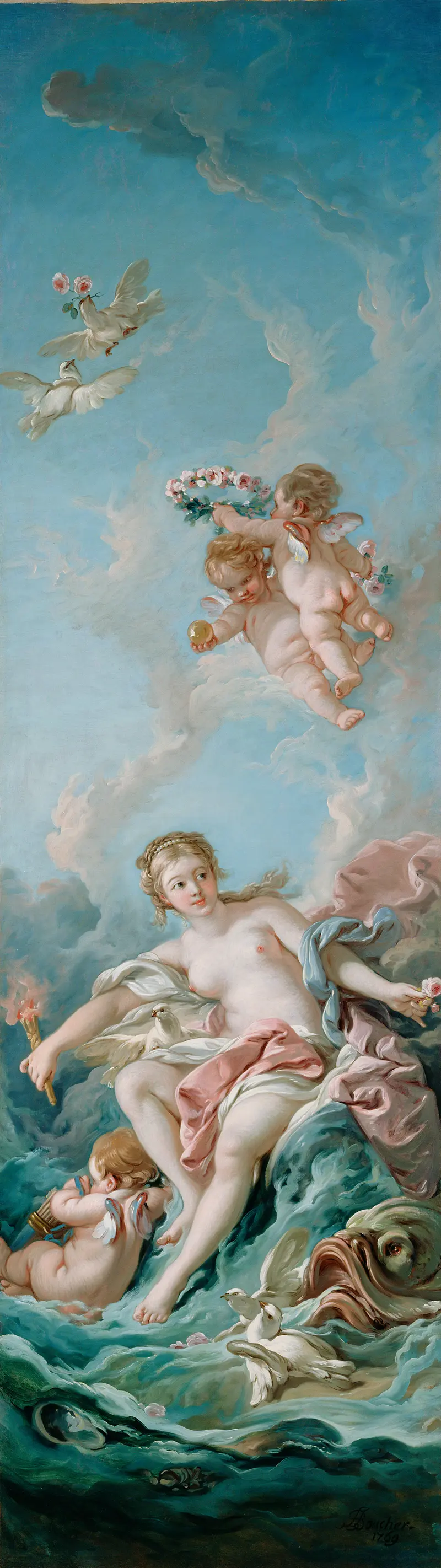
Scattered across the foreground are a gilded pitcher, loose flowers, and a shell-shaped silver tray, all rendered with delicate, fluid brushwork and a pastel palette characteristic of the Rococo style. A putto at the lower left corner leans forward, grasping a string of pearls that spills from a silver tray onto the marble floor. A third putto hovers above Venus’s shoulder, reaching toward her hair with one hand while its wings are softly highlighted by the light.
A large, heavy green curtain is drawn back on both sides of the composition, framing the scene and creating a dramatic backdrop. A pair of white doves is nestled at Venus’s feet, one with its wings outstretched as if about to take flight. The upper left corner is filled with soft blue sky and billowing clouds, providing a sense of openness and depth.
Light falls most strongly on Venus’s torso and thigh, casting gentle shadows that accentuate the curves of her body and the folds of the fabrics. The brushwork is especially loose and fluid in the depiction of the drapery and foliage, with delicate lines defining the edges of the pearls and ribbons. The composition is carefully balanced, with the reclining figure of Venus forming a diagonal axis from lower left to upper right, while the putti and objects animate the scene with lively gestures and sparkling detail. The Toilette of Venus was painted in 1751 by François Boucher, a leading figure of the Rococo movement.
The painting’s subject is the Roman goddess Venus, attended by putti and surrounded by symbols of love and beauty, such as doves, pearls, and flowers. Boucher’s mastery of light, color, and decorative surface is evident in the painting’s luminous flesh tones, the intricate rendering of fabrics, and the playful, intimate atmosphere that pervades the scene.
Sources: Metropolitan Museum of Art, record 20.155.9 · Wikidata Q19911802 · Wikipedia: The Toilet of Venus (Boucher) · Image source (Wikimedia Commons)
More Artworks by François Boucher

Diana leaving her Bath
François Boucher

Spring
François Boucher

The Rape of Europa or Abduction of Europa
François Boucher

Portrait of Madame de Pompadour
François Boucher

Vénus désarme l'Amour (Louvre, RF 289)
François Boucher

Madame de Pompadour
François Boucher

The Three Graces
François Boucher

Toilet of Venus
François Boucher

Triomphe de Vénus
François Boucher
Venus on the Waves
François Boucher





