
Blind Man's Buff — History & Facts
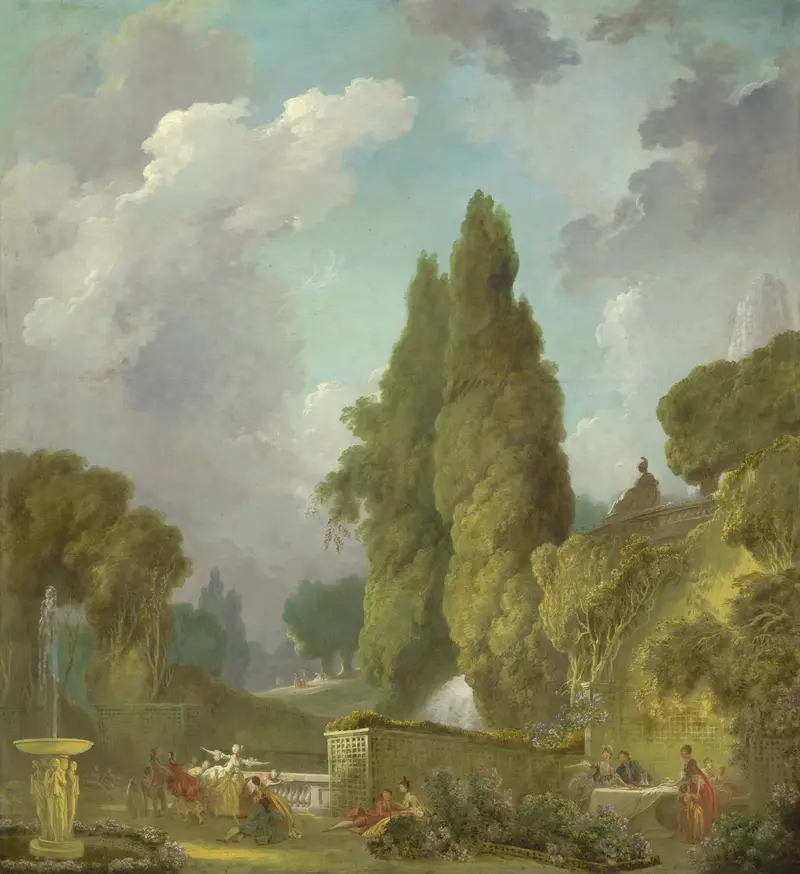
Few paintings better capture the spirit of Jean-Honoré Fragonard’s world than Blind Man's Buff, which was created in 1777 at the height of the Rococo era’s fascination with playful aristocratic leisure. This work is one of several versions Fragonard painted on the theme, a favorite among the French elite for its blend of flirtation and innocence. The game itself, a popular pastime in 18th-century salons and gardens, was seen as a metaphor for the games of love and courtship that preoccupied the period’s privileged classes.
In Blind Man's Buff, Fragonard’s brush captures not only a moment of amusement but also the social codes and subtleties of his time. The scene unfolds in a sun-dappled garden, where elegantly dressed young people swirl around a blindfolded companion, hands outstretched in laughter and anticipation. Fragonard chooses the instant when the "blind man" is just about to catch one of the others, her skirts swirling as she twists away. The light flickers through the leaves, illuminating faces and fabrics, while the lush foliage and marble statues evoke both nature and artifice.
Every detail—the fluttering ribbons, the secretive smiles, the gentle touch on a shoulder—suggests a choreography of desire and concealment. Unlike Watteau’s more wistful fêtes galantes, Fragonard’s approach is brisk and exuberant, with a sense of movement that feels almost improvised. The precise journey of this particular Blind Man's Buff remains somewhat mysterious, as Fragonard painted several canvases on the subject, often for private patrons whose names are now lost. Such works were typically commissioned as part of decorative cycles for aristocratic homes, and their intimate scale and subject matter reflect the tastes of a society on the eve of revolution.
Today, the painting stands as a testament to Fragonard’s virtuosity and his ability to capture fleeting pleasures in paint. Its place in the artist’s career marks the culmination of his Rococo style, just before the winds of change brought about by the French Revolution would sweep away the world it so delightfully depicts.
More Artworks by Jean-Honoré Fragonard
The Swing
Jean-Honoré Fragonard

The Swing
Jean-Honoré Fragonard
A Young Girl Reading
Jean-Honoré Fragonard
The Lock
Jean-Honoré Fragonard

The Triumph of Venus
Jean-Honoré Fragonard
A Game of Hot Cockles
Jean-Honoré Fragonard
Blindman’s Buff
Jean-Honoré Fragonard
The Beloved Child
Jean-Honoré Fragonard
Portrait of a Man in Costume
Jean-Honoré Fragonard
The First Steps
Jean-Honoré Fragonard
More Genre Scene Art

Banquet of the Officers of the St George Civic Guard
Frans Hals

Rembrandt and Saskia in the Scene of the Prodigal Son
Rembrandt van Rijn

Bal du moulin de la Galette
Pierre-Auguste Renoir

Quadrille at the Moulin Rouge
Henri de Toulouse-Lautrec

A Burial at Ornans
Gustave Courbet

When Will You Marry?
Paul Gauguin