
Le depart des guerriers — History & Facts
In the heart of chaos lies the seed of fear, where fragile courage ignites amidst the uncertainty of battle. Focus first on the deep, turbulent hues that swirl across the canvas, drawing your gaze to the right where warriors, cloaked in rich earth tones, seem to emerge from the shadows. The tension in their postures is palpable; the slight arch of their shoulders and clenched fists suggest the weight of impending conflict. Notice how the light struggles to break through the darkness, illuminating their determined faces only partially, thus capturing the emotional depth of anticipation and dread.
Fromentin's technique weaves each figure into a narrative, creating movement that speaks to both the physical and psychological realm of the warriors. Within the artwork, the interplay of color reveals a deeper contrast—between the boldness of the warriors and the muted tones of their surroundings. Each brushstroke seems to echo their unspoken fears, reminding us that bravery often coexists with vulnerability. The dramatic tension between light and shadow mirrors the internal conflicts, suggesting that the act of departure is not merely a march toward glory but a complex journey filled with trepidation.
Additionally, the fragmented landscape hints at a world that is as chaotic as the warriors' emotions, evoking a sense of impending strife. In 1852, Eugène Fromentin was painting during a time of great artistic transformation, immersed in the influences of Romanticism and early Realism. Living in France, he was inspired by the tumultuous social and political changes of the era, reflecting a growing interest in the human condition and the complexities of war. This piece encapsulates not only the sentiments of its time but also the artist's own struggle between idealism and the harsh truths of reality.
More Artworks by Eugène Fromentin
Browse all →
Arabs Crossing a Ford
Eugène Fromentin

Campement arabe dans les montagnes de l’Atlas
Eugène Fromentin

Falcon Hunt (‘Algeria Remembered’)
Eugène Fromentin

Women of the Ouled Nayls
Eugène Fromentin
An Arabian Camp
Eugène Fromentin

On the Nile
Eugène Fromentin
Horsemen at the Foot of the Chiffa Cliffs
Eugène Fromentin
Felucca Au Bord Du Nil
Eugène Fromentin
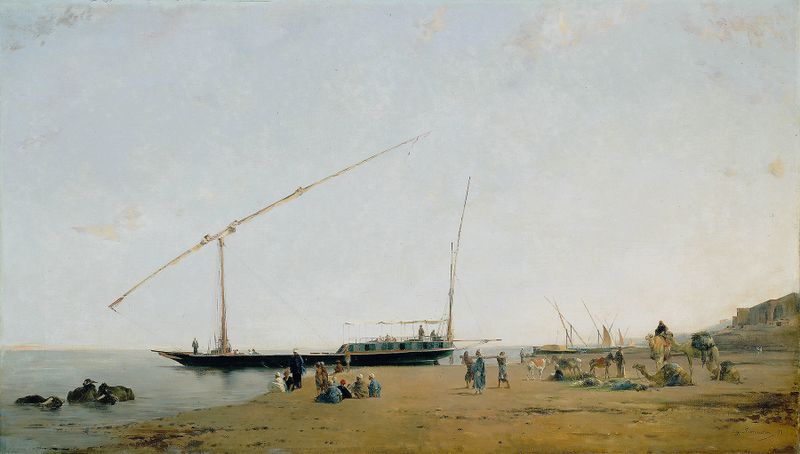
On the Nile, Near Philae
Eugène Fromentin

Arabs watering their horses
Eugène Fromentin
More Historical Art
Browse all →
The Night Watch Militia Company of District II under the Command of Captain Frans Banninck Cocq
Rembrandt van Rijn

Lincoln Memorial
Henry Bacon

The Third of May 1808
Francisco de Goya

Isaac and Rebecca, Known as ‘The Jewish Bride’
Rembrandt van Rijn

The Charge of the Mamelukes (1814)
Francisco de Goya

De vier ruiters van de apocalyps
Albrecht Dürer