
Ahasuerus Chooses Esther — History & Facts
When Ahasuerus Chooses Esther was painted by Sandro Botticelli around 1480, it was likely part of a grand decorative cycle commissioned for the Florentine banker Giovanni Tornabuoni’s family palace. Botticelli, already renowned for his mythological scenes, here turned his attention to a biblical drama that had particular resonance in Renaissance Florence, where themes of wise governance and political intrigue struck close to home. The story of Esther, a Jewish woman who risked her life to save her people from destruction, was often interpreted as a parable of courage and providence—a narrative that patrons like Tornabuoni may have seen as reflecting their own civic ambitions and anxieties. Botticelli chooses the pivotal moment when Esther, having fasted and prayed for three days, approaches King Ahasuerus unbidden—a crime punishable by death.
The king, seated on a raised throne, extends his golden scepter toward Esther, signaling her acceptance and the salvation of her people. Botticelli’s Esther is humble yet resolute, her downcast eyes and modest dress contrasting with the opulence of the Persian court. The artist’s delicate line and rhythmic drapery recall his treatment of mythological heroines, yet the tension here is heightened by the wary glances of courtiers and the careful choreography of hands and gestures.
Compared to Rembrandt’s later, darker Esther Before Ahasuerus, Botticelli’s scene is all clarity and order, emphasizing moral clarity over psychological drama. The painting’s precise original location and medium remain uncertain, as does its journey through the centuries—unlike Botticelli’s better-documented altarpieces and portraits, Ahasuerus Chooses Esther survives as a rare example of his biblical narrative work. It likely once formed part of a larger series, possibly adorning a private chapel or domestic interior, before being dispersed. Over time, some scholars have debated its attribution, noting the hand of assistants in certain passages, but the overall design and execution bear Botticelli’s unmistakable touch.
Today, the painting is valued as an important window into the artist’s engagement with sacred history and the tastes of his elite Florentine patrons in the late quattrocento.
More Artworks by Sandro Botticelli

Virgin and Child
Sandro Botticelli

Madonna and Child and the Young St John the Baptist
Sandro Botticelli

Madonna and Child with six angels and Saint John the Baptist as Child
Sandro Botticelli

Adoration of the Magi
Sandro Botticelli

Virgin and Child with the Young Saint John the Baptist
Sandro Botticelli
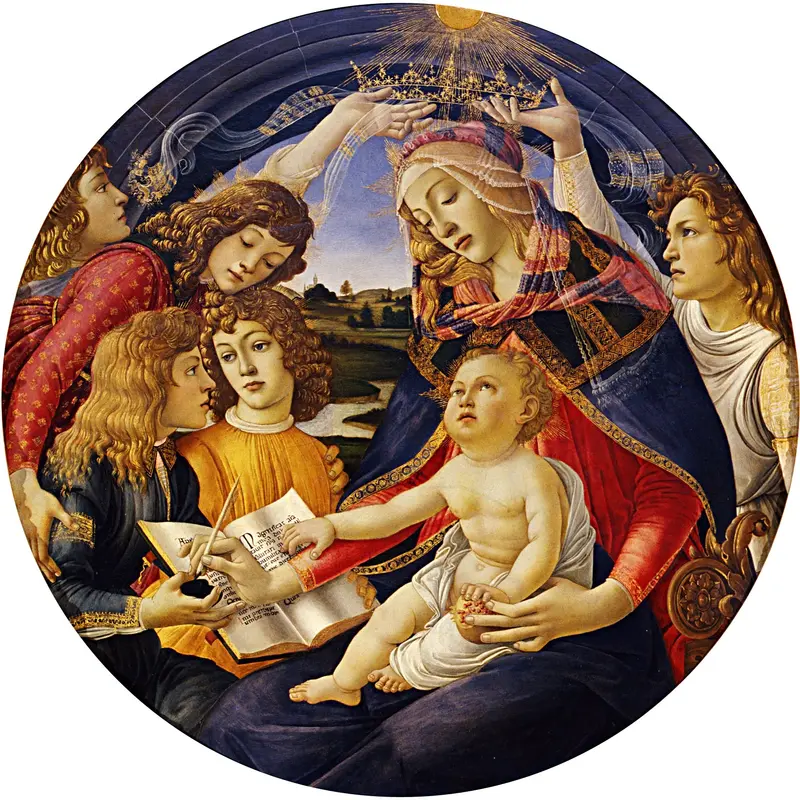
Madonna of the Magnificat
Sandro Botticelli
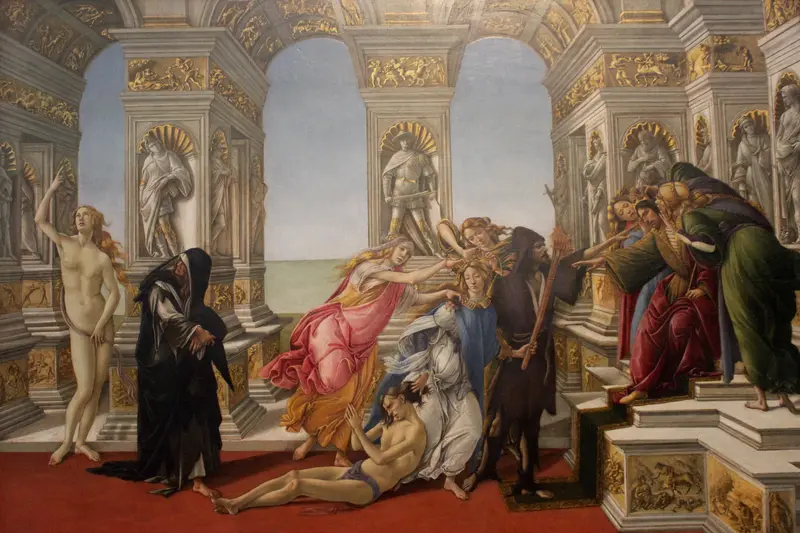
Calumny of Apelles
Sandro Botticelli

Portrait of a young man holding a roundel
Sandro Botticelli

The Trinity with Saint Mary Magdalene and Saint John the Baptist, the Archangel Raphael and Tobias
Sandro Botticelli

Idealized Portrait of a Lady (Portrait of Simonetta Vespucci as Nymph)
Sandro Botticelli





