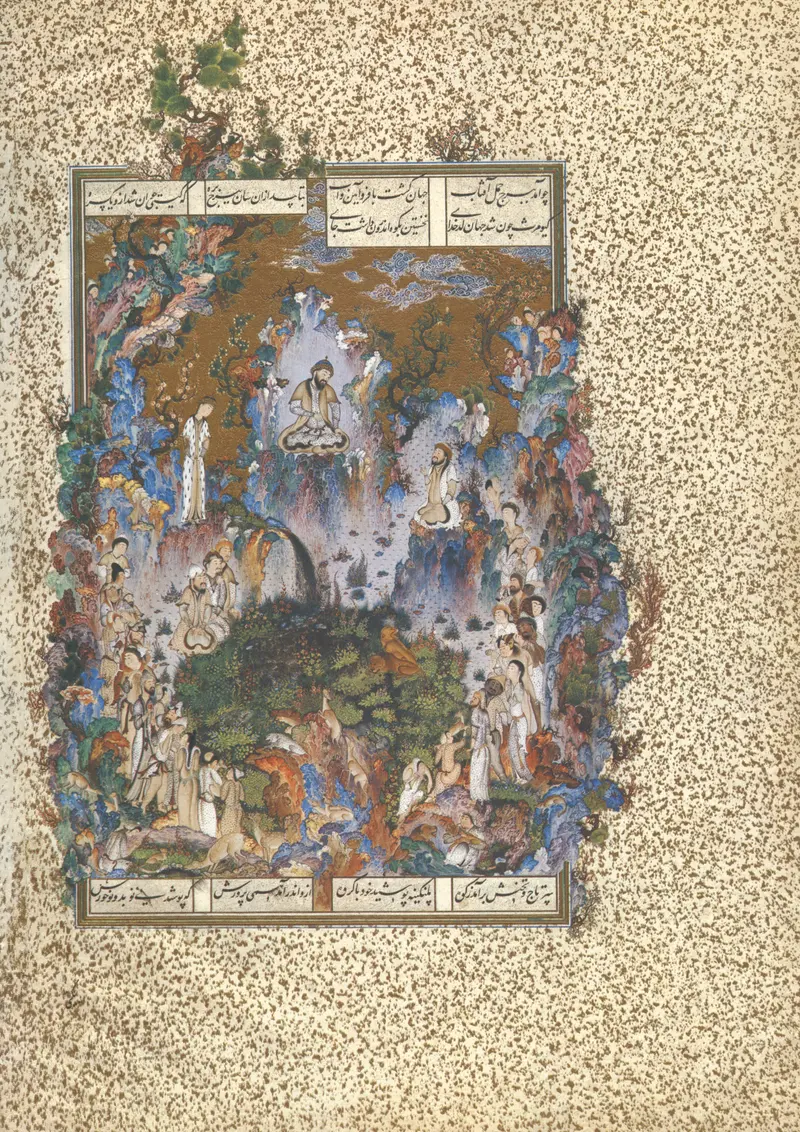
Allegory of Worldly and Otherworldly Drunkenness (Divan of Hafiz) — History & Facts
Allegory of Worldly and Otherworldly Drunkenness (Divan of Hafiz) by Sultan Muhammad was produced circa 1531–33 using opaque watercolor, ink, and gold on paper. This folio belongs to a manuscript of the Divan of Hafiz, created during the Safavid period. The work is attributed to one of the leading painters of the early Safavid court, active in the first half of the sixteenth century. The miniature depicts a multi-level architectural setting populated by numerous figures engaged in various activities.
The lower section shows a gathering of men in colorful robes, some reclining, some in animated conversation, and others appearing intoxicated or in states of abandon. The upper registers contain more intimate scenes within rooms, including figures drinking and interacting, while the uppermost space features winged beings serving drinks, possibly alluding to a heavenly or allegorical realm. The composition is rendered in vibrant colors, intricate patterns, and highlighted with gold, characteristic of Safavid manuscript illumination. This folio is part of a larger tradition of illustrated Persian poetry manuscripts, where visual allegory is used to complement and interpret the poetic text.
The Divan of Hafiz was a popular subject for luxurious manuscripts in the Safavid era, reflecting both literary and artistic tastes at the royal court. The folio, signed by Sultan Muhammad, comes from a manuscript of the Divan of Hafiz made in Tabriz about 1531–33 and is jointly owned by the Metropolitan Museum of Art and the Harvard Art Museums.