
Fisherman — History & Facts
When Fisherman appeared in 1824, it was part of a remarkable late flowering in the career of Katsushika Hokusai, who was then in his mid-sixties and already a household name in Edo (now Tokyo). By this time, Hokusai was deep into his obsession with depicting ordinary Japanese life, and he declared, "From the age of six I had a mania for drawing the shapes of things." This print belongs to a period when Hokusai was producing some of his most celebrated images of daily labor, far from the grand landscapes that would soon make him famous worldwide. The exact medium remains uncertain, but it is likely a woodblock print, as was typical for his work at the time. The scene captures a lone fisherman, poised at the edge of a riverbank, his body bent in concentration as he draws in his catch.
The moment is still, almost meditative: the fisherman’s simple robe and straw hat mark him as a figure of humble means, while the gentle curve of his fishing rod leads the viewer’s eye into the rippling water below. Hokusai’s attention to the subtle play of line and negative space is unmistakable, echoing the visual language he would perfect in Thirty-six Views of Mount Fuji. Unlike the heroic fishermen of Western art, such as in Winslow Homer’s The Herring Net, Hokusai’s subject is anonymous and solitary, merging with the landscape rather than dominating it. The journey of Fisherman as an object is less documented than some of Hokusai’s other works, in part because many of his prints were produced in large editions for popular consumption and have since scattered across collections worldwide.
There is no known record of a specific patron or commission for this piece; rather, it reflects the thriving commercial print market of Edo-period Japan, where artists like Hokusai sold images to a growing urban audience. Today, impressions of Fisherman can be found in several major museums, though the original blocks and publisher are not always identified. The print stands as a testament to Hokusai’s lifelong fascination with the rhythms of everyday life and his ability to find beauty in the most ordinary of moments.
More Artworks by Katsushika Hokusai

The Great Wave off Kanagawa
Katsushika Hokusai
Fine Wind, Clear Morning (Red Fuji)
Katsushika Hokusai
South Wind, Clear Dawn
Katsushika Hokusai
Rainstorm Beneath the Summit
Katsushika Hokusai
Clear Weather with a Southerly Wind
Katsushika Hokusai
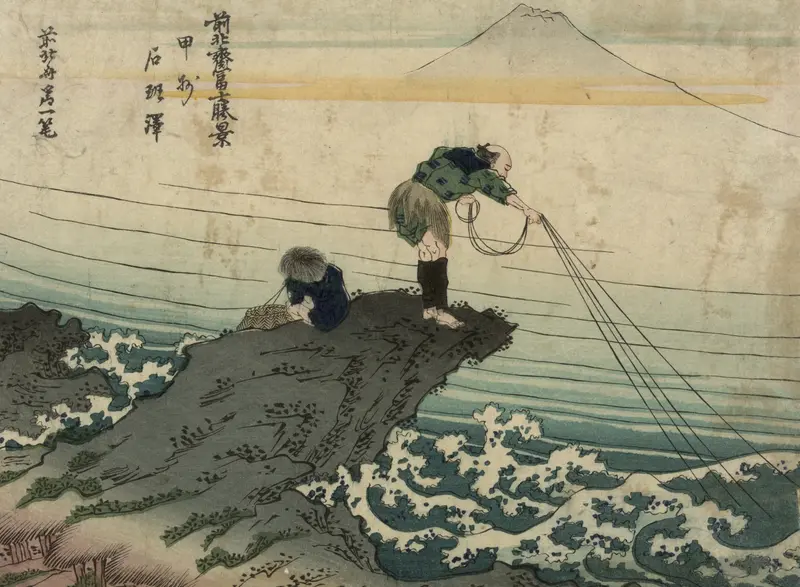
Kōshū kajikazawa
Katsushika Hokusai
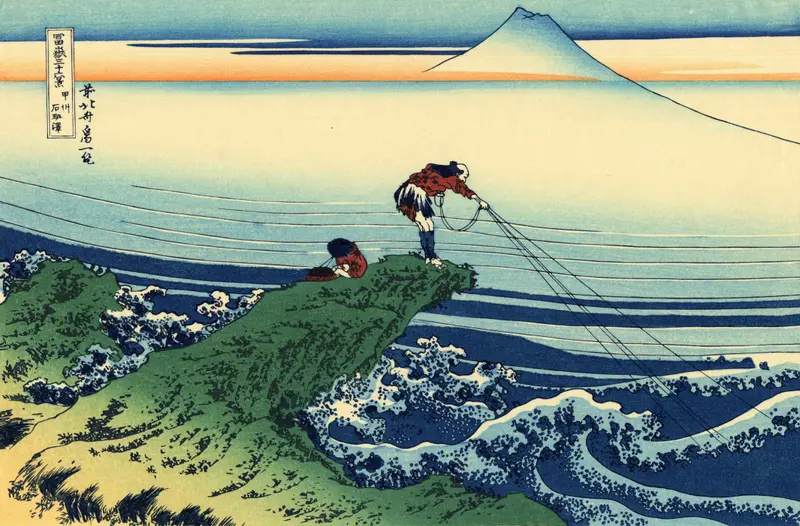
Kōshū kajikazawa 2
Katsushika Hokusai
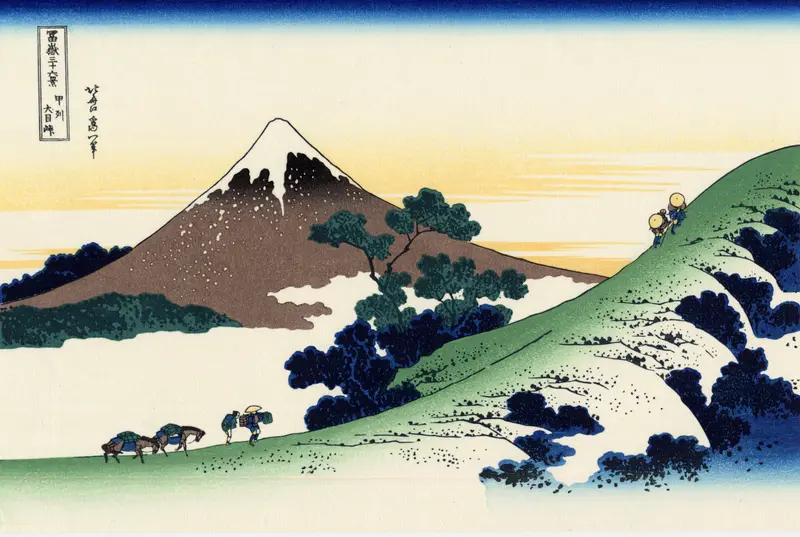
Inume Pass in Kai Province (Kôshû inume-tôge)
Katsushika Hokusai

Yoro Falls in Mino Province (Mino no Yoro no taki), from the series "A Tour of Waterfalls in Various Provinces (Shokoku taki meguri)"
Katsushika Hokusai
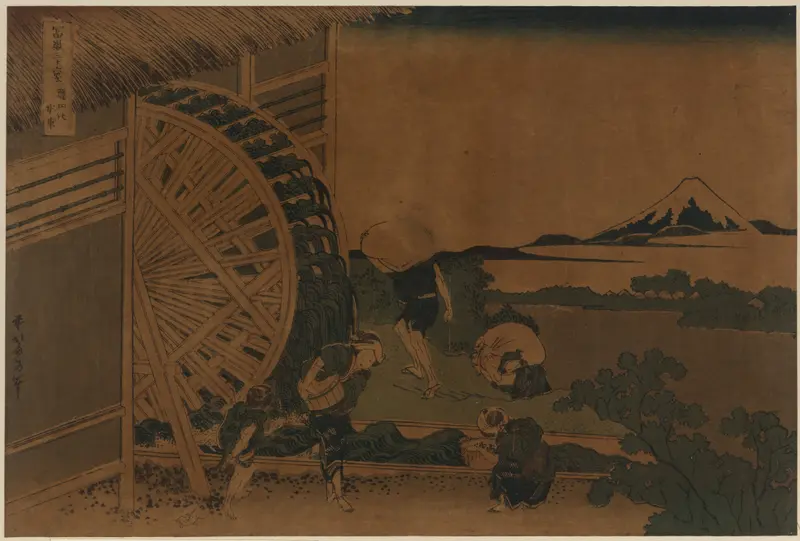
Onden no suisha
Katsushika Hokusai
More Genre Scene Art

Banquet of the Officers of the St George Civic Guard
Frans Hals

Rembrandt and Saskia in the Scene of the Prodigal Son
Rembrandt van Rijn

Bal du moulin de la Galette
Pierre-Auguste Renoir

Quadrille at the Moulin Rouge
Henri de Toulouse-Lautrec

A Burial at Ornans
Gustave Courbet

When Will You Marry?
Paul Gauguin