
Portrait of a Little Girl — History & Facts
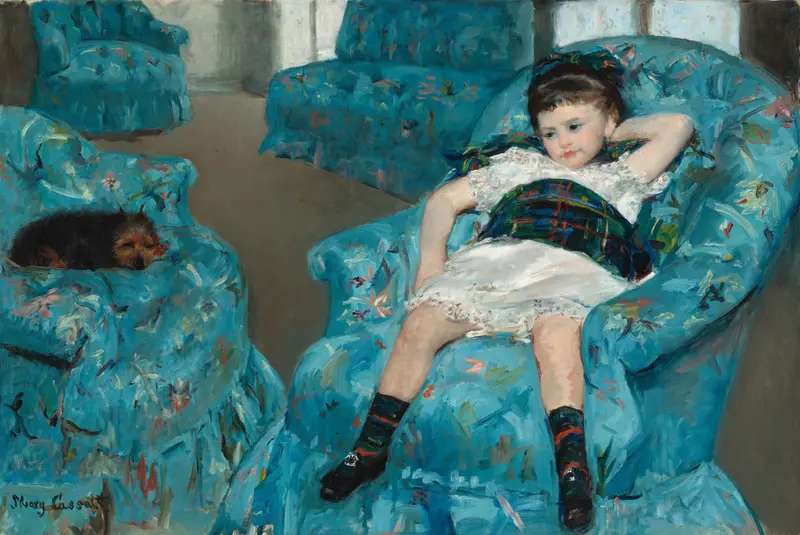
When Portrait of a Little Girl was exhibited in Paris in 1879, it marked one of the earliest moments when Mary Cassatt—an American in the heart of the French avant-garde—presented a solo depiction of a child to the public. At a time when women artists were rarely admitted into the ranks of the Impressionists, Cassatt’s focus on the private, everyday world of women and children was both a personal and artistic declaration. The painting stands out among her works for its intimate scale and the immediacy of its gaze, qualities that would become hallmarks of her later portraits.
Scholars have long noted that this particular image may have been inspired by the children of Cassatt’s own family, who visited her in Paris during these years. The child, seated upright, gazes directly at the viewer with a frankness unusual for formal portraiture of the era. Her hands rest quietly in her lap, the simple dress and loose hair signaling the informality of the setting—this is not a child made to pose stiffly for posterity, but one caught in a moment of genuine presence. Cassatt’s brushwork, loose yet attentive, animates the delicate flush of the girl’s cheeks and the soft light that falls across her face.
The composition’s focus on the child’s psychological world recalls Renoir’s Julie Manet, painted just a few years later, though Cassatt’s approach is more restrained, her palette cooler, her subject less adorned. The painting invites viewers to consider childhood not as a decorative theme, but as a state of being worthy of close observation. The precise journey of Portrait of a Little Girl after its creation is not fully documented, but it is typical of Cassatt’s portraits from this period, many of which remained in private collections or with the artist’s family for decades. The work reflects Cassatt’s growing confidence in the late 1870s, as she moved away from history painting and embraced scenes of domestic life—an area in which she would become one of the leading figures of the Impressionist movement.
Today, the painting is recognized as an early example of Cassatt’s lifelong exploration of childhood and the intimate bonds between sitter and artist. Its survival and continued display in museum collections attest to the quiet revolution Cassatt helped bring about in the art of portraiture.
More Artworks by Mary Cassatt

The Child's Bath
Mary Cassatt
Breakfast in Bed
Mary Cassatt

Mother and Child (Baby Getting Up from His Nap)
Mary Cassatt
Mrs. Robert S. Cassatt, the Artist's Mother
Mary Cassatt
Woman with a Pearl Necklace in a Loge
Mary Cassatt
Little Girl in a Blue Armchair
Mary Cassatt
Mother and Child (The Oval Mirror)
Mary Cassatt
Mother and Child
Mary Cassatt
In The Loge
Mary Cassatt
On a Balcony
Mary Cassatt





