
Portrait of Giuliano de' Medici — History & Facts
Few portraits in Renaissance Florence carry as much historical weight as Portrait of Giuliano de' Medici by Sandro Botticelli. Painted in 1478, the year Giuliano was assassinated during the infamous Pazzi Conspiracy, this likeness was created just before or soon after the brutal event that shook the Medici family and the city. The murder, which took place on April 26th during High Mass in Florence Cathedral, left Giuliano’s brother Lorenzo wounded but alive, and transformed the Medici legacy forever.
The painting thus stands as a silent witness to the tension and violence that shadowed Florence’s golden age. Giuliano appears here not as a ruler or martyr, but as a young man caught in a moment of introspection. Botticelli places him in strict profile, a pose reminiscent of ancient Roman coins, underscoring both his noble lineage and the Medici’s cultivated image as heirs to classical virtue. The dark background isolates Giuliano, drawing attention to his aquiline features and the medallion on his chest—possibly a symbol of family pride or a subtle reference to his fate.
Unlike the more theatrical Portrait of Lorenzo de’ Medici by Bronzino, Botticelli’s approach is restrained, almost melancholic, hinting at the vulnerability beneath the Medici power. The precise circumstances of the commission remain unclear, but it is likely that the Medici family or their close circle sought to memorialize Giuliano after his death. The portrait’s style and technique place it firmly within Botticelli’s early career, when he was closely associated with the Medici court and its circle of poets and philosophers. Over the centuries, the painting has been admired for its psychological depth and has influenced countless later depictions of the Medici.
Today, it is recognized as a rare and intimate record of a young man whose life and death shaped the course of Florentine history.
More Artworks by Sandro Botticelli

Virgin and Child
Sandro Botticelli

Madonna and Child and the Young St John the Baptist
Sandro Botticelli

Madonna and Child with six angels and Saint John the Baptist as Child
Sandro Botticelli

Adoration of the Magi
Sandro Botticelli

Virgin and Child with the Young Saint John the Baptist
Sandro Botticelli
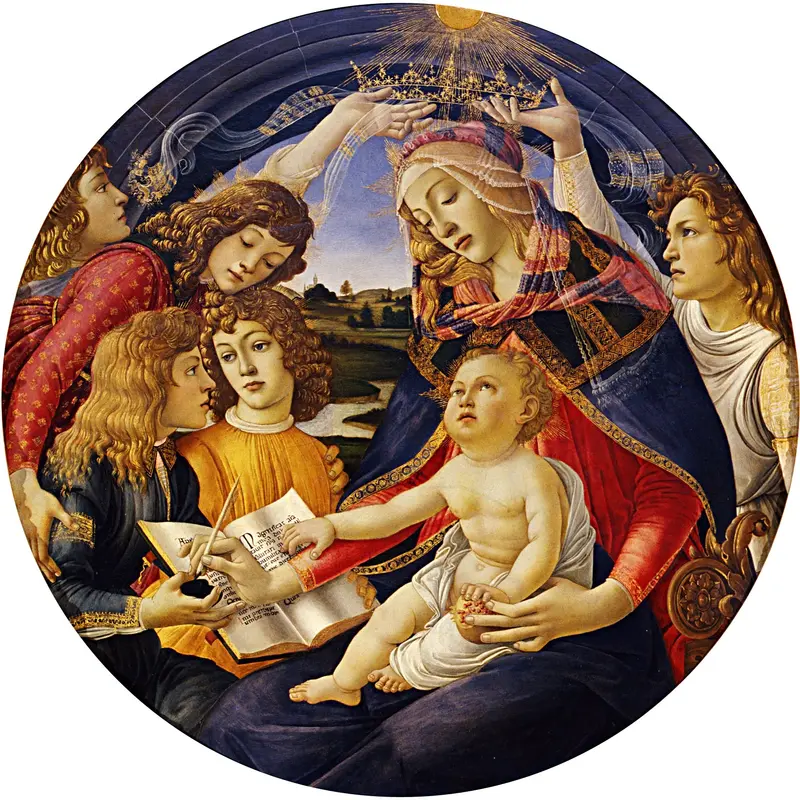
Madonna of the Magnificat
Sandro Botticelli
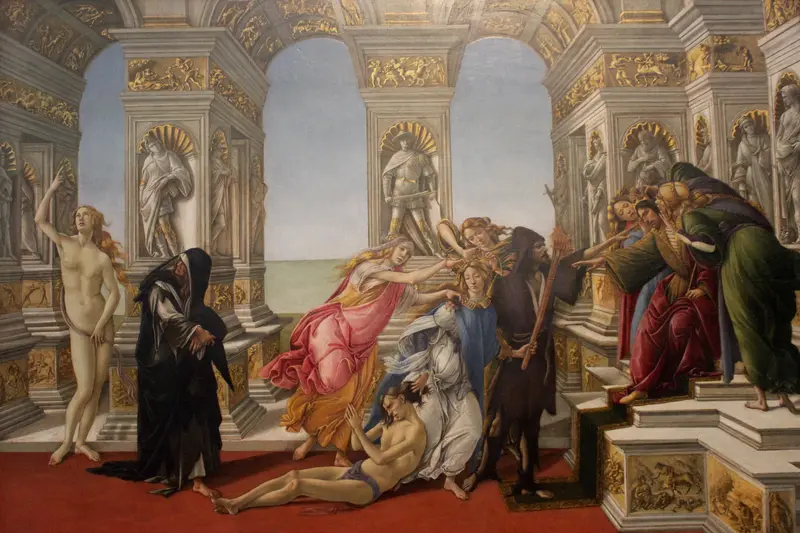
Calumny of Apelles
Sandro Botticelli

Portrait of a young man holding a roundel
Sandro Botticelli

The Trinity with Saint Mary Magdalene and Saint John the Baptist, the Archangel Raphael and Tobias
Sandro Botticelli

Idealized Portrait of a Lady (Portrait of Simonetta Vespucci as Nymph)
Sandro Botticelli





