
Louis vaz de Camoens (c.1524–1580) — History & Facts
When William Blake painted Louis vaz de Camoens (c.1524–1580) in 1800, he was engaging not just with the memory of Portugal’s national poet, but with a figure who had become a symbol of exile and creative suffering across Europe. Camoens, celebrated for his epic The Lusiads, died impoverished and nearly blind, a fate that haunted Romantic artists like Blake. The choice of Camoens as subject was rare in English art of the period, and it is not known whether Blake painted this work for a patron or as a private meditation.
The medium remains uncertain, adding another layer of mystery to a work that has attracted both literary and art historical curiosity. The moment Blake selects is one of introspection: Camoens, likely in his Lisbon exile, sits with a manuscript in hand, his gaze distant, his expression marked by both resilience and fatigue. The sparse background and the poet’s simple attire underscore his isolation, while the faint light falling on the manuscript hints at the enduring power of his words. Blake’s rendering of the face, with its deep-set eyes and furrowed brow, emphasizes the poet’s inner struggle—a motif Blake often explored in his own visionary subjects.
Unlike Delacroix’s later, more dramatic depictions of literary figures, Blake’s approach is intimate, focusing on the psychological cost of genius rather than outward heroism. The painting’s subsequent history is not thoroughly documented; it does not appear in early catalogues of Blake’s exhibited works, and its provenance prior to the twentieth century is unclear. Scholars have debated its attribution, noting the characteristic linearity and spiritual intensity typical of Blake’s portraits. Today, the work is recognized as a rare example of Blake’s engagement with historical portraiture, standing apart from his more familiar biblical and mythological scenes.
Its survival offers a glimpse into both the artist’s admiration for literary greatness and the Romantic fascination with the solitary, suffering creator.
More Artworks by William Blake
The Tyger
William Blake

Christ Blessing
William Blake
Homer
William Blake
Jacob's Ladder
William Blake
John Dryden (1631–1700)
William Blake
Landscape near Felpham
William Blake
Sacrifice of Job
William Blake
Christ's Entry into Jerusalem
William Blake
The Ancient of Days
William Blake
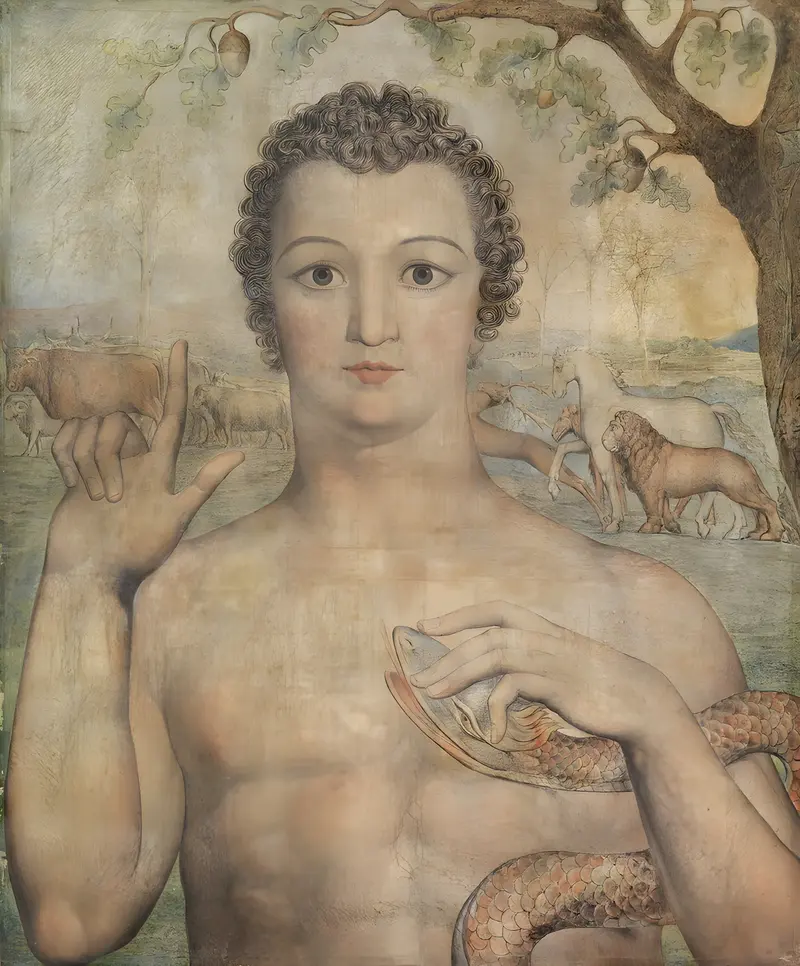
Adam Naming the Beasts
William Blake





