Study for Wadatsumi no Iroko no Miya — History & Facts
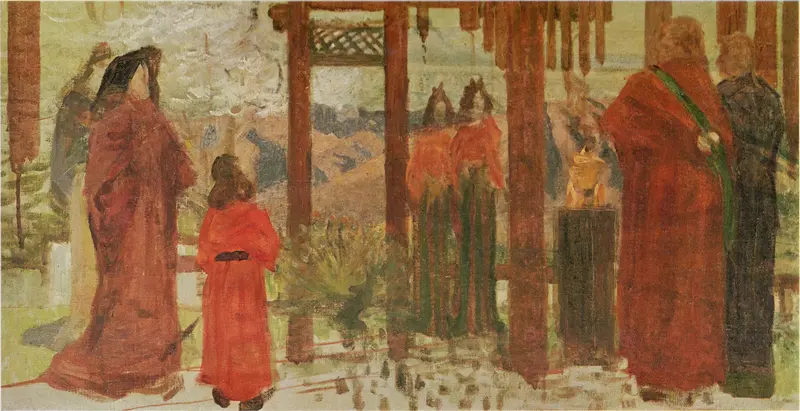
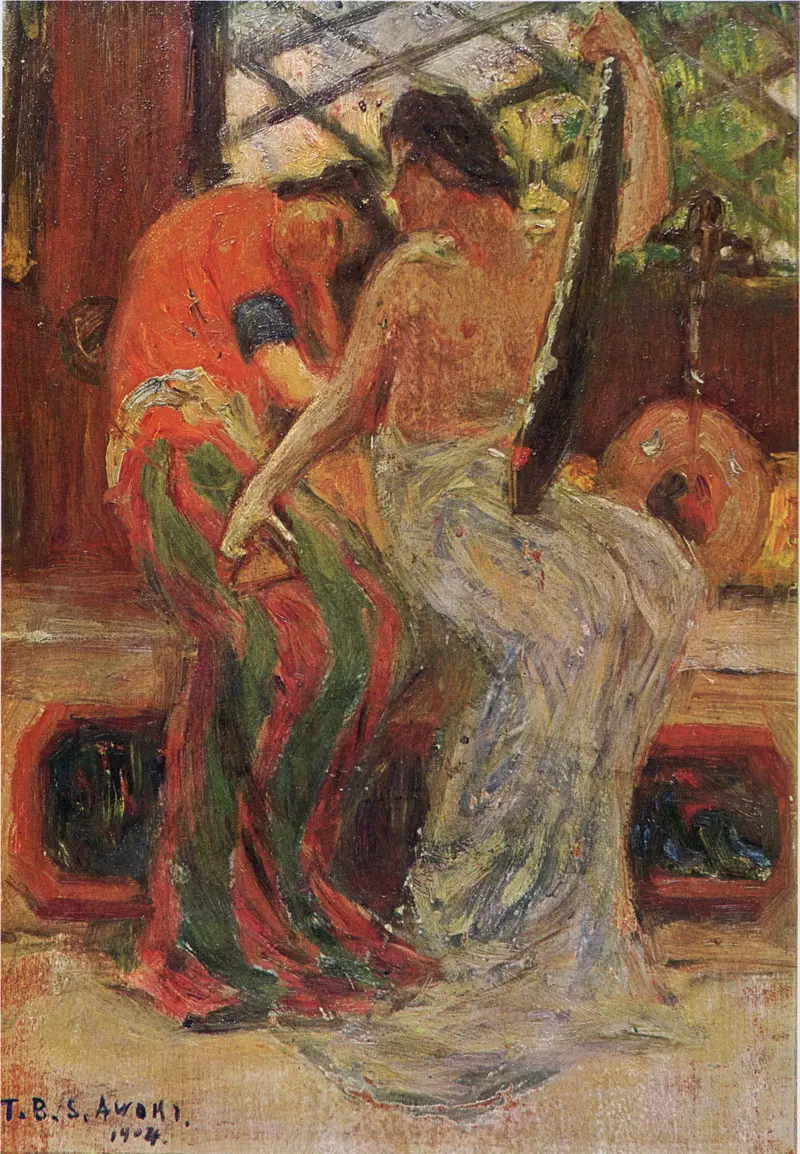
What first catches the eye in Study for Wadatsumi no Iroko no Miya is the sense of ritual, as two women—one in rose, one in sea-green—stand absorbed in a shared act that remains just out of reach for the viewer. The vertical canvas draws you upward, following the line of their bodies and the sweep of their garments, which are dotted with what seem to be blossoms or pearls. The woman in rose gazes intently, her hands raised in an offering or invocation, while her companion’s back is turned, her own gesture echoing the upward motion.
The palette is lush but muted, the brushwork loose and searching, as if the artist is feeling his way toward a vision that is both ancient and new. Created in 1907, this work belongs to a moment when Japanese artists like Aoki Shigeru were absorbing Western painting techniques while reimagining native legends and spiritual themes. The early twentieth century saw a surge of interest in mythic subjects, often commissioned for public spaces or as explorations of national identity in a rapidly modernizing society. While little is recorded about this particular study’s journey, its inclusion in the 1983 volume from Shogakukan hints at its quiet influence within the canon of Japanese modern art.
Look again at the shimmering outlines and the almost dreamlike ambiguity—here, history’s traces are not in the facts, but in the lingering presence of a half-remembered story.