
The Child — History & Facts
When The Child was first exhibited in 1905, it was met with a mixture of admiration and surprise: here was Mary Cassatt, an American woman in Paris, painting motherhood not as an allegory or ideal, but as an everyday intimacy. Cassatt’s focus on the private world of women and children was radical for her time, challenging the conventions of both subject and style. Critics noted her bold use of color and the almost tactile presence of her figures, which set her apart from her contemporaries in the Impressionist circle.
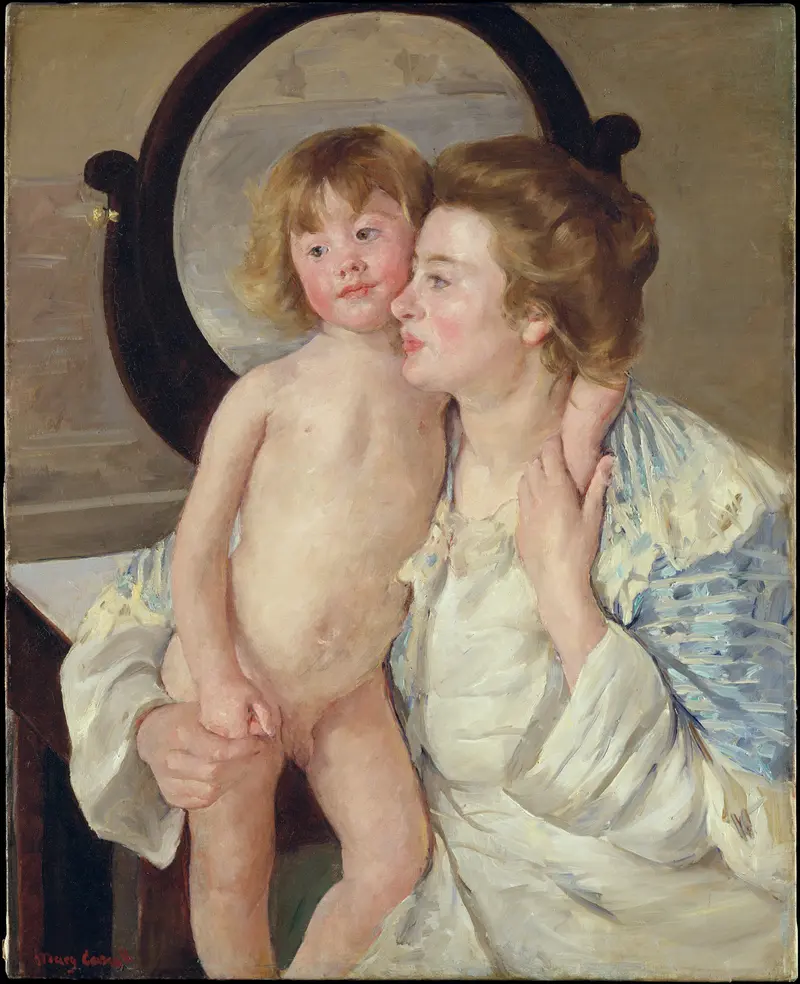
The painting stands as one of her last major works before her eyesight began to fail, marking the end of her most productive period. In The Child, Cassatt captures a quiet moment between a mother and her young daughter, the two figures forming a closed, protective circle. The mother’s gentle grip and the child’s trusting gaze create a sense of safety and affection, while the soft, luminous palette bathes the scene in warmth. The composition draws the viewer’s eye to the clasped hands, a motif Cassatt returned to again and again as a symbol of connection.
Unlike the formal portraits of children by John Singer Sargent, Cassatt’s work is intimate and unsentimental, focusing on the real, lived experience of childhood rather than its outward appearance. The exact provenance of The Child is not fully documented, but works of this period were often acquired by American collectors eager to bring European modernism across the Atlantic. Cassatt herself was instrumental in advising such patrons, helping to shape major collections in the United States. Today, The Child is celebrated as a prime example of Cassatt’s mature style, blending Impressionist technique with a distinctly personal vision.
Its place in her oeuvre marks a culmination of her lifelong exploration of the mother-and-child theme, a subject that would define her legacy and influence generations of artists to come.
More Artworks by Mary Cassatt

The Child's Bath
Mary Cassatt
Breakfast in Bed
Mary Cassatt

Mother and Child (Baby Getting Up from His Nap)
Mary Cassatt
Mrs. Robert S. Cassatt, the Artist's Mother
Mary Cassatt
Woman with a Pearl Necklace in a Loge
Mary Cassatt
Little Girl in a Blue Armchair
Mary Cassatt
Mother and Child (The Oval Mirror)
Mary Cassatt
Mother and Child
Mary Cassatt
In The Loge
Mary Cassatt
On a Balcony
Mary Cassatt
More Genre Scene Art

Banquet of the Officers of the St George Civic Guard
Frans Hals

Rembrandt and Saskia in the Scene of the Prodigal Son
Rembrandt van Rijn

Bal du moulin de la Galette
Pierre-Auguste Renoir

Quadrille at the Moulin Rouge
Henri de Toulouse-Lautrec

A Burial at Ornans
Gustave Courbet

When Will You Marry?
Paul Gauguin