Den drunknade flickan I — History & Facts
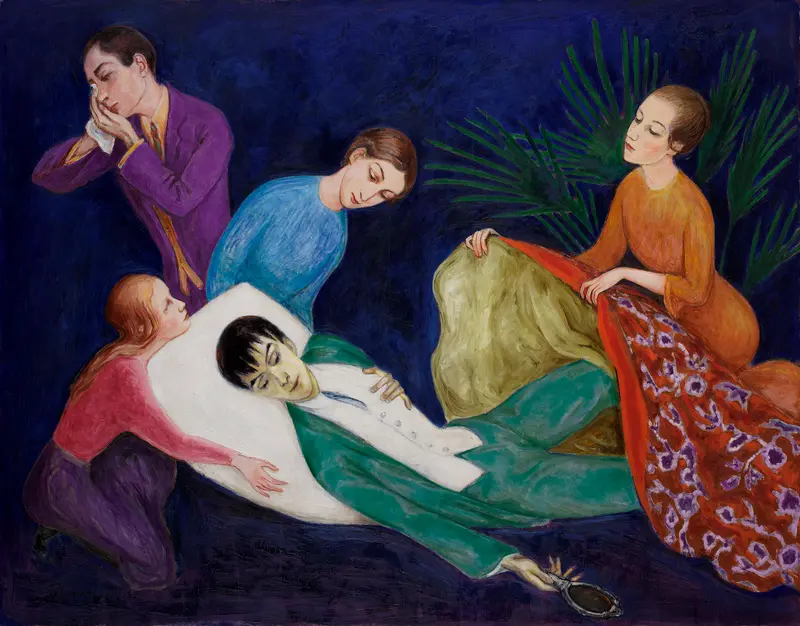
No other painting by Nils Dardel has generated as much speculation as Den drunknade flickan I. The work’s title, Swedish for “The Drowned Girl I,” hints at a story that has never been fully explained, and the absence of a known date or commission only deepens the mystery. Some art historians have connected the painting to the tragic real-life drownings that occurred in Sweden’s lakes during the early 20th century, but no definitive link has been established.
The painting is often discussed alongside its supposed companion, Den drunknade flickan II, though it remains uncertain whether Dardel intended a series or simply revisited a haunting theme. The moment Dardel chose to paint is one of stillness after catastrophe: a young woman lies lifeless at the water’s edge, her pale form contrasting with the dark, swirling currents that seem to both cradle and claim her. The delicate flowers scattered near her body suggest innocence lost, while the unnatural calm of her face hints at a peace found only in death. Dardel’s use of cool, muted tones amplifies the sense of isolation, drawing the viewer’s eye to the girl’s limp hand, half-submerged in water.
Unlike John Everett Millais’ Ophelia, where nature teems with life around the drowned figure, Dardel’s landscape feels emptied by tragedy, the silence almost oppressive. Little is known about the early history of Den drunknade flickan I, and it is not clear for whom it was painted or how it first entered public view. The painting’s provenance is patchy; it surfaced in Swedish private collections before being exhibited in retrospectives of Dardel’s work in the late 20th century. Today, it is considered a key example of the artist’s fascination with death and the unconscious, themes that recur throughout his career.
Its ambiguous origins and somber mood have made it a subject of ongoing scholarly interest, ensuring its place as one of the most enigmatic works in Nils Dardel’s oeuvre.