
La Mort d'Hippolyte — History & Facts
Few subjects gripped the imagination of Romantic artists like the tragic fate of Hippolytus, but Théodore Géricault’s La Mort d'Hippolyte stands out for the intensity with which it captures the fatal moment. Painted in 1850, late in the artist’s short but turbulent life, this work is often cited by scholars as a testament to Géricault’s lifelong fascination with the extremes of human suffering and physicality. The story of Hippolytus, torn apart by his own chariot after being cursed by his father Theseus, had appeared in art for centuries, but rarely with such visceral immediacy.
The painting’s dramatic composition and emotional force echo the artist’s earlier explorations of catastrophe, such as The Raft of the Medusa. In La Mort d'Hippolyte, Géricault chooses the instant after disaster strikes: Hippolytus lies sprawled on the ground, his body twisted and broken, while his terrified horses rear and bolt, still tangled in the wreckage of the chariot. The painter’s eye lingers on the contorted limbs and the wild, rolling eyes of both man and beast, underscoring the violence of the myth’s climax. The play of light isolates Hippolytus’s pale form against the shadowy chaos, focusing our attention on his suffering and innocence.
Nearby, a figure—perhaps a servant or a bystander—reaches toward the dying youth in a gesture of helpless horror. Unlike Poussin’s more restrained Death of Hippolytus, Géricault’s version thrusts the viewer into the heart of the calamity, emphasizing movement, terror, and the tragic consequences of misunderstanding and divine wrath. The exact provenance of La Mort d'Hippolyte remains somewhat obscure, as the painting was completed near the end of Géricault’s life, a period marked by declining health and relative isolation. There is no record of a specific patron, and it is unclear whether the work was exhibited publicly during the artist’s lifetime.
Today, it is recognized as a powerful example of the Romantic movement’s fascination with myth, violence, and the limits of the human body. The painting’s survival and current location are not widely documented, but it continues to be studied as a key work in understanding Géricault’s legacy and the broader artistic currents of mid-19th-century France.
More Artworks by Théodore Géricault
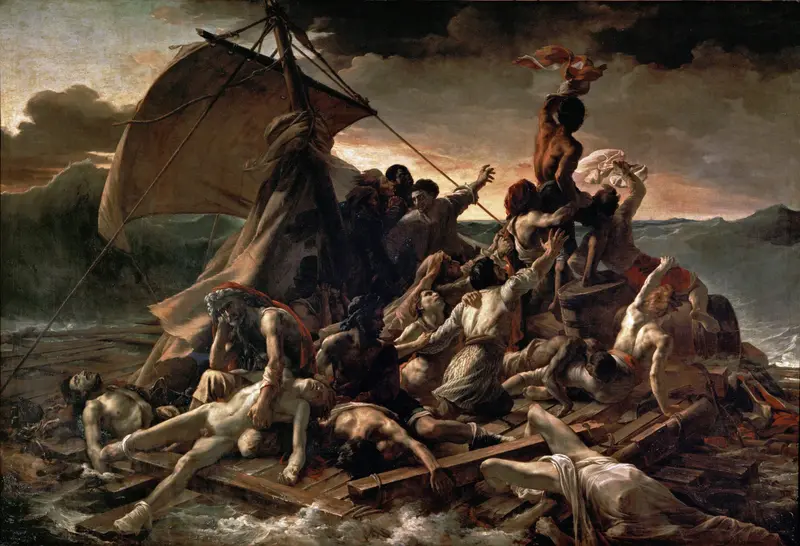
The Raft of the Medusa
Théodore Géricault

Géricault - Le naufrage du radeau de la Méduse, MBA 790
Théodore Géricault
Cattle Market
Théodore Géricault
Evening; Landscape with an Aqueduct
Théodore Géricault
Horse Race
Théodore Géricault

Horses Standing in a Mews
Théodore Géricault
Portrait of a Negro
Théodore Géricault
Portrait of Zoë Elmore
Théodore Géricault
Cheval attaqué par un lion
Théodore Géricault
Cheval brun à l'écurie
Théodore Géricault





