
Transsibiriska expressen — History & Facts
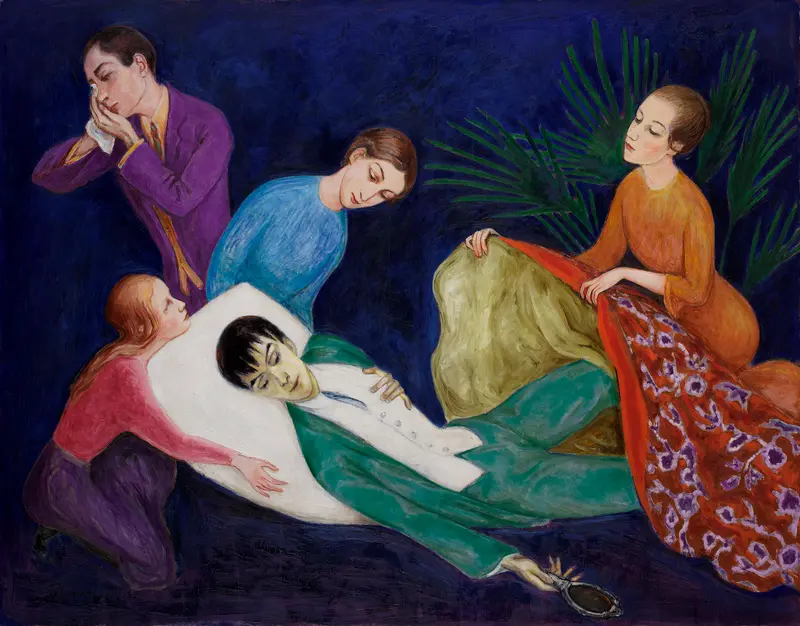
Few paintings by Nils Dardel have inspired as much speculation as Transsibiriska expressen, whose very title conjures the legendary railway that stitched together Europe and Asia. The work’s origins are shrouded in mystery—neither its date nor its commission is firmly documented—but its subject matter has led some to link it to the artist’s own travels, or to the feverish fascination with Russia that swept through Swedish artistic circles in the early twentieth century. The painting’s rarity adds to its allure: while Dardel’s more famous works, like The Dying Dandy, are widely reproduced, Transsibiriska expressen remains a seldom-seen gem, its whereabouts and provenance still uncertain. Dardel captures a moment of restless anticipation aboard the famed Trans-Siberian Express, the world’s longest railway.
Passengers, bundled in coats and hats, are caught between worlds: some gaze out frost-edged windows at the endless steppe, while others huddle in conversation, their faces illuminated by the warm glow of carriage lamps. The artist’s characteristic use of bold color and stylized figures conveys both the monotony and the romance of the journey—each suitcase, fur collar, and samovar a nod to the collision of cultures and the sense of adventure. Unlike the grand, heroic depictions of travel by artists such as Ilja Repin, Dardel’s focus is on the private, interior drama of travel: the nervous clasp of gloved hands, the fleeting glances exchanged between strangers. The physical history of Transsibiriska expressen is as elusive as the landscape it depicts.
There is no record of a specific patron or public exhibition, and the painting’s current location is not widely known—unusual for a work by Nils Dardel, whose reputation has only grown since his death in 1943. Some art historians speculate that the painting may have remained in a private collection, passed quietly from hand to hand, or that it was created as part of a series inspired by Dardel’s fascination with travel and cosmopolitan life. What is certain is that the painting stands as a testament to Dardel’s unique vision: a blend of restless modernity and psychological insight that marks his place in the history of Swedish modernism.
More Artworks by Nils Dardel



More Genre Scene Art

Banquet of the Officers of the St George Civic Guard
Frans Hals

Rembrandt and Saskia in the Scene of the Prodigal Son
Rembrandt van Rijn

Bal du moulin de la Galette
Pierre-Auguste Renoir

Quadrille at the Moulin Rouge
Henri de Toulouse-Lautrec

A Burial at Ornans
Gustave Courbet

When Will You Marry?
Paul Gauguin