
Art movement · 1917–1931 · Netherlands
De Stijl Art and Paintings
De Stijl is an art movement that began in the Netherlands in 1917, around a magazine of the same name, and made art from straight horizontal and vertical lines, flat rectangles and primary colors. It was founded by Piet Mondrian and Theo van Doesburg and lasted until 1931, with painters, designers and architects such as Bart van der Leck, Vilmos Huszár and Gerrit Rietveld.
Its name is Dutch for “The Style.” The group wanted one style for everything from paintings to chairs and houses, and Mondrian called its kind of painting Neoplasticism. Van Doesburg's Card Players of 1916–17 shows the road there: in 1917 he turned it into an abstract painting.
Browse 16 De Stijl paintings and artworks below, all public domain and free to download.
Selected and written by Pavel MazuelasUpdated November 5, 2026
Part of Art Movements and Painting StylesRelated: Modernism, Famous Abstract Paintings
All De Stijl paintings and artworks
Abstract paintings by Piet Mondrian and Theo van Doesburg, De Stijl magazine covers, a design for the Café Aubette, a stained-glass panel and a Dada poster. All public domain, free to download.
Famous De Stijl paintings
The best-known De Stijl paintings in our collection. Click any one to see it up close and download it free.
Famous De Stijl artists
The two founders, whose work is in the public domain. Bart van der Leck, Vilmos Huszár, Georges Vantongerloo and the architects Gerrit Rietveld and J. J. P. Oud belonged to De Stijl too, but they died between 1958 and 1965, so their work is still in copyright in much of the world and is not shown here.
 Piet Mondrian1872–1944. Co-founded De Stijl with Theo van Doesburg in 1917 and named his art of straight lines and primary colors Neoplasticism; lived in Paris from 1919 and left the group over van Doesburg's diagonals.
 Theo van Doesburg1883–1931. Painter, designer and writer who started the magazine De Stijl in Leiden in 1917 and ran it until he died; brought in the diagonal about 1924 and coined the term concrete art in 1930, Tate notes.
Neoplasticism: Piet Mondrian's style
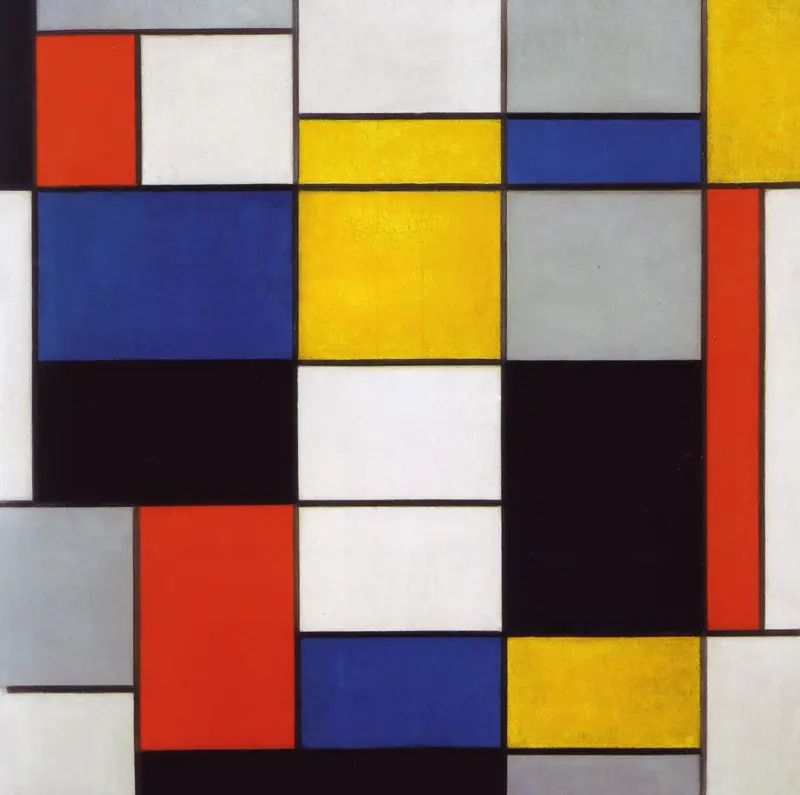
Neoplasticism was Mondrian's name for painting with only horizontal and vertical lines, the primary colors and black, white and gray, Tate explains. By the early 1920s, the Guggenheim says, his pictures were off-white grounds divided by black lines, with blocks of single primary colors, as in these paintings from 1921 to 1930.
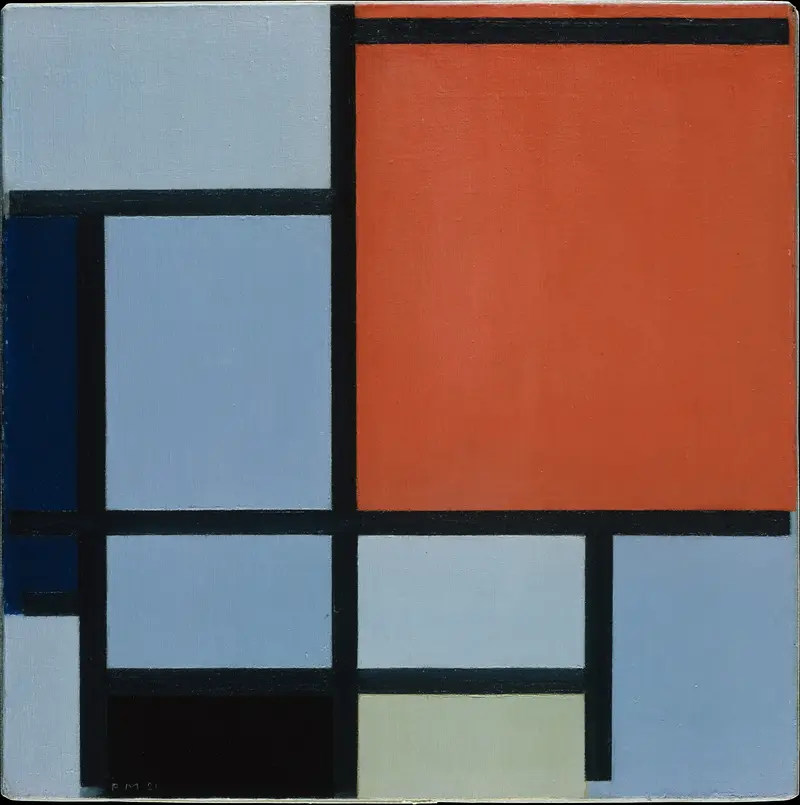 Composition, 1921Piet Mondrian
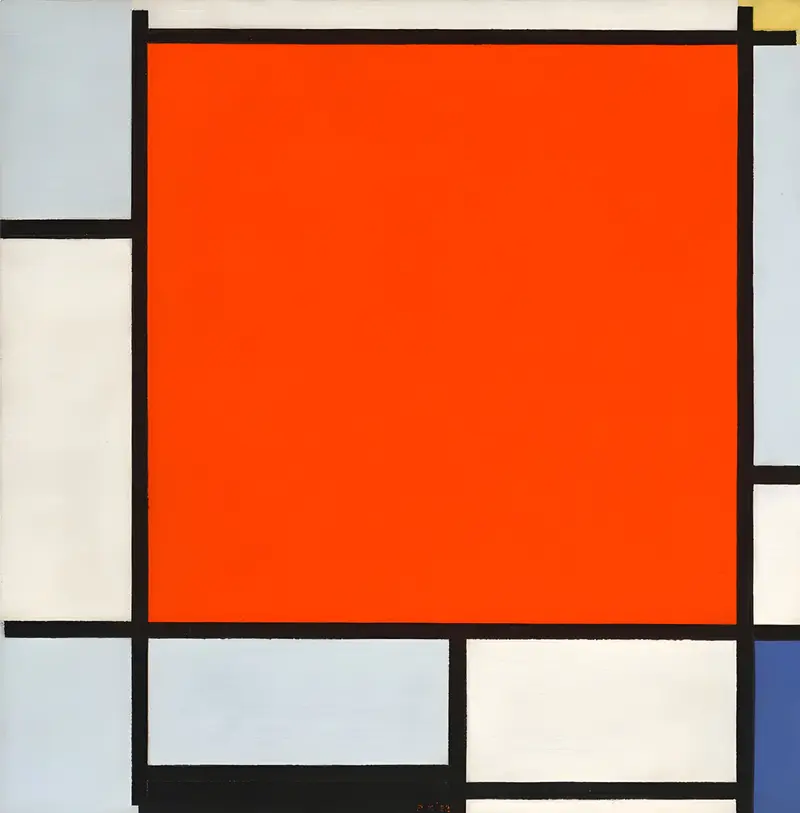 Composition with Large Red Plane, Bluish Gray, Yellow, Black and BluePiet Mondrian
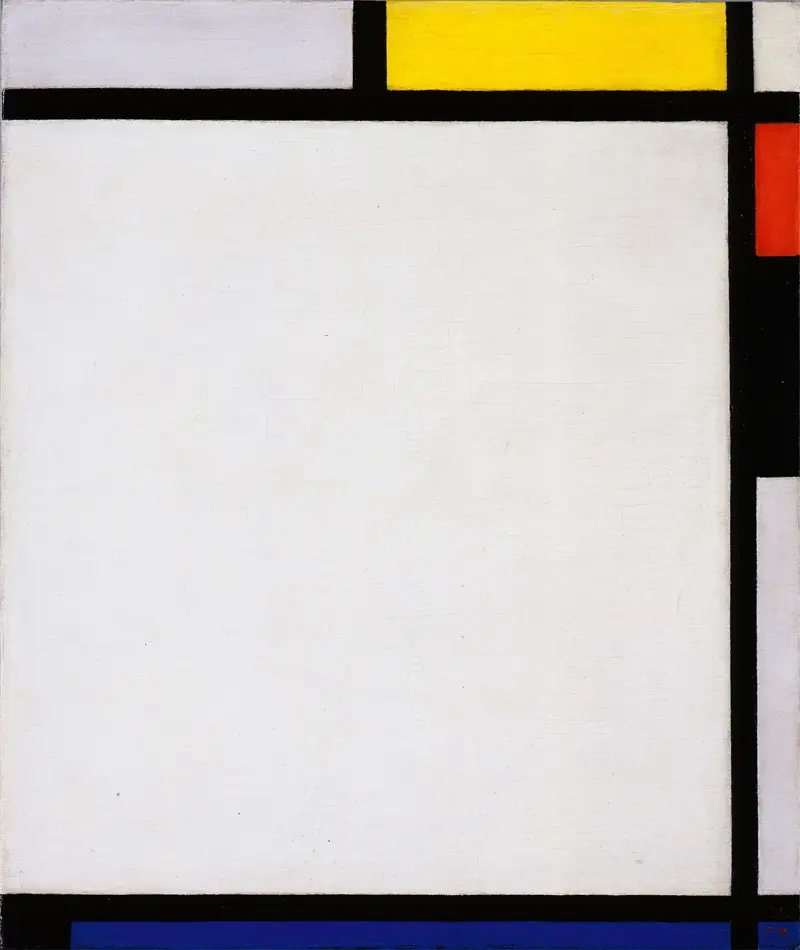 Tableau No. VIIIPiet Mondrian
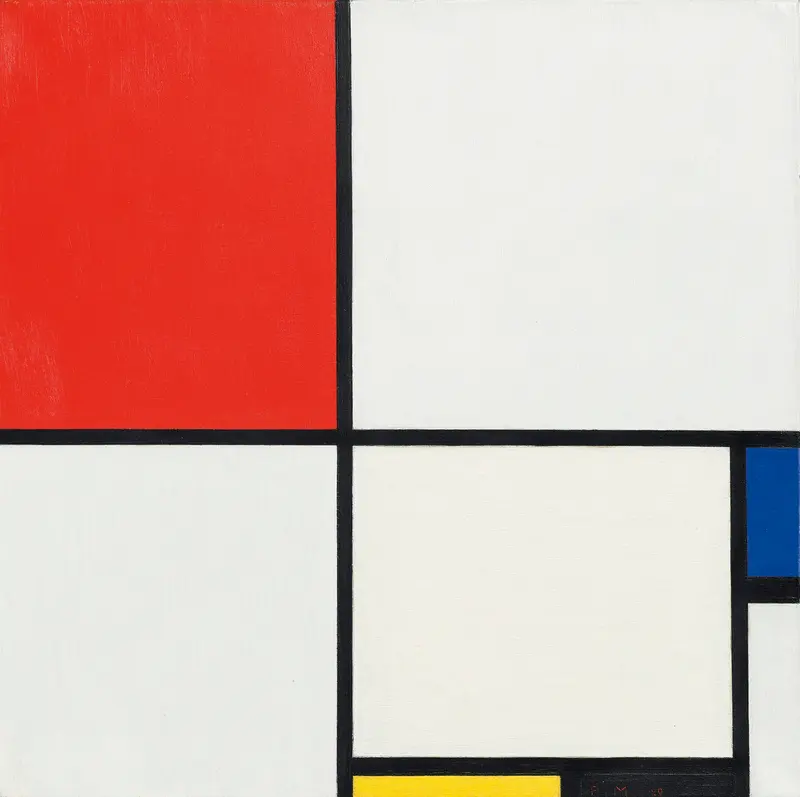 Composition No. III, with Red, Blue, Yellow and BlackPiet Mondrian
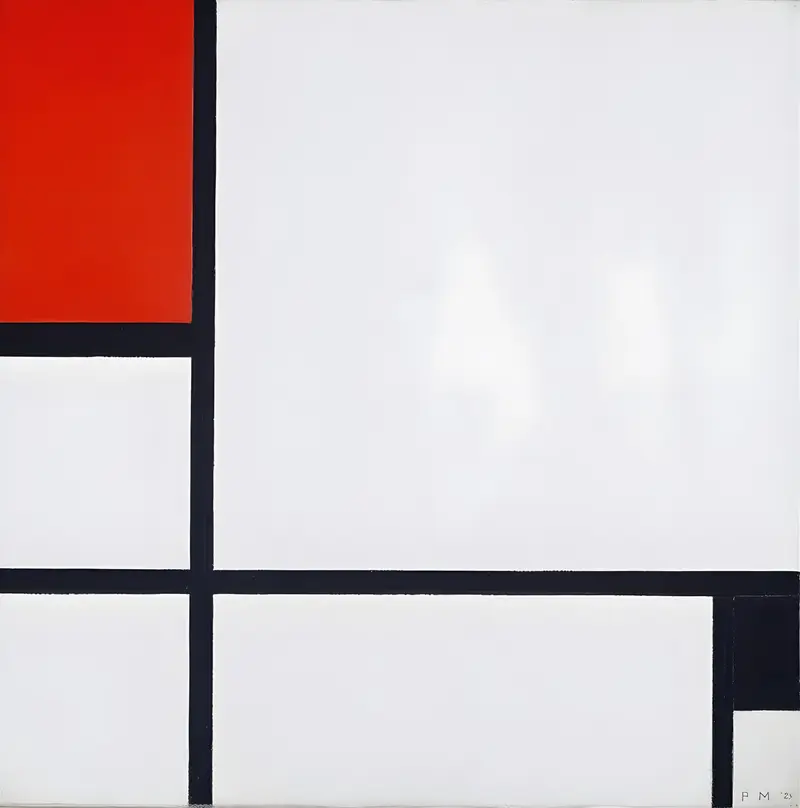 Composition No. I, with Red and BlackPiet Mondrian
 Composition II in Red, Blue and YellowPiet Mondrian
Theo van Doesburg and De Stijl
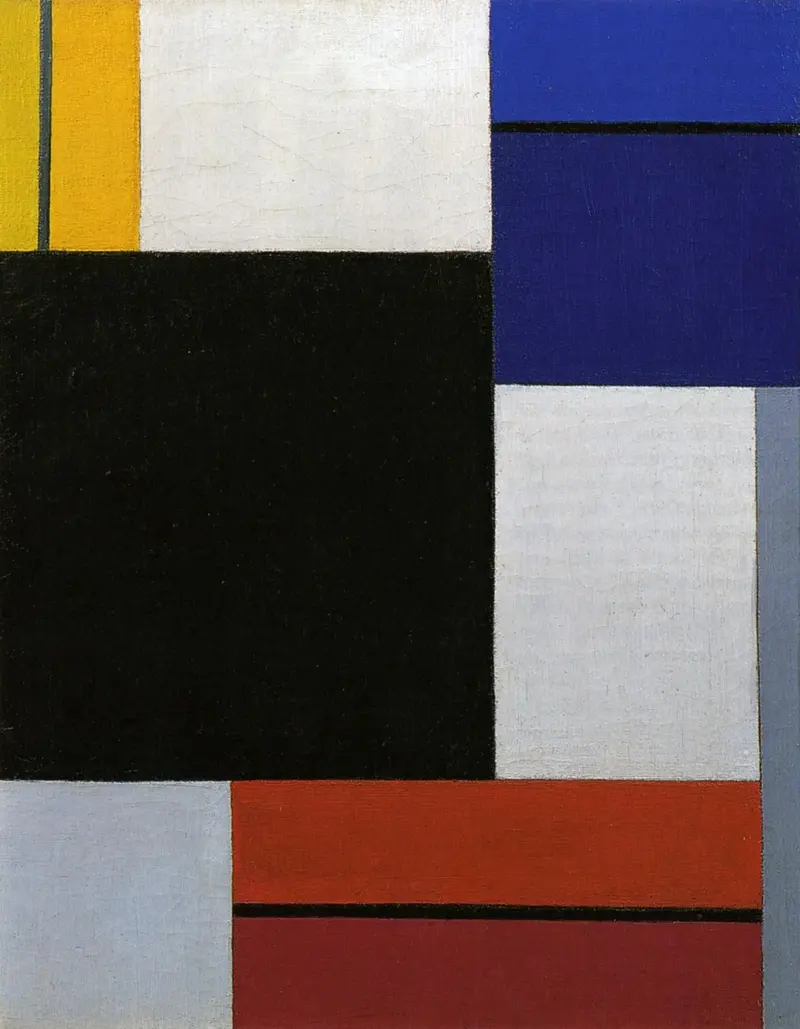
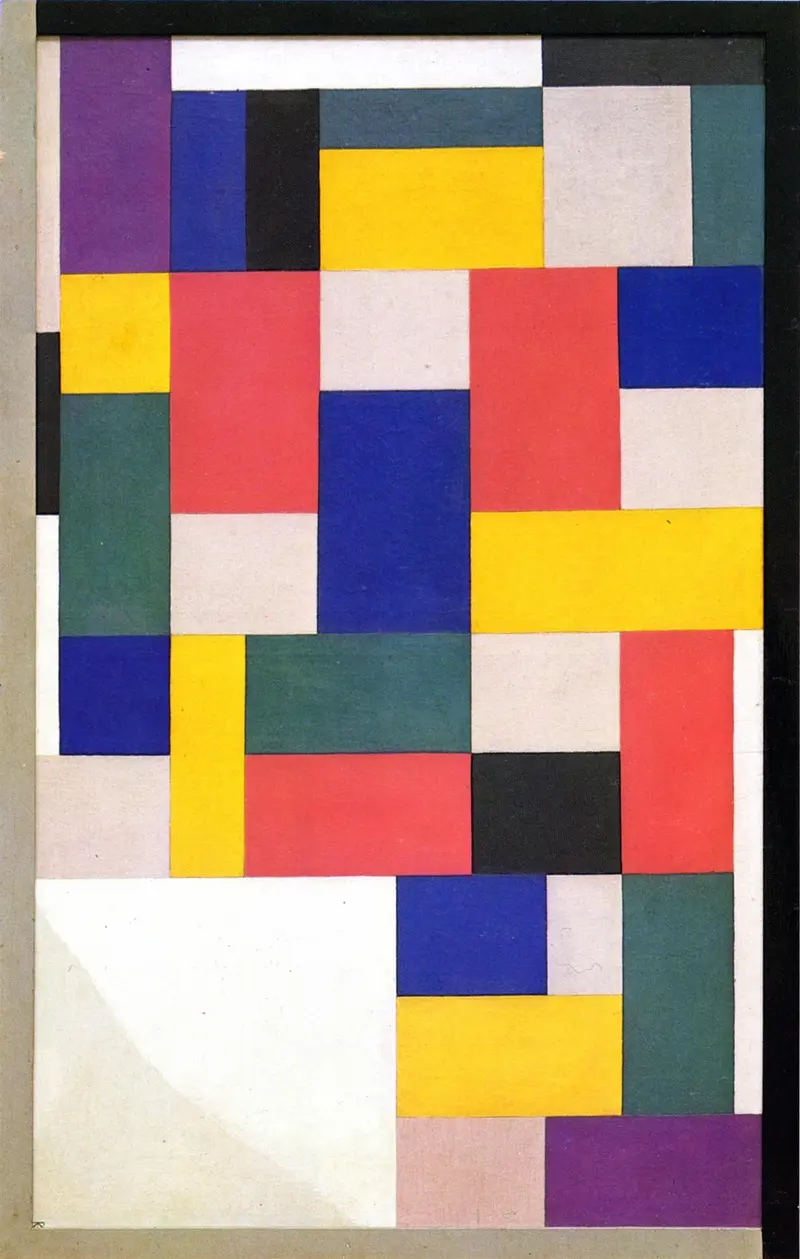
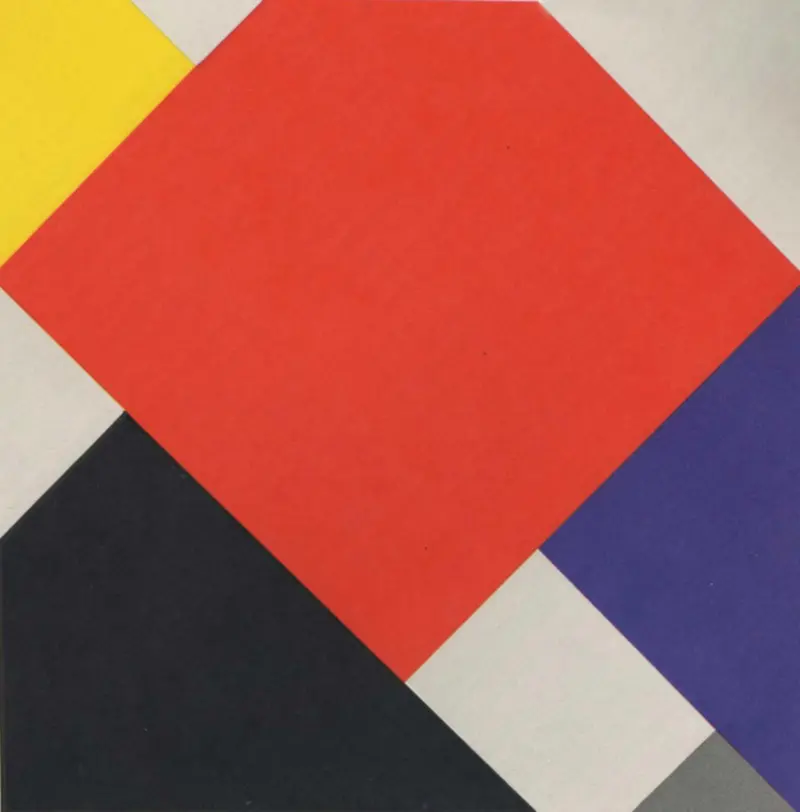
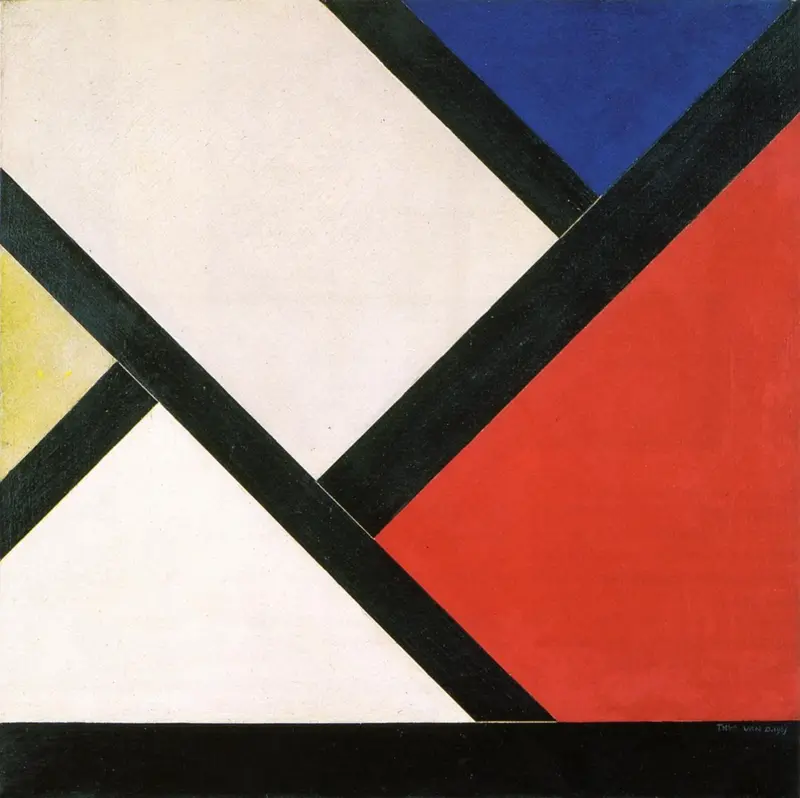
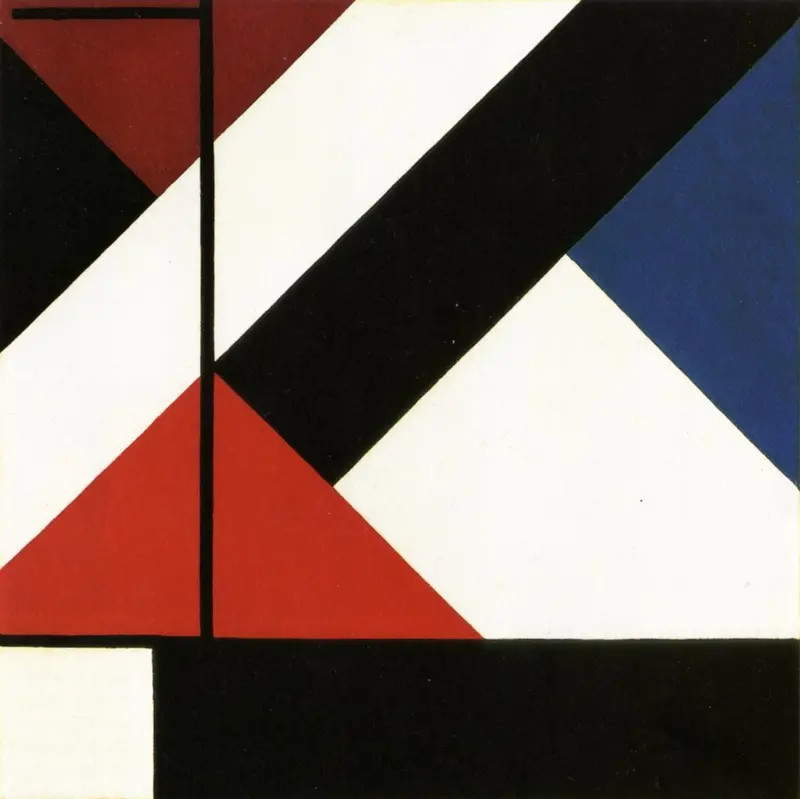
After 1917, the Guggenheim says, van Doesburg followed Mondrian's example and stripped his pictures of anything figurative, down to colors and geometric forms; from about 1924 he tilted them onto the diagonal in his Counter-Compositions. These paintings run from the end of the 1910s to a Simultaneous Counter-Composition of 1929.
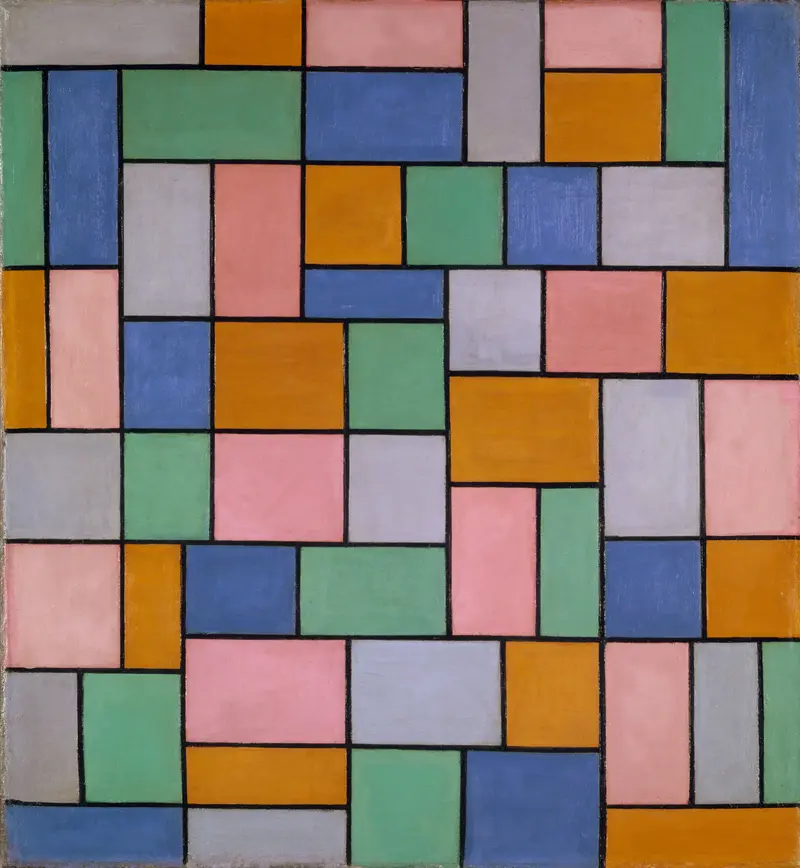
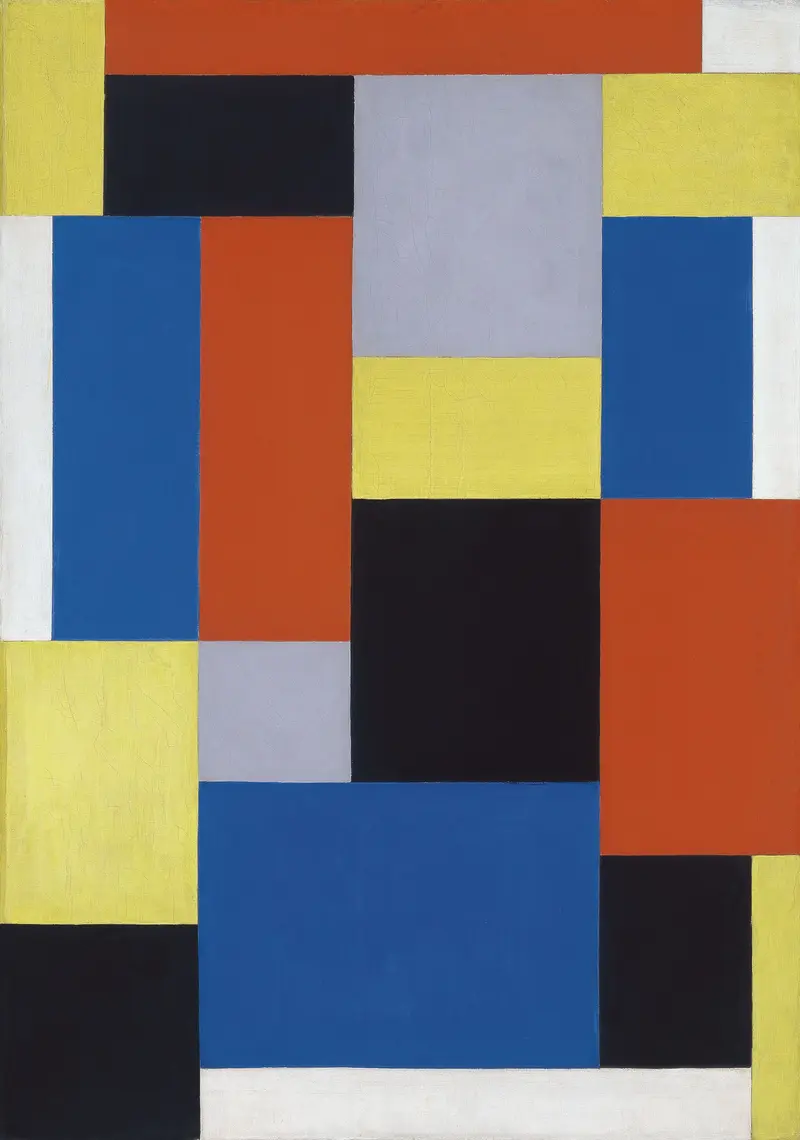
The De Stijl magazine and van Doesburg's designs
De Stijl began as a magazine edited by van Doesburg, first sent to subscribers in the autumn of 1917. In 1921 a bold red NB, thought up by van Doesburg and Mondrian, replaced the old vignette on the cover: it stood for Nieuwe Beelding, Neoplasticism, the Rijksmuseum Bulletin explains. The three covers are scans of the 1968 facsimile reprint, not of the original issues, and the last tile is Dada, not De Stijl: a 1922 poster for a Small Dada Evening that van Doesburg made with Kurt Schwitters.
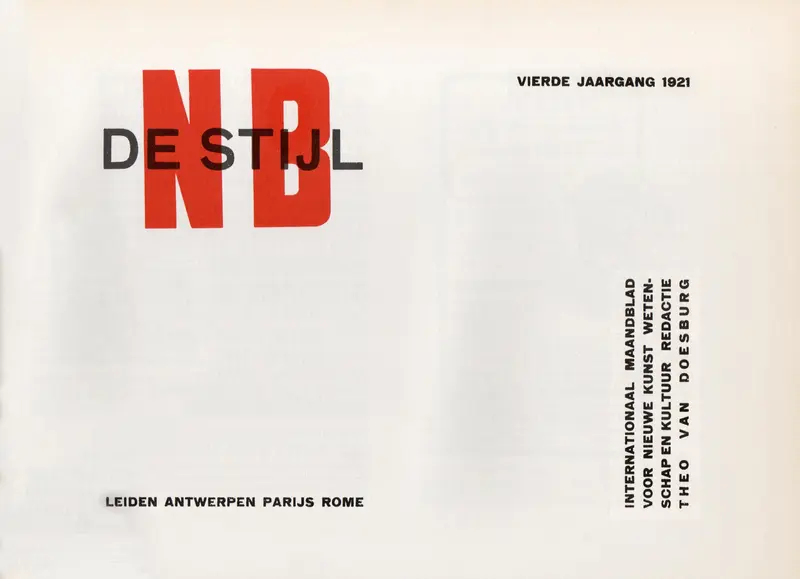 De Stijl magazine cover, 1921 (1968 facsimile)Theo van Doesburg
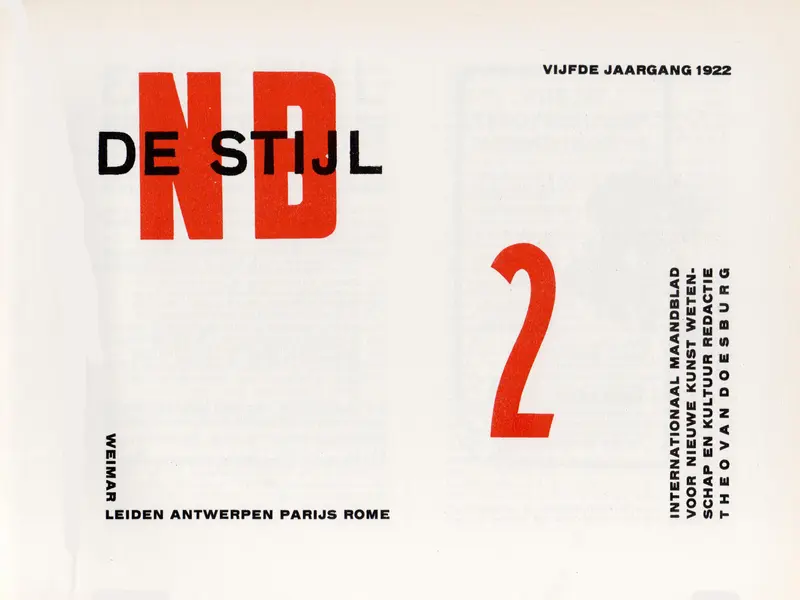 De Stijl magazine cover, 1922 (1968 facsimile)Theo van Doesburg
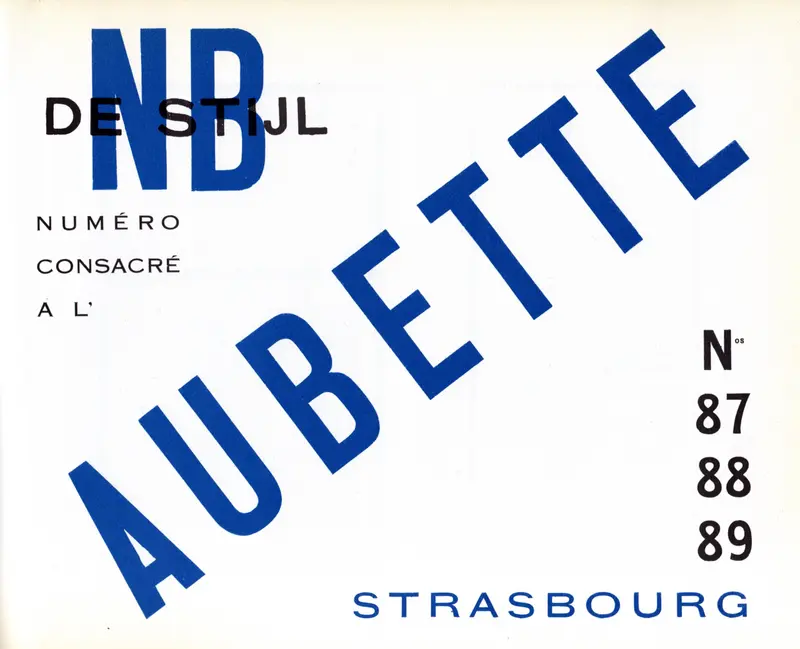 De Stijl Aubette issue cover, 1928 (1968 facsimile)Theo van Doesburg
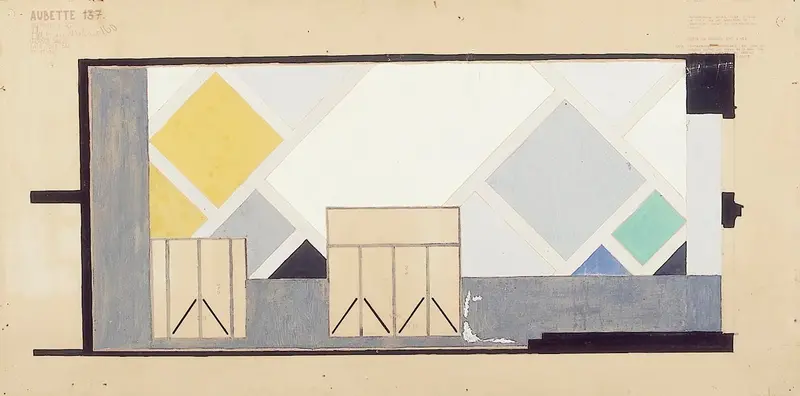 Color Design for a Wall of the Aubette Ciné-Dancing, 1927Theo van Doesburg
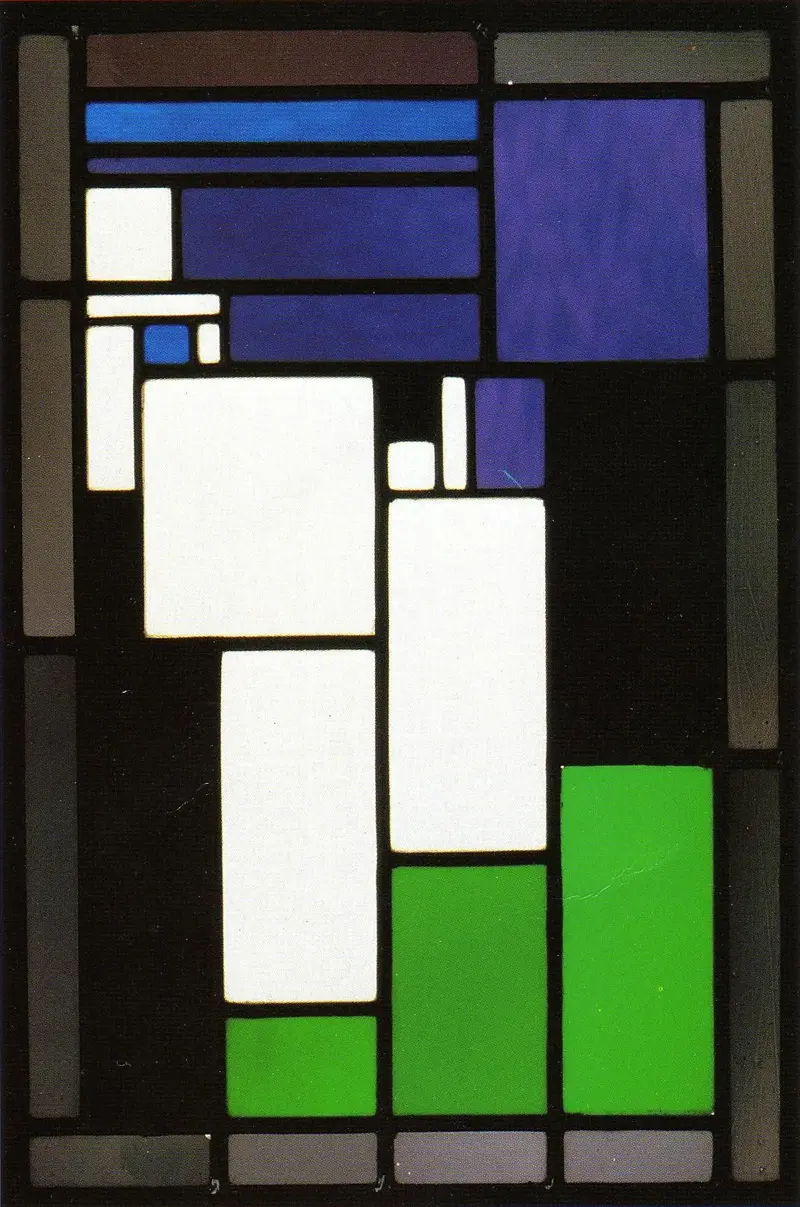 Stained-Glass Composition: Female Head, 1917Theo van Doesburg
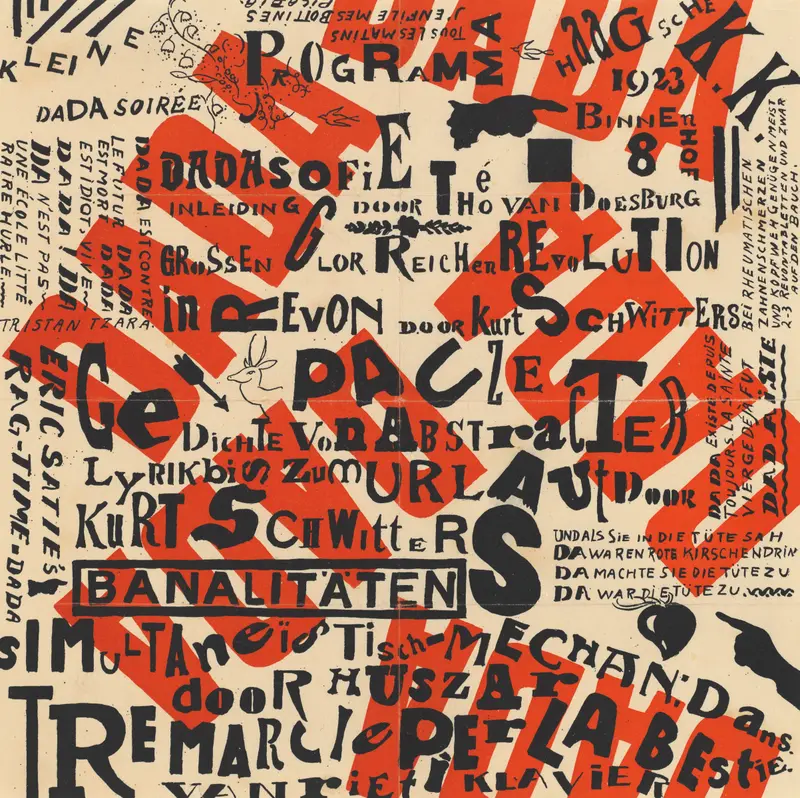 Kleine Dada Soirée: a Dada poster, 1922Theo van Doesburg and Kurt Schwitters
Characteristics of De Stijl: how to recognize it
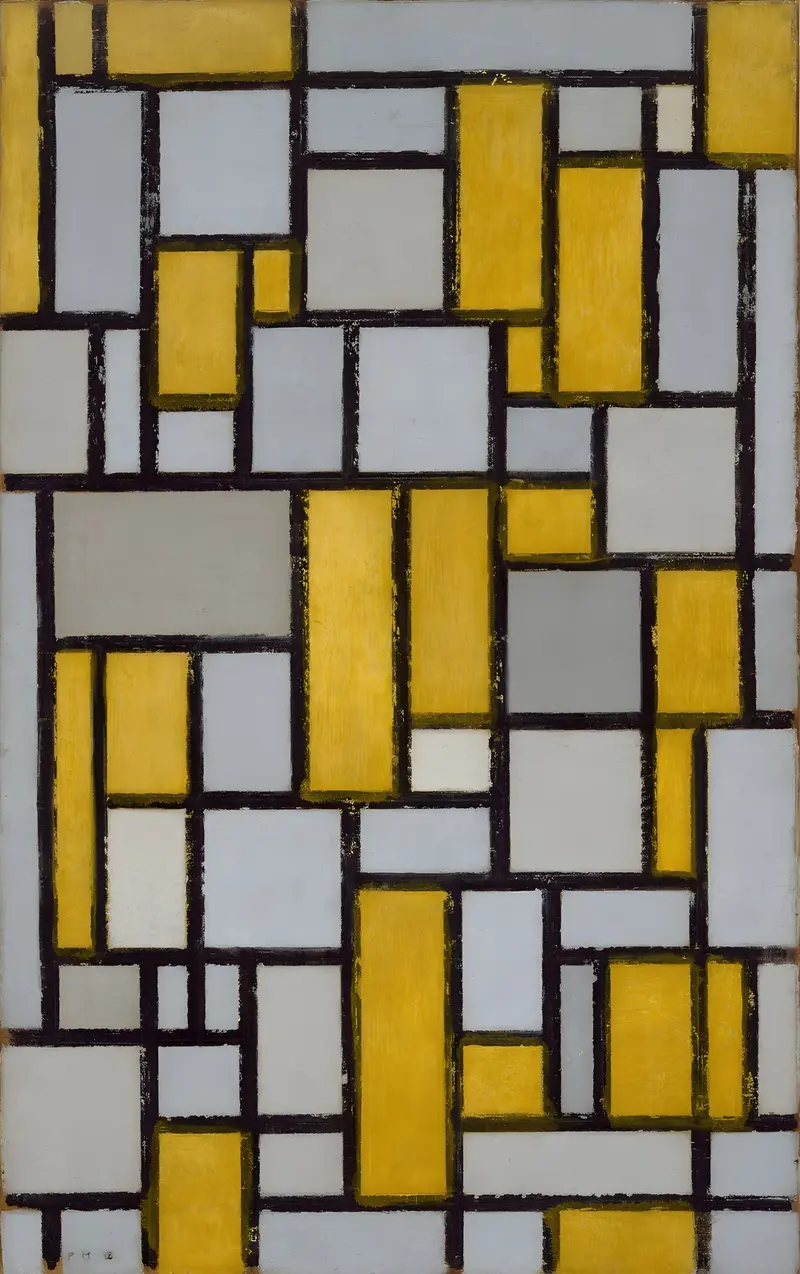
Only horizontal and vertical lines
Look for black lines that only ever run up and down or side to side, meeting at right angles, with nothing on a slant. Tate describes De Stijl as a style built on a strict geometry of horizontals and verticals; in 1918 Mondrian still filled the spaces between them with soft yellows and grays.
Composition with Grid 1, Piet Mondrian
Primary colors, black, white and gray
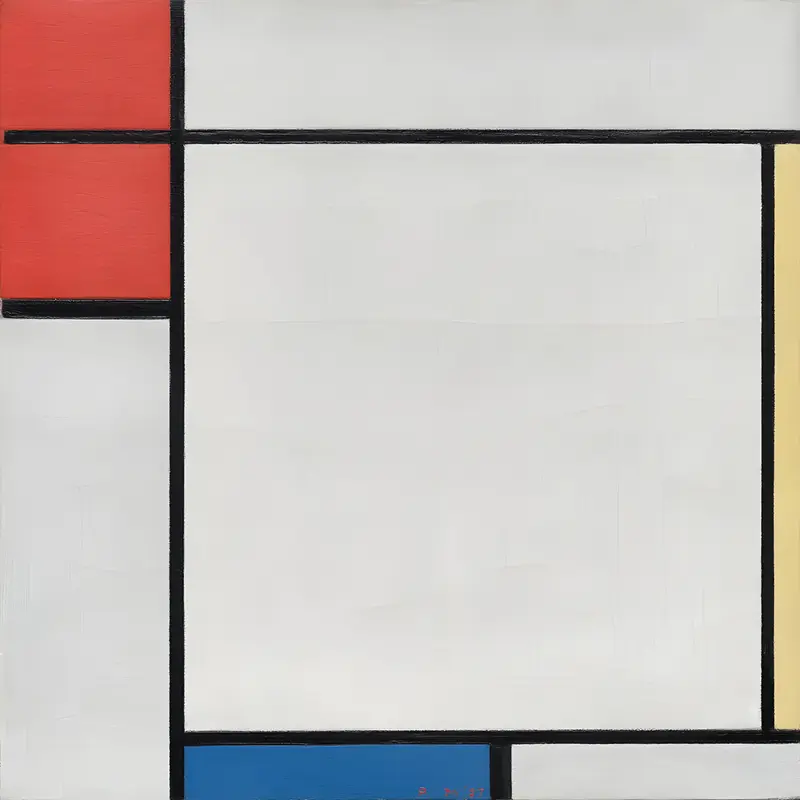
A red block, a thin strip of yellow and a bar of blue sit at the edges of a large white field, held apart by black lines. The Cleveland Museum of Art says Mondrian limited himself to horizontal and vertical rectangles in red, yellow and blue, along with black and white.
Composition with Red, Yellow, and Blue, Piet Mondrian
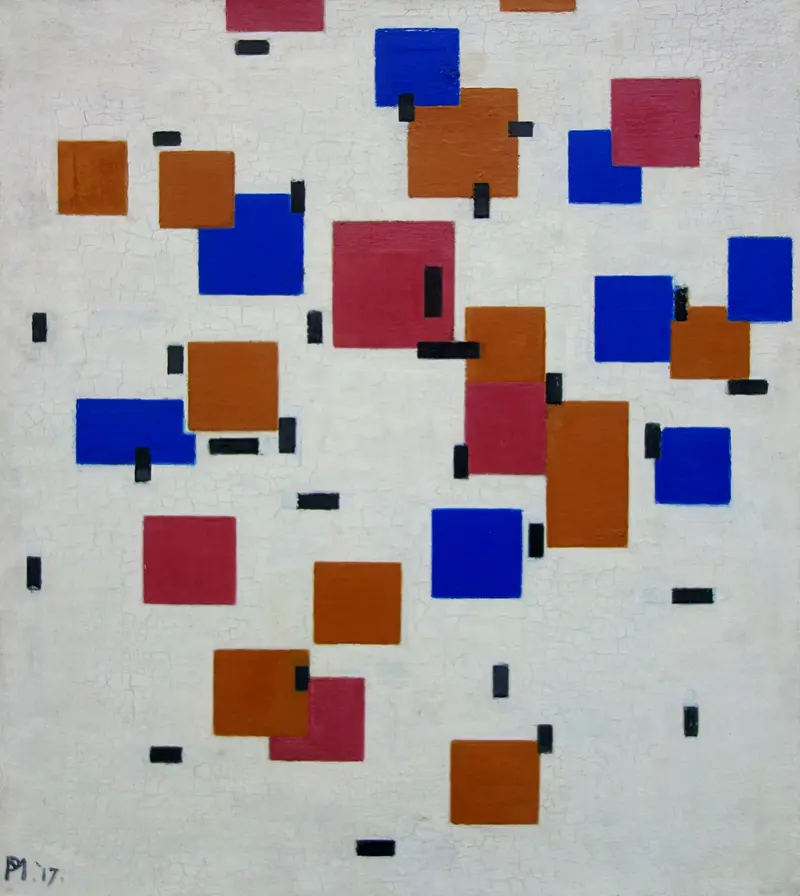
Planes of color floating on white
In 1917 Mondrian scattered small blocks of muted red, blue and ochre, with short black bars, over a white ground. The Kröller-Müller Museum notes that the white is not a neutral background but a living part of the painting; in later works he dropped this sense of depth and movement and kept to red, yellow and blue.
Composition in Colour A, Piet Mondrian
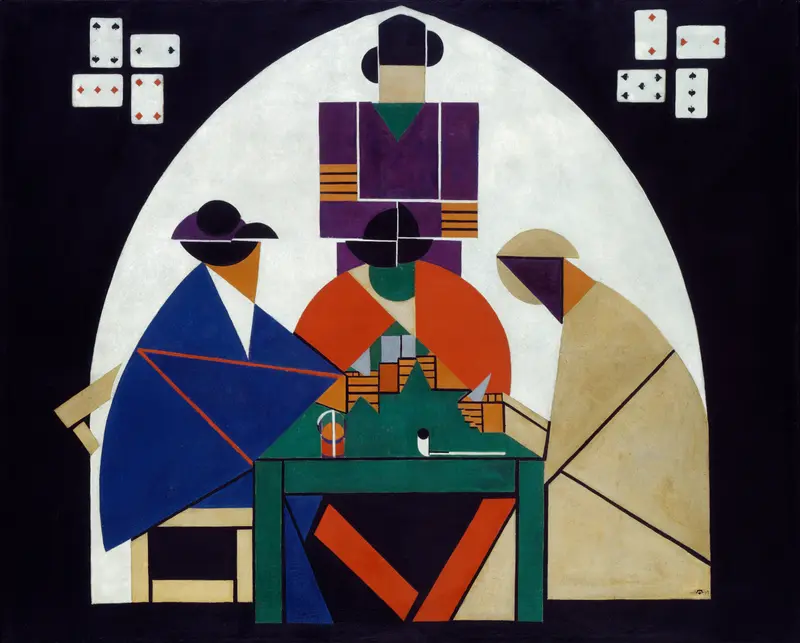
From real life to pure abstraction
Many De Stijl pictures began with a real subject. Van Doesburg first built three card players from flat geometric shapes, then reworked them into Composition IX of 1917; the full title Kunstmuseum Den Haag gives that painting calls it an abstraction of The Card Players.
Card Players, Theo van Doesburg
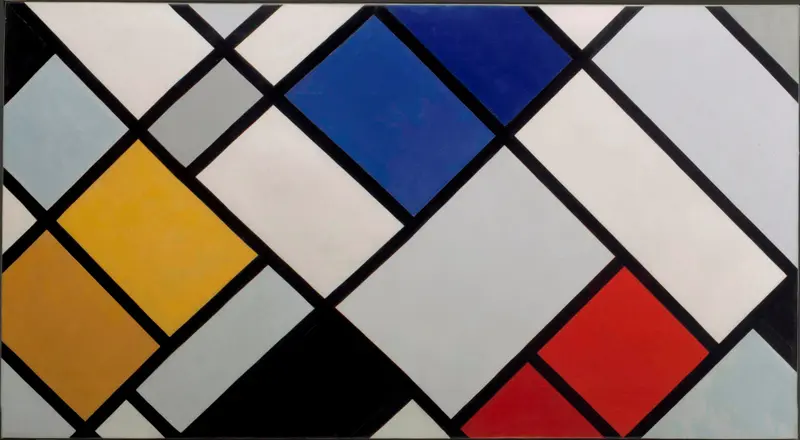
The diagonal of the Counter-Compositions
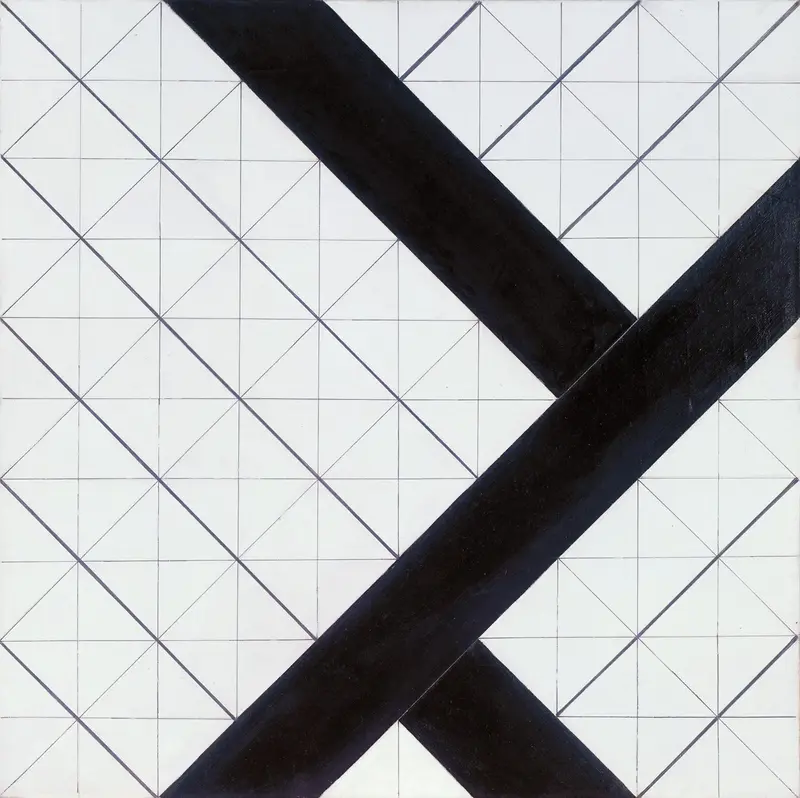
From about 1924 van Doesburg tilted his grid by 45 degrees and called the result Elementarism, the Guggenheim explains. Mondrian, who held to verticals and horizontals, saw it as heresy, and Tate says the diagonal drove him out of De Stijl.
Counter-Composition of Dissonances XVI, Theo van Doesburg
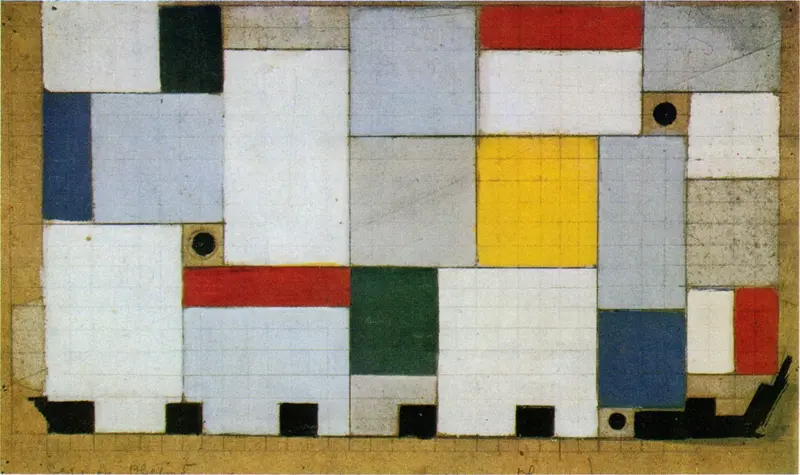
Art for whole rooms
De Stijl was never only painting: its artists wanted a new art for all of society, including design and architecture, Kunstmuseum Den Haag says. This 1927 color design for the ceiling of the café-brasserie in the Aubette in Strasbourg plans a whole room in the same blocks of color as the canvases.
L'Aubette, Theo van Doesburg
Before and after De Stijl
 Cubismc. 1907–1914
 Suprematismc. 1913–1919
- De Stijl1917–1931
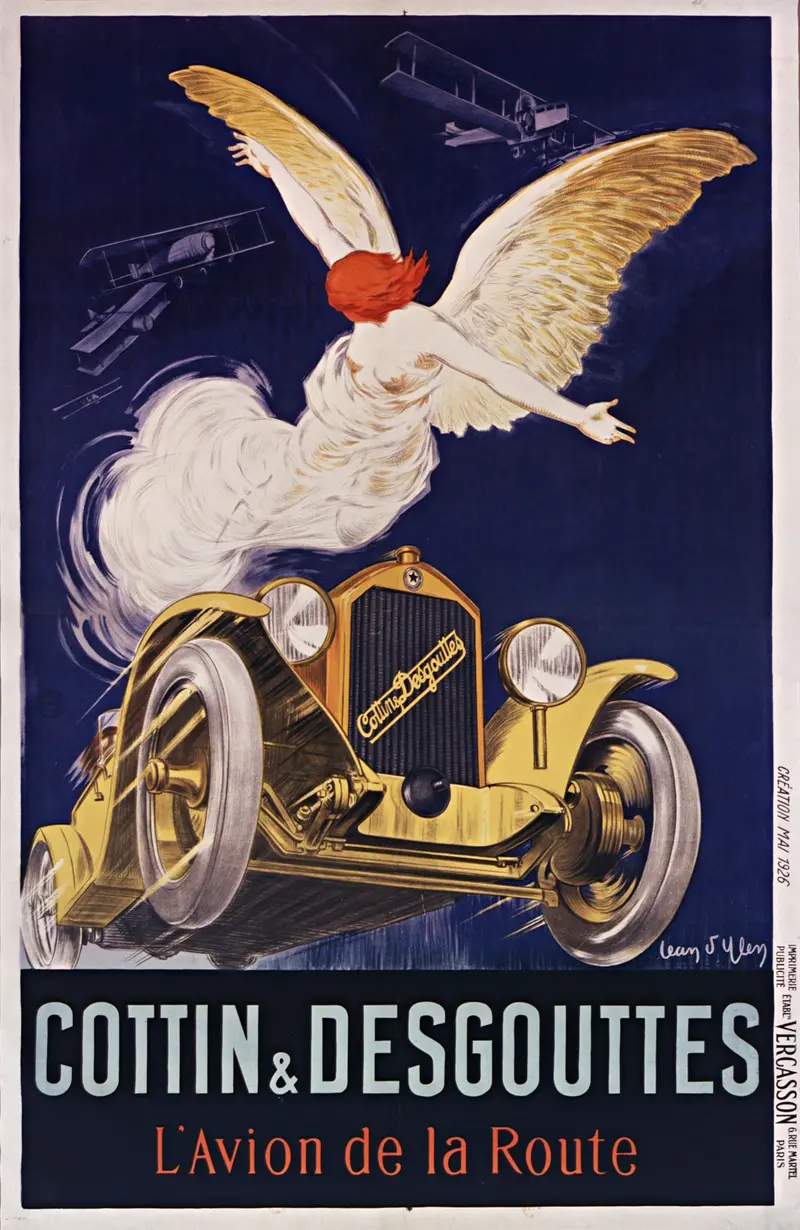 Art Deco1920s–1930s
 Abstract Expressionism1940s–1950s
De Stijl vs Cubism and the Bauhaus
| Compared | Cubism | De Stijl | Bauhaus |
|---|---|---|---|
| When | c. 1907–1914 | 1917–1931 | 1919–1933 |
| Where | Paris | Netherlands (Leiden), then Paris | Germany (Weimar, Dessau, Berlin) |
| What it was | A new way of painting | A circle of artists and their magazine | A school of art, architecture and design |
| Aim | Show a subject from several viewpoints on a flat surface | A pure abstract art for a new and better world | Bring art back into everyday life, with design and architecture as important as fine art |
| Look | Objects broken into flat planes, first in grays and ochres, then brighter color | Straight horizontal and vertical lines, flat rectangles, red, yellow and blue with black, white and gray | Simple geometric forms and functional designs |
| Famous example | Gris, Still Life with Checked Tablecloth | Mondrian, Composition II in Red, Blue and Yellow | Gropius, the Bauhaus building in Dessau |
| Key artists | Picasso, Braque, Gris, Léger | Mondrian, van Doesburg, van der Leck, Huszár, Rietveld | Gropius, Kandinsky, Klee, Moholy-Nagy, Albers |
List of famous De Stijl paintings and their artists
The famous De Stijl paintings: who painted them, when, and where each one is today.
Show the listHide the list
| Painting | Painted by | Year | Medium | Size | Located in | City |
|---|---|---|---|---|---|---|
| Card Players | Theo van Doesburg | 1916–17 | Oil and tempera on canvas | 120.2 × 149.8 cm (47.3 × 59 in) | Kunstmuseum Den Haag | The Hague |
| Composition with Grid 1 | Piet Mondrian | 1918 | Oil on canvas | 80.2 × 49.9 cm (31.6 × 19.6 in) | Museum of Fine Arts, Houston | Houston |
| Composition A | Piet Mondrian | 1919–20 | Oil on canvas | 91.5 × 92 cm (36 × 36.2 in) | Galleria Nazionale d'Arte Moderna | Rome |
| Counter-Composition of Dissonances XVI | Theo van Doesburg | 1925 | Oil on canvas | 100 × 180 cm (39.4 × 70.9 in) | Kunstmuseum Den Haag | The Hague |
De Stijl: questions and answers
What is De Stijl in art, and what does it mean?
De Stijl is Dutch for “The Style.” In art it means the abstract style of a group of Dutch painters, designers and architects who, from 1917 to 1931, made pictures from straight horizontal and vertical lines, flat rectangles and the primary colors with black, white and gray. Tate notes that De Stijl began as a magazine, founded in 1917 by Piet Mondrian and Theo van Doesburg, and that Mondrian's name for this kind of painting was Neoplasticism.
Sources: Tate: De Stijl · Tate: Neo-plasticism
What was the De Stijl movement?
De Stijl was a circle of Dutch abstract artists and the magazine they published, promoting an art of strict horizontals and verticals, Tate explains. Its painters, architects and designers wanted to build a new society after the First World War, with one international style for art and design alike. The Getty's art vocabulary describes a movement that used pure abstract form to express the universal.
Sources: Tate: De Stijl · Tate Modern: Van Doesburg and the International Avant-Garde · Getty AAT: De Stijl
What are the characteristics of De Stijl?
De Stijl paintings use only straight lines that run horizontally or vertically, flat squares and rectangles, and red, yellow and blue with black, white and gray; nothing in them depicts a real object. Tate lists exactly these elements for Neoplasticism, Mondrian's name for the style. From about 1924 van Doesburg added the diagonal, which split the group, and the same rules were used for furniture, interiors and buildings, such as the Rietveld Schröder House in Utrecht.
Sources: Tate: Neo-plasticism · Guggenheim: van Doesburg, Counter-Composition XIII · Rietveld Schröder House (Centraal Museum)
Who founded De Stijl?
Theo van Doesburg founded De Stijl in 1917 as a magazine, which he edited from Leiden, and Tate names Piet Mondrian as its co-founder; Mondrian set out his ideas in a long essay that ran through the magazine's first year. The Rijksmuseum Bulletin adds that the poet Antony Kok, the architect J. J. P. Oud and the painter Vilmos Huszár helped van Doesburg found it, and that Bart van der Leck wrote for the first issues.
Sources: Kunstmuseum Den Haag: Card Players · Tate: De Stijl · Tate: Neo-plasticism · Rijksmuseum Bulletin: Nota Bene: De Stijl (2017)
When did De Stijl start and end?
De Stijl started in 1917 with the first issue of its magazine and ended with Theo van Doesburg's death in 1931; Tate notes that he kept the magazine going until then, and the Rijksmuseum Bulletin adds that a last issue in his honor followed in 1932. Mondrian had already left the group in the mid-1920s, after van Doesburg brought the diagonal into his paintings. Kunstmuseum Den Haag says the abstract art van Doesburg laid the basis for became influential in the 1930s.
Sources: Tate: De Stijl · Rijksmuseum Bulletin: Nota Bene: De Stijl (2017) · Guggenheim: Mondrian, Composition No. 1: Lozenge with Four Lines · Kunstmuseum Den Haag: Card Players
What is Neoplasticism, and is it the same as De Stijl?
Neoplasticism is the term Mondrian adopted for his own abstract painting, made with only horizontal and vertical lines, primary colors and the non-colors black, white and gray. It comes from the Dutch de nieuwe beelding and basically means new art, Tate explains. The two overlap but are not the same: De Stijl is the group and its magazine, and Tate applies Neoplasticism to the work of the whole De Stijl circle at least until Mondrian broke with it, while Mondrian went on painting in his Neoplastic style after he left.
Sources: Tate: Neo-plasticism · Guggenheim: Mondrian, Composition No. 1: Lozenge with Four Lines
What art movement was Piet Mondrian part of?
Piet Mondrian was a co-founder of De Stijl, after a Cubist phase in Paris, and wrote its theory: in the magazine's first year he published the essay in which he defined Neoplasticism, Tate notes. By the early 1920s, the Guggenheim says, he limited his pictures to off-white grounds divided by black horizontal and vertical lines, with blocks of single primary colors. He lived in Paris from 1919 and broke with the group over van Doesburg's diagonals, but kept painting in the same language.
Sources: Tate: Neo-plasticism · Guggenheim: Mondrian, Composition No. 1: Lozenge with Four Lines · Tate: Piet Mondrian
Who were the De Stijl artists?
De Stijl's central figures are its founders, Piet Mondrian (1872–1944) and Theo van Doesburg (1883–1931). The Rijksmuseum Bulletin names the others who joined them: the poet Antony Kok, the architect J. J. P. Oud and the painter Vilmos Huszár from the start, with Bart van der Leck among the first contributors; the architects Jan Wils and Robert van 't Hoff, the Belgian sculptor Georges Vantongerloo and the Italian painter Gino Severini during the first year; and the furniture maker Gerrit Rietveld in 1919.
Sources: Tate: De Stijl · Rijksmuseum Bulletin: Nota Bene: De Stijl (2017) · Kunstmuseum Den Haag: Card Players
Is De Stijl part of the Bauhaus?
No. De Stijl was a Dutch group built around a magazine, founded in 1917; the Bauhaus was a German school of art, architecture and design that Walter Gropius opened in Weimar in 1919, Tate explains. Both wanted to bring art into everyday life, and their paths crossed: Tate's 2010 van Doesburg exhibition looked at his efforts to influence the Bauhaus.
Sources: Tate: De Stijl · Tate: Bauhaus · Tate Modern: Van Doesburg and the International Avant-Garde
Is De Stijl Art Deco or modernism?
De Stijl belongs to modernism, not to Art Deco. Tate calls Mondrian, with Malevich, a pioneer of pure abstract painting, and De Stijl rejected any depiction of real things. Art Deco was a design style of the 1920s and 1930s in furniture, the decorative arts and architecture; it was geometric too, but Tate notes that it drew on Cubism, ancient Egyptian and Aztec art and the design of modern ships, trains and cars.
Sources: Tate: Abstract art · Tate: Neo-plasticism · Tate: Art deco
What inspired De Stijl?
Cubism was the main starting point. Mondrian lived in Paris from 1912 to 1914 and, Tate says, carried Cubism to the point of abstraction; Tate also calls Cubism a starting point for Neoplasticism. Van Doesburg was struck by Wassily Kandinsky's abstract paintings in 1913, Kunstmuseum Den Haag notes. The First World War mattered too: the Cleveland Museum of Art says Mondrian believed abstract compositions could help build a more harmonious society after it.
Sources: Tate: Piet Mondrian · Tate: Cubism · Kunstmuseum Den Haag: Card Players · Cleveland Museum of Art: Mondrian, Composition with Red, Yellow, and Blue
Was De Stijl also furniture and architecture?
Yes. Its artists wanted a new art for the whole of society, including design and architecture, Kunstmuseum Den Haag says, and they also made stained glass, typography and interiors. Gerrit Rietveld designed his Red and Blue Chair around 1919, and in 1924 he designed a house in Utrecht with its owner, Truus Schröder, using horizontal and vertical lines and all the primary colors with white, gray and black. Rietveld died in 1964, so pictures of his designs are still in copyright and we do not show them.
Sources: Kunstmuseum Den Haag: Card Players · Tate Modern: Van Doesburg and the International Avant-Garde · Rietveld Schröder House (Centraal Museum)
Can I download De Stijl paintings for free?
Yes for Mondrian and van Doesburg. Mondrian died in 1944 and van Doesburg in 1931, so their works are public domain wherever copyright lasts 70 years after death, and in the United States works published before 1931 are public domain too. Bart van der Leck, Vilmos Huszár, Gerrit Rietveld and Georges Vantongerloo died between 1958 and 1965, so their work enters the public domain in those countries only between 2029 and 2036. Paintings Mondrian made after 1930 may still be protected in the United States, so our De Stijl collection stops at 1930.
Sources: Cornell University Library: Copyright Term and the Public Domain · Kunstmuseum Den Haag: Card Players · Kunstmuseum Den Haag: Tableau I (Dutch)
Where can I see De Stijl art?
Kunstmuseum Den Haag in The Hague holds the largest Mondrian collection in the world, the museum says, along with works by Rietveld, van der Leck and Huszár, and it shows van Doesburg's Card Players. The Rijksmuseum Bulletin names the Stedelijk Museum in Amsterdam and the Centraal Museum in Utrecht among the main Dutch De Stijl collections, and the Kröller-Müller Museum in Otterlo holds Mondrian's Composition in Color A. In New York, the Guggenheim files works by Mondrian and van Doesburg under De Stijl.
Sources: Kunstmuseum Den Haag: Card Players · Kunstmuseum Den Haag: Compositie met groot rood vlak (Dutch) · Rijksmuseum Bulletin: Nota Bene: De Stijl (2017) · Kröller-Müller Museum: Mondrian, Composition in colour A · Guggenheim: De Stijl (collection by movement)
How we chose the famous paintings
The famous paintings on this page are the De Stijl paintings known most widely around the world, measured by the number of languages that have an encyclopedia entry about each one, checked in November 2026. Only paintings with entries in at least two languages count, which leaves four in our collection. We include only artists who died by 1955, so every image is in the public domain; that leaves out Bart van der Leck, Vilmos Huszár, Georges Vantongerloo, Gerrit Rietveld and J. J. P. Oud, and Mondrian's paintings after 1930, such as Broadway Boogie Woogie.
Our catalog files much of Mondrian's and van Doesburg's work from the De Stijl years under Modernism, so the list also takes paintings the two founders made inside the movement's dates, 1917 to 1931. Card Players of 1916–17 is the one exception: Kunstmuseum Den Haag shows it with its De Stijl collection, and van Doesburg turned it into an abstract painting in 1917. Mondrian's Composition II in Red, Blue and Yellow of 1930 is shown on our Modernism page, and two widely known works, Mondrian's Composition with Large Red Plane, Yellow, Black, Grey and Blue of 1921 and van Doesburg's Composition IX of 1917, are not yet in our collection.
Dates, sizes and locations come from the museums' own records and from Wikidata.
Spotted a mistake? Tell us and we will correct it.